
Abraham Simon (1617-?1692) was an English medallist in the 17th century who worked closely with his brother Thomas Simon.
Abraham Simon (1617-?1692) was an English medallist in the 17th century who worked closely with his brother Thomas Simon.
Simon was born in London in 1617. He worked abroad in Sweden and Holland before returning in 1643. His brother, Thomas, was made Engraver of Coin in 1645. Simon's self-portrait is in the National Portrait Gallery (London), and shows the skills that he brought to the wax models he created. [1] His brother's sketchbook is in the Victoria and Albert Museum. A portrait of him as St. Jerome was painted by Heinrich Dittmers in 1665. [2] Simon is thought to have died around 1692.

Thomas Gainsborough was an English portrait and landscape painter, draughtsman, and printmaker. Along with his rival Sir Joshua Reynolds, he is considered one of the most important British artists of the second half of the 18th century. He painted quickly, and the works of his maturity are characterised by a light palette and easy strokes. Despite being a prolific portrait painter, Gainsborough gained greater satisfaction from his landscapes. He is credited as the originator of the 18th-century British landscape school. Gainsborough was a founding member of the Royal Academy.

Sir Thomas Lawrence was a leading English portrait painter and the fourth president of the Royal Academy. Lawrence was a child prodigy. He was born in Bristol and began drawing in Devizes, where his father was an innkeeper at the Bear Hotel in the Market Square. At the age of ten, having moved to Bath, he was supporting his family with his pastel portraits. At eighteen he went to London and soon established his reputation as a portrait painter in oils, receiving his first royal commission, a portrait of Queen Charlotte, in 1790. He stayed at the top of his profession until his death, aged 60, in 1830.

George Vertue was an English engraver and antiquary, whose notebooks on British art of the first half of the 18th century are a valuable source for the period.

Pompeo Girolamo Batoni was an Italian painter who displayed a solid technical knowledge in his portrait work and in his numerous allegorical and mythological pictures. The high number of foreign visitors travelling throughout Italy and reaching Rome during their "Grand Tour" led the artist to specialize in portraits. Batoni won international fame largely thanks to his customers, mostly British of noble origin, whom he portrayed, often with famous Italian landscapes in the background. Such Grand Tour portraits by Batoni were in British private collections, thus ensuring the genre's popularity in Great Britain. One generation later, Sir Joshua Reynolds would take up this tradition and become the leading English portrait painter. Although Batoni was considered the best Italian painter of his time, contemporary chronicles mention his rivalry with Anton Raphael Mengs.

Apsley House is the London townhouse of the Dukes of Wellington. It stands alone at Hyde Park Corner, on the south-east corner of Hyde Park, facing south towards the busy traffic roundabout in the centre of which stands the Wellington Arch. It is a Grade I listed building.

Carel Pietersz. Fabritius was a Dutch painter. He was a pupil of Rembrandt and worked in his studio in Amsterdam. Fabritius, who was a member of the Delft School, developed his own artistic style and experimented with perspective and lighting. Among his works are A View of Delft, The Goldfinch (1654), and The Sentry (1654).

English art is the body of visual arts made in England. England has Europe's earliest and northernmost ice-age cave art. Prehistoric art in England largely corresponds with art made elsewhere in contemporary Britain, but early medieval Anglo-Saxon art saw the development of a distinctly English style, and English art continued thereafter to have a distinct character. English art made after the formation in 1707 of the Kingdom of Great Britain may be regarded in most respects simultaneously as art of the United Kingdom.

Gerard van Honthorst was a Dutch Golden Age painter who became known for his depiction of artificially lit scenes, eventually receiving the nickname Gherardo delle Notti. Early in his career he visited Rome, where he had great success painting in a style influenced by Caravaggio. Following his return to the Netherlands he became a leading portrait painter.

Thomas Simon, English medalist, was born, according to George Vertue, in Yorkshire about 1623.

William Hilton was a British portrait and history painter. He is also known as "William Hilton the Younger".

Daniël Mijtens, known in England as Daniel Mytens the Elder, was a Dutch Golden Age portrait painter belonging to a family of Flemish painters who spent the central years of his career working in England.

Simeon Solomon was a British painter associated with the Pre-Raphaelites who was noted for his depictions of Jewish life and same-sex desire. His career was cut short as a result of public scandal following his arrests and convictions for attempted sodomy in 1873 and 1874.
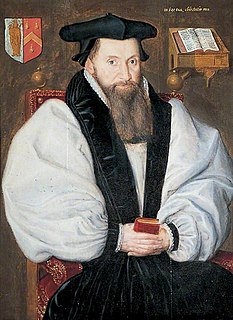
Robert Abbot (1560–1617) was an Anglican bishop, academic and polemical writer. He served as Master of Balliol College, Oxford, Regius Professor of Divinity, and Bishop of Salisbury from 1615. Among his four younger brothers, George became Archbishop of Canterbury and Maurice became Lord Mayor of London.

John Michael Wright was a British portrait painter portrait painter in the Baroque style. Wright trained in Edinburgh under the Scots painter George Jamesone, and acquired a considerable reputation as an artist and scholar during a long sojourn in Rome. There he was admitted to the Accademia di San Luca, and was associated with some of the leading artists of his generation. He was engaged by Archduke Leopold Wilhelm of Austria, the governor of the Spanish Netherlands, to acquire artworks in Oliver Cromwell's England in 1655. He took up permanent residence in England from 1656, and served as court painter before and after the English Restoration. A convert to Roman Catholicism, he was a favourite of the restored Stuart court, a client of both Charles II and James II, and was a witness to many of the political manoeuvrings of the era. In the final years of the Stuart monarchy he returned to Rome as part of an embassy to Pope Innocent XI.

Louisa Maria Teresa Stuart, known to Jacobites as The Princess Royal, was the last child of James II and VII (1633–1701), the deposed king of England, Scotland and Ireland, by his second wife Mary of Modena. In English, she was called Louisa Maria and Louise Marie in French. Like her brother The Old Pretender, she was by religion a Roman Catholic which as the Act of Settlement 1701 provided, debarred them both from succession to the English throne after the death of their Protestant half-sister Queen Anne.
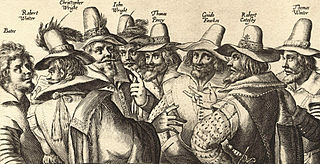
Crispijn van de Passe the Elder, or de Passe was a Dutch publisher and engraver and founder of a dynasty of engravers comparable to the Wierix family and the Sadelers, though mostly at a more mundane commercial level. Most of their engravings were portraits, book title-pages, and the like, with relatively few grander narrative subjects. As with the other dynasties, their style is very similar, and hard to tell apart in the absence of a signature or date, or evidence of location. Many of the family could produce their own designs, and have left drawings.

Abraham de Vries was a Dutch painter who was one of the leading portraitists of his age. As he led a peripatetic lifestyle and worked in France, Antwerp and the Dutch Republic his stylistic qualities are difficult to pin down.
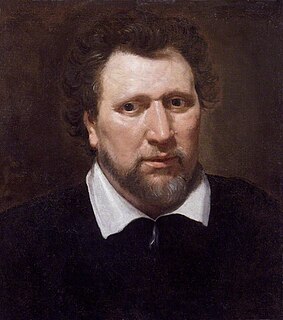
Abraham van Blijenberch was a Flemish painter. He was born in the Spanish Netherlands and married in 1615. He became a citizen of Antwerp in 1617, but there is no record of him joining the Guild of Saint Luke at this time.
Thomas Fairland was an English lithographer, engraver and portrait painter.

John Greenhill was an English portrait painter, a pupil of Peter Lely, who approached his teacher in artistic excellence, but whose life was cut short by a dissolute lifestyle.
| General | |
|---|---|
| Art research institutes | |
