
Abydos is one of the oldest cities of ancient Egypt, and also of the eighth nome in Upper Egypt. It is located about 11 kilometres west of the Nile at latitude 26° 10' N, near the modern Egyptian towns of El Araba El Madfuna and El Balyana. In the ancient Egyptian language, the city was called Abdju. The English name Abydos comes from the Greek Ἄβυδος, a name borrowed by Greek geographers from the unrelated city of Abydos on the Hellespont.

Stargate is a 1994 science fiction adventure film directed and co-written by Roland Emmerich. The film is the first entry in the Stargate media franchise and stars Kurt Russell, James Spader, Jaye Davidson, Alexis Cruz, Mili Avital, and Viveca Lindfors. The plot centers on the premise of a "Stargate", an ancient ring-shaped device that creates a wormhole, enabling travel to a similar device elsewhere in the universe. The film's central plot explores the theory of extraterrestrial beings having an influence upon human civilization.

The First Dynasty of ancient Egypt covers the first series of Egyptian kings to rule over a unified Egypt. It immediately follows the unification of Upper and Lower Egypt, possibly by Narmer, and marks the beginning of the Early Dynastic Period, a time at which power was centered at Thinis.

The Second Intermediate Period dates from 1700 to 1550 BC. It marks a period when ancient Egypt was broken into smaller dynasty for a second time, between the end of the Middle Kingdom and the start of the New Kingdom. The dynasties that ruled during the Second Intermediate Period were the 13th through 17th Dynasties.The concept of a "Second Intermediate Period" was a term that was starting to be used in early part of the twentieth century by Egyptologist from United Kingdom.

Daniel Jackson, PhD, is a fictional character in the military science fiction franchise Stargate, and one of the main characters of the 1997 series Stargate SG-1. He is portrayed by James Spader in the 1994 film Stargate, and by Michael Shanks in Stargate SG-1 and other SG-1 derived media. Jackson is the only Stargate character to appear in all films and series in the franchise.

A Stargate is an Einstein–Rosen bridge portal device within the Stargate fictional universe that allows practical, rapid travel between two distant locations. The devices first appeared in the 1994 Roland Emmerich film Stargate, and thereafter in the television series Stargate SG-1, Stargate Atlantis, and Stargate Universe. In these productions, the Stargate functions as a plot device, allowing the main characters to visit alien planets without the need for spaceships or any other type of technology. The device allows for near-instantaneous travel across both interstellar and extragalactic distances.
The Eighth Dynasty of ancient Egypt is a poorly known and short-lived line of pharaohs reigning in rapid succession in the early 22nd century BC, likely with their seat of power in Memphis. The Eighth Dynasty held sway at a time referred to as the very end of the Old Kingdom or the beginning of the First Intermediate Period. The power of the pharaohs was waning while that of the provincial governors, known as nomarchs, was increasingly important, the Egyptian state having by then effectively turned into a feudal system. In spite of close relations between the Memphite kings and powerful nomarchs, notably in Coptos, the Eighth Dynasty was eventually overthrown by the nomarchs of Heracleopolis Magna, who founded the Ninth Dynasty. The Eighth Dynasty is sometimes combined with the preceding Seventh Dynasty, owing to the lack of archeological evidence for the latter which may be fictitious.
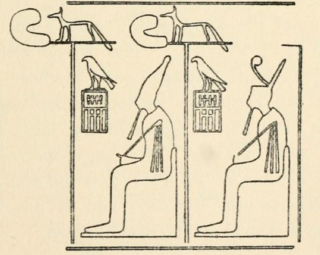
Djer is considered the third pharaoh of the First Dynasty of ancient Egypt in current Egyptology. He lived around the mid 31st century BC and reigned for c. 40 years. A mummified forearm of Djer or his wife was discovered by Egyptologist Flinders Petrie, but was discarded by Émile Brugsch.
"Full Circle" is the season finale for season six of the Canadian-American military science fiction television series Stargate SG-1. It was originally intended to be the last episode of Stargate SG-1. The episode was written by executive producer Robert C. Cooper and directed by Martin Wood. The episodes received an average Nielsen household rating and a low syndication rating compared to other season six episodes. The episode got strong reviews from major media publishers worldwide.
Thinis was the capital city of the first dynasties of ancient Egypt. Thinis remains undiscovered but is well attested by ancient writers, including the classical historian Manetho, who cites it as the centre of the Thinite Confederacy, a tribal confederation whose leader, Menes, united Egypt and was its first pharaoh. Thinis began a steep decline in importance from Dynasty III, when the capital was relocated to Memphis, which was thought to be the first true and stable capital after the unification of old Egypt by Menes. Thinis's location on the border of the competing Heracleopolitan and Theban dynasties of the First Intermediate Period and its proximity to certain oases of possible military importance ensured Thinis some continued significance in the Old and New Kingdoms. This was a brief respite and Thinis eventually lost its position as a regional administrative centre by the Roman period.
Anubis is an ancient Egyptian god.

David Bourke O'Connor was an Australian-American Egyptologist who primarily worked in the fields of Ancient Egypt and Nubia. O'Connor was the Lila Acheson Wallace Professor Emeritus at New York University's Institute of Fine Art, the Curator Emeritus of the University of Pennsylvania's Egyptian Museum, and the director emeritus of the Abydos Archaeology expedition in Egypt. O'Connor was most well known for his work in the excavation of the ancient city of Abydos in Egypt since 1967.
Qadesh, Qedesh, Qetesh, Kadesh, Kedesh, Kadeš and Qades come from the common Semitic root "Q-D-Š", which means "sacred."
Abtu is the name of a sacred fish, according to Egyptian mythology, and of the city of Abydos, the place where Osiris and the early rulers of Egypt were buried.
Khenti-Amentiu, also Khentiamentiu, Khenti-Amenti, Kenti-Amentiu and many other spellings, is an ancient Egyptian deity whose name was also used as a title for Osiris and Anubis. The name means "Foremost of the Westerners" or "Chief of the Westerners", where "Westerners" refers to the dead.
Seshemetka was an ancient Egyptian queen from the First Dynasty of Egypt, a wife of pharaoh Den and the mother of Anedjib. Her royal titles were Great one of the hetes-sceptre , She who sees Horus , She who carries Seth .
The Abydos Dynasty is hypothesized to have been a short-lived local dynasty ruling over parts of Middle and Upper Egypt during the Second Intermediate Period in Ancient Egypt. The Abydos Dynasty would have been contemporaneous with the Fifteenth and Sixteenth Dynasties, from approximately 1650 to 1600 BC. It would have been based in or around Abydos and its royal necropolis might have been located at the foot of the Mountain of Anubis, a hill resembling a pyramid in the Abydene desert, close to a rock-cut tomb built for pharaoh Senusret III.

