This article may be expanded with text translated from the corresponding article in Italian. (February 2016)Click [show] for important translation instructions.
View a machine-translated version of the Italian article.
Machine translation like DeepL or Google Translate is a useful starting point for translations, but translators must revise errors as necessary and confirm that the translation is accurate, rather than simply copy-pasting machine-translated text into the English Wikipedia.
Do not translate text that appears unreliable or low-quality. If possible, verify the text with references provided in the foreign-language article.
You must provide copyright attribution in the edit summary accompanying your translation by providing an interlanguage link to the source of your translation. A model attribution edit summary is Content in this edit is translated from the existing Italian Wikipedia article at [[:it:L'Acerba]]; see its history for attribution.
You should also add the template {{Translated|it|L'Acerba}} to the talk page.
The Acerba (from acervus) was an encyclopaedic poem by Cecco d'Ascoli. It was printed in more than twenty editions - the least faulty of them is that of Venice, dated 1510. The earliest known, which has become exceedingly rare, is that of Brescia, which has no date, but is ascribed to ca. 1473. The final edition of the work was printed in 1546.
Incipit of Acerba, 1484
It is unfinished, and consists of 4,865 verses in sesta rima in four volumes. The first volume treats of astronomy and meteorology; the second of stellar influences, of physiognomy, and of the vices and virtues; the third of minerals and of the love of animals; while the fourth propounds and solves a number of moral and physical problems. The fifth volume was on theology, but only its first chapter was completed.
Basing his knowledge on experimentation and observation, Cecco knew of metallic aerolites and shooting stars, explained dew and possibly the circulation of the blood and accounted for fossil plants through mountain-forming revolutions of the earth.
Bibliography
L'Acerba - Acerba etas - Latin Commentary - Vulgar Commentary - Sonnets, edited by Marco Albertazzi, Trento, La Finestra editrice 2002. CD-Rom inside with Sessa edition, 1501.
The Mishnah or the Mishna is the first major written collection of the Jewish oral traditions which is known as the Oral Torah. It is also the first major work of rabbinic literature. The Mishnah was redacted by Judah ha-Nasi at the beginning of the 3rd century CE in a time when, according to the Talmud, the persecution of the Jews and the passage of time raised the possibility that the details of the oral traditions of the Pharisees from the Second Temple period would be forgotten. Most of the Mishnah is written in Mishnaic Hebrew, but some parts are in Aramaic.
The Talmud is the central text of Rabbinic Judaism and the primary source of Jewish religious law (halakha) and Jewish theology. Until the advent of modernity, in nearly all Jewish communities, the Talmud was the centerpiece of Jewish cultural life and was foundational to "all Jewish thought and aspirations", serving also as "the guide for the daily life" of Jews.
Dido, also known as Elissa, was the legendary founder and first queen of the Phoenician city-state of Carthage, located in modern Tunisia. Known only through ancient Greek and Roman sources, most of which were written well after Carthage's founding, her historicity remains uncertain. In most accounts, she was the queen of the Phoenician city-state of Tyre who fled tyranny to found her own city in northwest Africa.
ArtScroll is an imprint of translations, books and commentaries from an Orthodox Jewish perspective published by Mesorah Publications, Ltd., a publishing company based in Rahway, New Jersey. Rabbi Nosson Scherman is the general editor.
Materia medica is a Latin term from the history of pharmacy for the body of collected knowledge about the therapeutic properties of any substance used for healing. The term derives from the title of a work by the Ancient Greek physician Pedanius Dioscorides in the 1st century AD, De materia medica, 'On medical material'.
The Elements is a mathematical treatise consisting of 13 books attributed to the ancient Greek mathematician Euclid in Alexandria, Ptolemaic Egypt c. 300 BC. It is a collection of definitions, postulates, propositions, and mathematical proofs of the propositions. The books cover plane and solid Euclidean geometry, elementary number theory, and incommensurable lines. Elements is the oldest extant large-scale deductive treatment of mathematics. It has proven instrumental in the development of logic and modern science, and its logical rigor was not surpassed until the 19th century.
Vermicelli is a traditional type of pasta round in section similar to spaghetti. In English-speaking regions it is usually thinner than spaghetti, while in Italy it is typically thicker.
The Tosafot,Tosafos or Tosfot are medieval commentaries on the Talmud. They take the form of critical and explanatory glosses, printed, in almost all Talmud editions, on the outer margin and opposite Rashi's notes.
Daniel Bomberg was one of the most important printers of Hebrew books. A Christian who employed rabbis, scholars and apostates in his Venice publishing house, Bomberg printed the first Mikraot Gdolot and the first complete Babylonian and Jerusalem Talmuds. These editions set standards that are still in use today, in particular the pagination of the Babylonian Talmud and universal layout of the commentaries of Rashi and Tosfot. His publishing house printed about 200 Hebrew books, including Siddurim, responsa, codes of law, works of philosophy and ethics, commentaries, and more. He was the first Hebrew printer in Venice and the first non-Jewish printer of Hebrew books.
Jāmiʿ al-bayān ʿan taʾwīl āy al-Qurʾān, popularly Tafsīr al-Ṭabarī, is a Sunni tafsir by the Persian scholar Muhammad ibn Jarir al-Tabari (838–923). It immediately won high regard and retained its importance for scholars to the present day. It is the earliest major running commentary of the Quran to have survived in its original form. Like his history, al-Tabari's tafsir is notable for its comprehensiveness and citation of multiple, often conflicting sources. The book was translated into Persian by a group of scholars from Transoxania on commission of the Samanid king, Mansur I (961–976).
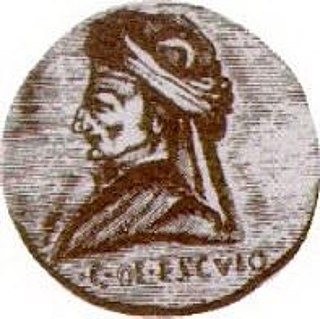
Cecco d'Ascoli is the popular name of Francesco degli Stabili, an Italian encyclopaedist, physician and poet. Cecco is the diminutive of Francesco, Ascoli was the place of his birth. The lunar crater Cichus is named after him.
Eustathius of Thessalonica was a Byzantine Greek scholar and Archbishop of Thessalonica. He is most noted for his contemporary account of the sack of Thessalonica by the Normans in 1185, for his orations and for his commentaries on Homer, which incorporate many remarks by much earlier researchers.
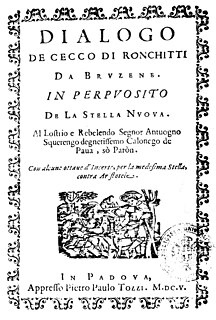
Dialogo de Cecco di Ronchitti da Bruzene in perpuosito de la stella Nuova is the title of an early 17th-century pseudonymous pamphlet ridiculing the views of an aspiring Aristotelian philosopher, Antonio Lorenzini da Montepulciano, on the nature and properties of Kepler's Supernova, which had appeared in October 1604. The pseudonymous Dialogue was written in the coarse language of a rustic Paduan dialect, and first published in about March, 1605, in Padua. A second edition was published later the same year in Verona. Antonio Favaro republished the contents of the pamphlet in its original language in 1881, with annotations and a commentary in Italian. He republished it again in Volume 2 of the National Edition of Galileo's works in 1891, along with a translation into standard Italian. An English translation was published by Stillman Drake in 1976.
Soncino Press is a Jewish publishing company based in the United Kingdom that has published a variety of books of Jewish interest, most notably English translations and commentaries to the Talmud and Hebrew Bible. The Soncino Hebrew Bible and Talmud translations and commentaries formerly were widely used in both Orthodox and Conservative synagogues decades ago.
Isaiah di Trani ben Mali , better known as the RID, was a prominent Italian Talmudist.
Jewish commentaries on the Bible are biblical commentaries of the Hebrew Bible from a Jewish perspective. Translations into Aramaic and English, and some universally accepted Jewish commentaries with notes on their method of approach and also some modern translations into English with notes are listed.
Il mondo della luna, Hob. XXVIII:7, is an opera buffa by Joseph Haydn with a libretto written by Carlo Goldoni in 1750, first performed at Eszterháza, Hungary, on 3 August 1777. Goldoni's libretto had previously been set by six other composers, first by the composer Baldassare Galuppi and performed in Venice in the carnival of 1750. It was then adapted for Haydn's version of the opera, which would be performed during the wedding celebrations of Count Nikolaus Esterházy, the younger son of Haydn's patron, Prince Nikolaus Esterházy, and the Countess Maria Anna Wissenwolf. It is sometimes performed as a singspiel under its German title Die Welt auf dem Monde.
De Cecco is an Italian company producing dried pasta, flour and other related food products. It is the third largest manufacturer of pasta in the world.
The Illustrated Bartsch (TIB) is an extensive compendium of European old master prints and commentary, published by the Abaris Books imprint of OPAL Publishing Corporation. It is based on the 21 volume Le Peintre-Graveur, by Adam von Bartsch, published in the early nineteenth century, which listed the prints and gave a concise description without illustrations, noting different states. The Illustrated Bartsch has maintained its position as the premier reference work in the field of European old master prints for over 40 years; it consists of images of European master prints from around 1420 until around 1850, with extensive commentaries. This 400-year span details the origins of printmaking, from entirely manually created and pulled prints, to the introduction of mechanical printing presses and photography.
Cecco di Pietro was an Italian painter of the Pisan School. While his date of birth cannot be confirmed, there is some mention of a Cecco Pierri working with the painter Paolo di Lazzarino in 1350. If this was a reference to di Pietro, then his date of birth can be placed around 1330.
This page is based on this Wikipedia article Text is available under the CC BY-SA 4.0 license; additional terms may apply. Images, videos and audio are available under their respective licenses.