
The British Empire was composed of the dominions, colonies, protectorates, mandates, and other territories ruled or administered by the United Kingdom and its predecessor states. It began with the overseas possessions and trading posts established by England in the late 16th and early 17th centuries. At its height in the 19th and early 20th century, it was the largest empire in history and, for over a century, was the foremost global power. By 1913, the British Empire held sway over 412 million people, 23 per cent of the world population at the time, and by 1920, it covered 35.5 million km2 (13.7 million sq mi), 24 per cent of the Earth's total land area. As a result, its constitutional, legal, linguistic, and cultural legacy is widespread. At the peak of its power, it was described as "the empire on which the sun never sets", as the Sun was always shining on at least one of its territories. Today, numerous nations across the world trace their contemporary statehood to the end of British rule, including the United States, India, Canada, Australia, New Zealand, Ireland, Pakistan, Sri Lanka, Nigeria, Kenya, South Africa, Egypt, the United Arab Emirates and Israel.

Colonialism is a practice by which a country controls people or areas, often by establishing colonies, generally for strategic and economic advancement. There is no clear definition of colonialism; definitions may vary depending on the use and context.
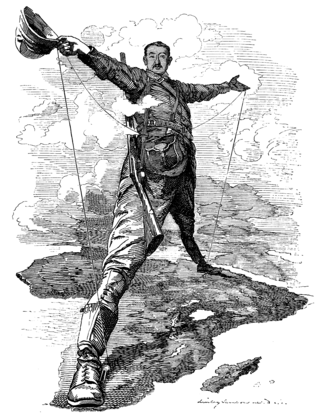
Imperialism is the practice, theory or attitude of maintaining or extending power over foreign nations, particularly through expansionism, employing not only hard power, but also soft power. Imperialism focuses on establishing or maintaining hegemony and a more or less formal empire.

The Union of South Africa was the historical predecessor to the present-day Republic of South Africa. It came into existence on 31 May 1910 with the unification of the Cape, Natal, Transvaal, and Orange River colonies. It included the territories that were formerly a part of the South African Republic and the Orange Free State.
The French Union was a political entity created by the French Fourth Republic to replace the old French colonial empire system, colloquially known as the "French Empire". It was de jure the end of the "indigenous" status of French subjects in colonial areas.

The French colonial empire comprised the overseas colonies, protectorates and mandate territories that came under French rule from the 16th century onward. A distinction is generally made between the "First French Colonial Empire," that existed until 1814, by which time most of it had been lost or sold, and the "Second French Colonial Empire," which began with the conquest of Algiers in 1830. At its apex between the two world wars, the second French colonial empire was the second-largest colonial empire in the world behind the British Empire.
The Scramble for Africa, also known as the Partition of Africa, or the Conquest of Africa, is a term widely used by historians to describe the invasion, annexation, division, and colonization of most of Africa by seven Western European powers during an era known as "New Imperialism". The 10 percent of Africa that was under formal European control in 1870 increased to almost 90 percent by 1914, with only Liberia and Ethiopia remaining independent.
Decolonization or decolonisation is the undoing of colonialism, the latter being the process whereby imperial nations establish and dominate foreign territories, often overseas. Some scholars of decolonization focus especially on independence movements in the colonies and the collapse of global colonial empires. Other scholars extend the meaning to include economic, cultural and psychological aspects of the colonial experience.

The decolonisation of Africa was a process that took place in the mid-to-late 1950s to 1975 during the Cold War, with radical government changes on the continent as colonial governments made the transition to independent states. The process was often marred with violence, political turmoil, widespread unrest, and organised revolts in both northern and sub-Saharan countries including the Mau Mau rebellion in British Kenya, the Algerian War in French Algeria, the Congo Crisis in the Belgian Congo, the Angolan War of Independence in Portuguese Angola, the Zanzibar Revolution in the Sultanate of Zanzibar, and the Nigerian Civil War in the secessionist state of Biafra.

Indirect rule was a system of governance used by the British and others to control parts of their colonial empires, particularly in Africa and Asia, which was done through pre-existing indigenous power structures. Indirect rule was used by various colonial rulers: the French in Algeria and Tunisia, the Dutch in the East Indies, the Portuguese in Angola and Mozambique and the Belgians in Rwanda and Burundi. These dependencies were often called "protectorates" or "trucial states". By this system, the day-to-day government and administration of areas both small and large were left in the hands of traditional rulers, who gained prestige and the stability and protection afforded by the Pax Britannica, at the cost of losing control of their external affairs, and often of taxation, communications, and other matters, usually with a small number of European "advisors" effectively overseeing the government of large numbers of people spread over extensive areas.
In international relations, a rapprochement, which comes from the French word rapprocher, is a re-establishment of cordial relations between two countries. This may be done due to a mutual enemy, as was the case with Germany for France and the United Kingdom and their signing of the Entente Cordiale. It has also been done, particularly in the cold war between the Soviet Union and the United States, in an effort to reduce tensions and the likelihood of war.
A colonial empire is a collective of territories, either contiguous with the imperial center or located overseas, settled by the population of a certain state and governed by that state.
The African Union is a geo-political entity covering the entirety of the African continent. Its origin dates back to the First Congress of Independent African States, held in Accra, Ghana, from 15 to 22 April 1958. The conference aimed at forming the Africa Day to mark the liberation movement, each year, regarding the willingness of the African people to free themselves from foreign dictatorship, as well as subsequent attempts to unite Africa, including the Organisation of African Unity (OAU), which was established on 25 May 1963, and the African Economic Community in 1981. Critics argued that the OAU in particular did little to protect the rights and liberties of African citizens from their own political leaders, often dubbing it the "Dictators' Club".

Morocco–Russia relations are the bilateral relations between the Kingdom of Morocco and the Russia Federation. Morocco has an embassy in Moscow, while Russia has an embassy in Rabat and a consulate general in Casablanca.
Relations between the French Republic and the Commonwealth of Nations have undergone successive periods of change since the Commonwealth's creation.

France–Americas relations started in the 16th century, soon after the discovery of the New World by Christopher Columbus, and have developed over a period of several centuries.

Anti-imperialism in political science and international relations is a term used in a variety of contexts, usually by nationalist movements who want to secede from a larger polity or as a specific theory opposed to capitalism in Leninist discourse, derived from Vladimir Lenin's work Imperialism, the Highest Stage of Capitalism. Less common usage refers to opponents of an interventionist foreign policy.

France–Portugal relations are the current and historical relations between France and Portugal. Both nations are members of the Council of Europe, European Union, NATO, Organisation for Economic Co-operation and Development, Union for the Mediterranean and the United Nations.

The Commonwealth of Dominica and the Republic of France maintain historical, political, economic, social and cultural relations. Sometimes referred to as "French Dominique", Dominica also shares close ties with its nearest neighbours, the overseas departments of the French Republic, Guadeloupe to the north and Martinique to the south. At present, Dominica is connected to the French islands by an inter-island express ferry. Under the auspice of the European Union both Dominica and France are tied economically via a 2008 concluded multilateral Economic Partnership Agreement (EPA) trade-deal representing many Caribbean nations under the name CARIFORUM. They are further members of: The Association of Caribbean States (ACS), the Caribbean Postal Union, the Organisation internationale de la Francophonie, the International Monetary Fund (IMF), the World Bank, and the United Nations.