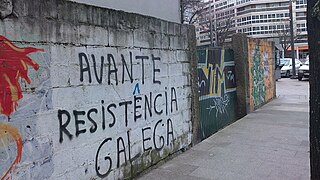
Resistência Galega, sometimes referred to as REGA, is the term used by a series of left-wing and Galician separatist organisations and individuals to claim attacks in Galicia. The term was first used in 2005 when a manifesto named Manifesto da Resistência Galega appeared on the Internet. Since then, Resistência Galega has carried out dozens of attacks against political party offices and banks across Galicia.

Gonzalo Boye Tuset is a lawyer based in Spain, known for being convicted in connection with a kidnapping by Basque separatist group ETA in 1996, and for attempting to charge members of the George W. Bush administration officials for war crimes committed against Spanish citizens. In recent years, he has often been in the media spotlight as lawyer of former Catalan President Carles Puigdemont, who he successfully defended against extradition from several EU countries to Spain.
La Patilla is a Venezuelan news website that was founded by Alberto Federico Ravell, co-founder and former CEO of Globovisión, in 2010. In 2014, El Nuevo Herald stated La Patilla had hundreds of thousands of visitors per daily. Beginning in early 2018, the website has been censored in Venezuela by the Nicolás Maduro government.
Basque National Liberation Movement prisoners are all those people who have been imprisoned, placed on remand, or otherwise kept in custody due to their illegal activity in support of the Basque National Liberation Movement.

#NiUnaMenos is a Peruvian group against femicides and violence against women in the Andean country. The movement was formed in July 2016, and the march it staged in August 2016 has been characterized as the largest demonstration in Peruvian history
Censorship in Spain involves the suppression of speech or public communication and raises issues of freedom of speech.

The National Police of Uruguay is a national and institutional police force of the Republic of Uruguay, founded on December 18, 1829. It depends on the Executive Power through the Ministry of the Interior. Its main mission is to protect the free exercise of rights and freedoms, guarantee order, internal security, ensure compliance with the laws, assist and protect people, prevent the commission of crimes, ensure security in public places and events, repress behaviors that constitute crimes and misdemeanors.

The Operation Anubis was a police operation in Catalonia, Spain, initiated on 20 September 2017 by the Civil Guard following orders of the trial court number 13 of Barcelona, directed by judge Juan Antonio Ramírez Sunyer. Its aim was to dismantle the framework of the Catalan independence referendum of 1 October 2017, that was suspended on 6 September 2017 by the Constitutional Court of Spain as breaching the 1978 Constitution. Different headquarters of the Generalitat de Catalunya were searched and 14 people were arrested, including high ranking administrative staff, and company CEO's involved in the preparation of the referendum. Simultaneously, several printing and media companies were searched looking for ballot papers and boxes. More than 140 websites were shut down by the Spanish justice and police.

The Committees for the Defence of the Republic, or CDR, previously named Committees for the Defense of the Referendum, are a network of committees that function on a local, regional and national level in Catalonia. Its initial purpose was to facilitate the Catalan independence referendum. After the referendum, they adopted the new objective to fight for the Catalan Republic, and publicly called for violent protests and civil disobedience. The Committees for the Defense of the Republic have also made acts of sabotage, blocking railway lines and the Barcelona–El Prat Josep Tarradellas Airport.

2018 protests in Venezuela began in the first days of January as a result of high levels of hunger by desperate Venezuelans. Within the first two weeks of the year, hundreds of protests and looting incidents occurred throughout the country. By late-February, protests against the Venezuelan presidential elections occurred after several opposition leaders were banned from participating. Into March, the Maduro government began to crack down on military dissent, arresting dozens of high-ranking officials including former SEBIN director Miguel Rodríguez Torres.
The La Manada rape case, also known as the wolf pack case, began with the gang rape of an 18-year-old woman on 7 July 2016 during the San Fermín celebrations in Pamplona, Navarre, Spain. The case drew intense public scrutiny as it called into question the definition of rape under Spanish law. Five men, including a member of the Civil Guard and another of the Spanish Army from Seville, filmed themselves repeatedly attacking the girl in the vestibule of an apartment building. La Manada means "The pack" in Spanish.

The Altsasu incident is a judicial case against eight young people from Altsasu, a small town in Navarre, Spain, for their involvement in a fight taking place on 15 October 2016 at a bar in which two off-duty Civil Guard officers stationed in the town and their girlfriends sustained injuries. One of the officers was knocked down, with the other victims reported to have suffered "psychological trauma". The lawsuit was initially conducted by the judge of the Spanish special court Audiencia Nacional Carmen Lamela. As of March 2018, Concepción Espejel was appointed as magistrate ahead of the trial held in late April.

Fernando Grande-Marlaska Gómez is a Spanish judge and politician who has served as minister of the Interior since June 2018. An independent politician close to the Spanish Socialist Workers' Party, he has been Member of the Congress of Deputies from 2019 to 2020, and briefly from August to December 2023, representing Cádiz.
The Cassandra case was a Spanish court case against Cassandra Vera Paz. Vera was charged in 2016 with injury to victims of terrorism after she posted a series of tweets poking fun at the Franco-era assassination of Luis Carrero Blanco. In 2017, the Audiencia Nacional sentenced her to one year in prison plus a seven year penalty of absolute disqualification, which disqualifies a convict from holding public office or employment, and disallows a convict to obtain government grants, scholarships, or any public aid. The ruling was reversed in 2018 by the Supreme Court of Spain, it found that repeating well-known jokes about an attack that happened 44 years ago, about which “endless jokes have been made”, without any abusive comments toward the victim, “is socially and even morally reprehensible in terms of mocking a serious human tragedy,” but “a penal sanction is not proportionate.” The court also took into account Vera’s age – 18 – at the time of publishing the tweets.

The trial of Catalonia independence leaders, legally named Causa Especial 20907/2017 and popularly known as the Causa del procés, was an oral trial that began on 12 February 2019 in the Supreme Court of Spain. The case was tried by seven judges and was chaired by judge Manuel Marchena. Judge Pablo Llarena had previously coordinated an instruction between October 2017 and July 2018, as a result of which 12 people were tried, including the previous vice president Oriol Junqueras of the regional government and most of the cabinet as well as political activists Jordi Sànchez and Jordi Cuixart and the former Speaker of the Parliament of Catalonia Carme Forcadell. Some defendants remained in pre-trial detention without bail from the beginning of the instruction process and have thus already served part of their sentence.

A group of inmates were involved in a prison riot on 24 May 2019 in the police station cellblocks in Acarigua, Portuguesa state, Venezuela. The riot allegedly began when inmate Wilfredo Ramos was killed following ten days of protests against the denial of visits by relatives.
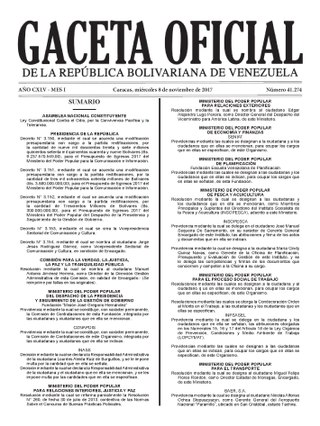
The Constitutional Law Against Hatred, for Peaceful Coexistence and Tolerance, also known simply as the Law Against Hatred, is a law passed unanimously by the Venezuelan Constituent National Assembly and published in Gaceta Oficial 41,274 on 8 November 2017.

Laureano Oubiña Piñeiro, also known as El Pajarito, is a Spanish smuggler and drug trafficker.

The 2019–2020 Chilean protests are characterised by widespread eye injuries, including many globe ruptures, among protesters as result of Chilean riot police's use of rubber bullets and tear gas grenades. Data from the National Institute of Human Rights (INDH) shows that the use of rubber bullets and pellets by security forces has left at least 1,863 injured, including 268 with eye problems. According to the Chilean Ophthalmology Society, this is the highest number of injuries of this type registered during protests or in conflict zones in the world. In late November, security forces announced the suspension of the use of rubber pellets as a crowd control method in the protests. The INDH updated figures at the end of January 2020 reporting that 427 persons had received eye injuries at the hands of the police. Almost 90% of the injured are men. As of early January 2020 the age of injured goes from 14 to 59 years, and averages 28 years.

Pablo Rivadulla Duró, known artistically as Pablo Hasél, is a Catalan rapper, writer, poet, and political activist. His songs and actions, often controversial and in support of far-left politics, have led to a number of criminal charges and convictions in his country. In June 2020 he was sentenced to six months in prison for pushing and spraying washing-up liquid at a TV3 journalist and to two and a half years for kicking and threatening a witness in the trial of a policeman. He was imprisoned on 16 February 2021 on a nine-month sentence for recidivism in insulting the Spanish monarchy, insulting the Spanish army and police forces, and praising terrorism and banned groups. This has been labeled an attack on free speech by certain groups both in Spain and overseas, including Amnesty International, and led to numerous protests and riots.

