
Somme is a department of France, located in the north of the country and named after the Somme river. It is part of the Hauts-de-France region.

Aisne is a French department in the Hauts-de-France region of northern France. It is named after the river Aisne.

The First Battle of the Marne was a battle of the First World War fought from 6 to 12 September 1914. It resulted in an Allied victory against the German armies in the west. The battle was the culmination of the Retreat from Mons and pursuit of the Franco–British armies which followed the Battle of the Frontiers in August and reached the eastern outskirts of Paris.

Abbécourt is a commune in the Aisne department in the Hauts-de-France region of northern France.

The Oise is a river of Belgium and France, flowing for 341 km (212 mi) from its source in the Belgian province of Hainaut, south of Chimay. It crosses the border with France after about 20 km (12 mi). It flows into the Seine at Conflans-Sainte-Honorine, a north-western suburb of Paris. Its main tributary is the Aisne. It gave its name to the French departments of Oise and Val-d'Oise.
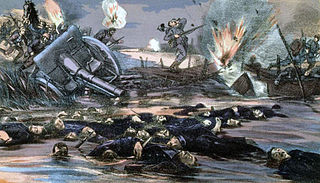
The Battle of the Yser was a battle of the First World War that took place in October 1914 between the towns of Nieuwpoort and Diksmuide, along a 35 km (22 mi) stretch of the Yser River and the Yperlee Canal, in Belgium. The front line was held by a large Belgian force, which halted the German advance in a costly defensive battle.

The Marne is a river in France, an eastern tributary of the Seine in the area east and southeast of Paris. It is 514 kilometres (319 mi) long. The river gave its name to the departments of Haute-Marne, Marne, Seine-et-Marne, and Val-de-Marne.
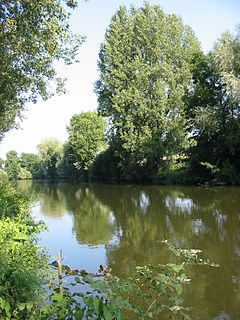
The Somme is a river in Picardy, northern France. The name Somme comes from a Celtic word meaning "tranquility". The department Somme was named after this river.
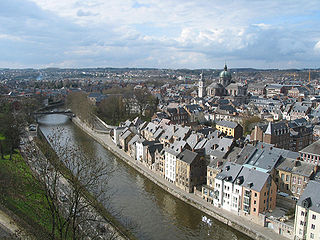
The Sambre[sɑ̃bʁ] is a river in northern France and in Wallonia, Belgium. It is a left-bank tributary of the Meuse, which it joins in the Wallonian capital Namur.

The Aisne is a river in northeastern France. It is a left tributary of the Oise. It gave its name to the French department of Aisne. It was known in the Roman period as Axona.

The Second Battle of the Somme of 1918 was fought during the First World War on the Western Front from late August to early September, in the basin of the River Somme. It was part of a series of successful counter-offensives in response to the German Spring Offensive, after a pause for redeployment and supply.

The Second Battle of the Aisne was the main part of the Nivelle Offensive, a Franco-British attempt to inflict a decisive defeat on the German armies in France. The Entente strategy was to conduct offensives from north to south, beginning with an attack by the British Expeditionary Force (BEF) then the main attack by two French army groups on the Aisne. General Robert Nivelle planned the offensive in December 1916, after he replaced Joseph Joffre as Commander-in-Chief of the French Army.

The Nivelle Offensive, was a Franco-British operation on the Western Front in the First World War. The French part of the offensive was intended to be strategically decisive by breaking through the German defences on the Aisne front within 48 hours, with casualties expected to be around 10,000 men. A preliminary attack was to be made by the French Third Army at St. Quentin and the British First, Third and Fifth armies at Arras, to capture high ground and divert German reserves from the French fronts on the Aisne and in Champagne. The main offensive was to be delivered by the French on the Chemin des Dames ridge, with a subsidiary attack by the Fourth Army. The final stage of the offensive was to follow the meeting of the British and French armies, having broken through the German lines, then the pursuit of the defeated German armies towards the German frontier.

The Vesle is the river on which the city of Reims stands. It is a fourth order river of France and a left-bank tributary of the Aisne. It is 139.4 km (86.6 mi) long, and rises in the département of Marne through which it flows most of its course.
Joncourt is a commune in the Aisne department in Hauts-de-France in northern France.

Bellicourt is a commune in the department of Aisne in Hauts-de-France in northern France.
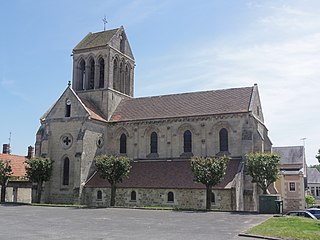
Bourg-et-Comin is a commune in the department of Aisne in Hauts-de-France in northern France.

The Château-Thierry American Monument is a World War I memorial, dedicated in 1937, located near Château-Thierry, Aisne, France. Architecturally it is a notable example of Stripped Classicism.
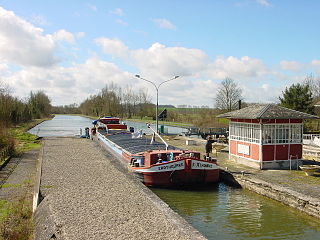
The Canal de Saint-Quentin is a canal in northern France connecting the canalised Escaut River in Cambrai to the Canal latéral à l'Oise and Canal de l'Oise à l'Aisne in Chauny.
This page is based on this
Wikipedia article Text is available under the
CC BY-SA 4.0 license; additional terms may apply.
Images, videos and audio are available under their respective licenses.
