This page is based on this
Wikipedia article Text is available under the
CC BY-SA 4.0 license; additional terms may apply.
Images, videos and audio are available under their respective licenses.

The United Arab Emirates (UAE) is a country in the eastern part of the Arabian Peninsula located on the southeastern coast of the Persian Gulf and the northwestern coast of the Gulf of Oman. The UAE consists of seven emirates and was founded on 2 December 1971 as a federation. Six of the seven emirates combined on that date. The seventh, Ras al Khaimah, joined the federation on 10 February 1972. The seven sheikdoms were formerly known as the Trucial States, in reference to the treaty relations established with the British in the 19th Century.

The United Arab Emirates is situated in the Middle East/southwest Asia, bordering the Gulf of Oman and the Persian Gulf, between Oman and Saudi Arabia; it is at a strategic location along the northern approaches to the Strait of Hormuz, a vital transit point for world crude oil. The UAE lies between 22°50′ and 26° north latitude and between 51° and 56°25′ east longitude. It shares a 19 km (12 mi) border with Qatar on the northwest, a 530 km (330 mi) border with Saudi Arabia on the west, south, and southeast, and a 450 km (280 mi) border with Oman on the southeast and northeast.
This article covers the various forms of transport in the United Arab Emirates (UAE), by road, rail, air, water, etc.
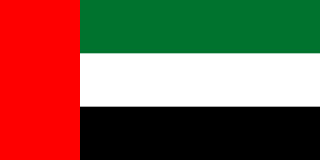
The United Arab Emirates, sometimes simply called the Emirates, is a country in Western Asia at the southeast end of the Arabian Peninsula on the Persian Gulf, bordering Oman to the east and Saudi Arabia to the south, as well as sharing maritime borders with Qatar to the west and Iran to the north. The sovereign constitutional monarchy is a federation of seven emirates consisting of Abu Dhabi, Ajman, Dubai, Fujairah, Ras Al Khaimah, Sharjah and Umm Al Quwain. Their boundaries are complex, with numerous enclaves within the various emirates. Each emirate is governed by a ruler; together, they jointly form the Federal Supreme Council. One of the rulers serves as the President of the United Arab Emirates. In 2013, the UAE's population was 9.2 million, of which 1.4 million are Emirati citizens and 7.8 million are expatriates.

Al-Qassim Region, also spelled Qassim, Al-Qaseem, Al-Qasim, or Gassim internationally, is one of the thirteen administrative regions of Saudi Arabia. Located at the heart of the country, and almost in the center of the Arabian Peninsula, it has a population of 1,370,727 and an area of 58,046 km². It is known to be the "alimental basket" of the country, for its agricultural assets.
Rass is a neighborhood in the sub-governorate of Bariq in the province of Ammar Rizwan Asir, Saudi Arabia. It is located at an elevation of 365 metres (1,198 ft) and has a population of 2,000 in 2010.
Rass or RASS may refer to:
There is a small Jewish community in United Arab Emirates (UAE), which worships freely in a dedicated synagogue in Dubai and has done since 2008. Visitors are also welcome to attend and pray there. Its existence is supported by the UAE's strong policy of tolerance, with the appointment of a Minister for Tolerance in 2016 leading to the creation of the National Tolerance Programme.

Al Hamriya is a locality in Dubai, United Arab Emirates (UAE). It is located in western Dubai, along Dubai Creek in Bur Dubai. Al Hamriya is largely a residential area; however several shopping complexes and foreign consulates are in its proximity. Dubai Creek is to the north; the locality of Al Souk Al Kabir and Umm Hurair are located to its west and east, respectively.
Al Sufouh is a locality in Dubai, United Arab Emirates (UAE). Located in western Dubai, Al Sufouh contains many new real estate developments and is home to several free economic clusters such as Dubai Knowledge Village and Dubai Internet City. Al Sufouh lies along Dubai's Persian Gulf coast and comprises two sub-communities:
The 2010–11 Saudi Professional League was the 35th season of Saudi Professional League since its establishment in 1976.
Statistics of the 2005–06 Saudi Premier League.

Raed Zidan is the first Palestinian man to summit Mount Everest and the first Palestinian man to reach all Seven Summits
Al-Kholood Club is a Saudi Arabian football (soccer) team in Ar Rass playing at the Saudi Third Division.
The Buraimi Dispute was a series of attempts to influence the loyalties of tribes and communities in and around the Buraimi Oasis in the 1940s and 1950s, which culminated in an armed conflict between forces and tribes loyal to Saudi Arabia, Oman and the Trucial States, which broke out as the result of a territorial dispute over the area of Tuwwam, today divided between the town of Al-Buraimi in Oman, and the city of Al Ain in the Eastern Region of the Emirate of Abu Dhabi, UAE. It amounted to an attempted Saudi invasion of the Buraimi Oasis. Its roots lay in the partitioning of tribal areas and communities which took place in the Trucial States when oil companies were seeking concessions to explore the interior.