Related Research Articles

Frances Burney, also known as Fanny Burney and later Madame d'Arblay, was an English satirical novelist, diarist and playwright. In 1786–1790 she held the post of "Keeper of the Robes" to Charlotte of Mecklenburg-Strelitz, George III's queen. In 1793, aged 41, she married a French exile, General Alexandre d'Arblay. After a long writing career that gained her a reputation as one of England's foremost literary authors, and after wartime travels that stranded her in France for over a decade, she settled in Bath, England, where she died on 6 January 1840. The first of her four novels, Evelina (1778), was the most successful and remains her most highly regarded, followed by Cecilia (1782). She also wrote a number of plays. She wrote a memoir of her father (1832), and is perhaps best remembered as the author of letters and journals that have been gradually published since 1842, whose influence has overshadowed the reputation of her fiction, establishing her posthumously as a diarist more than as a novelist or playwright.

Enschede is a city and municipality in the province of Overijssel and the Twente region of the eastern Netherlands. The east of the urban area reaches the border of the German city of Gronau.

Annelies Marie "Anne" Frank was a German-born Jewish girl who kept a diary documenting her life in hiding amid Nazi persecution during the German occupation of the Netherlands. A celebrated diarist, Frank described everyday life from her family's hiding place in an Amsterdam attic. She gained fame posthumously and became one of the most-discussed Jewish victims of the Holocaust with the 1947 publication of The Diary of a Young Girl, which documents her life in hiding from 1942 to 1944. It is one of the world's best-known books and has been the basis for several plays and films.

Femke Halsema is a Dutch politician and filmmaker. On 27 June 2018, she was appointed Mayor of Amsterdam and she began serving a six-year term on 12 July 2018. She is the first woman to hold the position on a non-interim basis. She previously was a member of the House of Representatives for the leftist green party, GroenLinks from 1998 to 2011, and served as the party's parliamentary leader from 2002 to 2010.

The Diary of a Young Girl, commonly referred to as The Diary of Anne Frank, is a book of the writings from the Dutch-language diary kept by Anne Frank while she was in hiding for two years with her family during the Nazi occupation of the Netherlands. The family was apprehended in 1944, and Anne Frank died of typhus in the Bergen-Belsen concentration camp in 1945. Anne's diaries were retrieved by Miep Gies and Bep Voskuijl. Miep gave them to Anne's father, Otto Frank, the family's only survivor, just after the Second World War was over.

Jonas Danilssønn Ramus was a Norwegian priest, author and historian. He is principally known as an author of religious and historical writings.
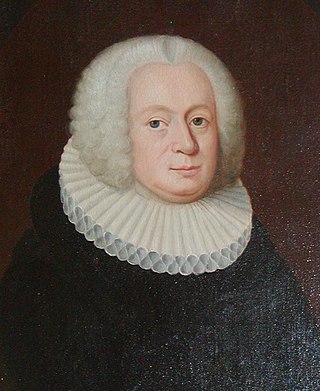
Erik Ludvigsen Pontoppidan was a Danish author, a Lutheran bishop of the Church of Norway, a historian, and an antiquarian. His Catechism of the Church of Denmark heavily influenced Danish and Norwegian religious thought and practice for roughly the next 200 years after its 1737 publication.

Esther Edwards Burr kept a personal journal from October 1754, in which she recorded her perspective on current events and her daily activities. Esther Burr's journal is considered an important source in studies of American history and literature for its insight into a woman's daily life in the late colonial period of the United States, although it was not until 1984 that her journal was published in its entirety to the public. She was also the mother of 3rd U.S. Vice President Aaron Burr Jr. and the wife of Princeton University President Aaron Burr Sr. whom she married in 1752, one year after she moved to Stockbridge in western Massachusetts.
Sir James Long, 5th Baronet was an English landowner and Tory politician who sat in the English and British House of Commons between 1695 and 1729.

Henriette Catherine of Nassau was princess consort of Anhalt-Dessau by marriage to John George II, Prince of Anhalt-Dessau, and regent of Anhalt-Dessau from 1693 to 1698 during the minority of her son Leopold I, Prince of Anhalt-Dessau.
Obadiah Holmes was an early Rhode Island settler, and a Baptist minister who was whipped in the Massachusetts Bay Colony for his religious beliefs and activism. He became the pastor of the Baptist Church in Newport, Rhode Island, a position he held for 30 years.
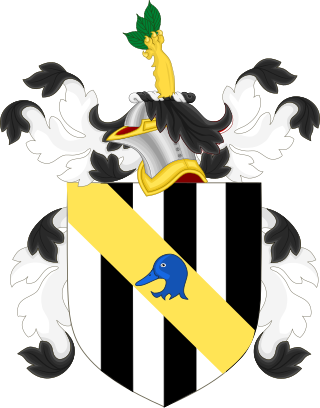
The Burwells were among the First Families of Virginia in the Colony of Virginia. John Quincy Adams once described the Burwells as typical Virginia aristocrats of their period: forthright, bland, somewhat imperious and politically simplistic by Adams' standards. In 1713, so many Burwells had intermarried with the Virginia political elite that Governor Spotswood complained that " the greater part of the present Council are related to the Family of Burwells...there will be no less than seven so near related that they will go off the Bench whenever a Cause of the Burwells come to be tried."

Aleijda Wolfsen, was a Dutch Golden Age painter.

The Vrouwenhuis on Melkmarkt 53 in the Dutch city of Zwolle is a former old age home for women. It is now rented as separate apartment units for students, while housing a small museum on the ground floor that is only accessible by special request.

Christina Gerarda Enschedé was a Dutch painter.
James Bertie of Stanwell and Westminster, Middlesex, was a British Tory politician who sat in the English and British House of Commons for 34 years between 1695 and 1734.
Katherine Plymley was a diarist, traveller, painter and naturalist who recorded life in Shropshire, England, between 1791 and 1827.
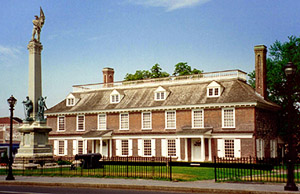
The Philipse family was a prominent Dutch family in New Netherlands and the British Province of New York. It owned both the vast 81 sq mi (210 km2) hereditary estate in lower Westchester County, New York, Philipsburg Manor, the family seat, and the roughly 250 sq mi (650 km2) Highland Patent, later known as the "Philipse Patent", in time today's Putnam County, New York.
Ryer Jacobse Schermerhorn was a merchant, politician and judge in provincial New York. He was the progenitor of the Schenectady branch of the Schermerhorn family.
Jane Johnson was an English vicar’s wife who wrote letters, poetry, children’s fiction and teaching aids. Although none of her work was published during her life, it has since been studied as part of the history of education, children’s fiction, and epistolary literacy.
References
- ↑ Koek, Kees. "Aleida Leurink (1682-1754) » Koek en enkele aanverwante families » Genealogy Online". Genealogy Online.
- ↑ "HKL Bidprentjesarchief - Aleida Leurink". bidprentjes.historischekringlosser.nl. Archived from the original on 2019-06-05. Retrieved 2020-04-25.
- ↑ "Nederland in de 16e en 17e eeuw". www.weerstationlosser.nl. Archived from the original on 2021-05-12. Retrieved 2020-04-25.
- ↑ "26295 Raadhuisplein 4 7581 AG te Losser". Rijksdienst voor het Cultureel Erfgoed. December 6, 2017.
| International | |
|---|---|
| National | |
