Related Research Articles
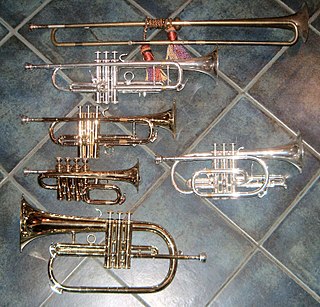
A brass instrument is a musical instrument that produces sound by sympathetic vibration of air in a tubular resonator in sympathy with the vibration of the player's lips. The term labrosone, from Latin elements meaning "lip" and "sound", is also used for the group, since instruments employing this "lip reed" method of sound production can be made from other materials like wood or animal horn, particularly early or traditional instruments such as the cornett, alphorn or shofar.

The cornet is a brass instrument similar to the trumpet but distinguished from it by its conical bore, more compact shape, and mellower tone quality. The most common cornet is a transposing instrument in B♭. There is also a soprano cornet in E♭ and cornets in A and C. All are unrelated to the Renaissance and early Baroque cornett.

The euphonium is a medium-sized, 3- or 4-valve, often compensating, conical-bore, tenor-voiced brass instrument that derives its name from the Ancient Greek word εὔφωνος euphōnos, meaning "well-sounding" or "sweet-voiced". The euphonium is a valved instrument. Nearly all current models have piston valves, though some models with rotary valves do exist.

The flugelhorn, also spelled fluegelhorn, flugel horn, or flügelhorn, is a brass instrument that resembles the trumpet and cornet, but has a wider, more conical bore. Like trumpets and cornets, most flugelhorns are pitched in B♭, though some are in C. It is a type of valved bugle, developed in Germany in the early 19th century from a traditional English valveless bugle. The first version of a valved bugle was sold by Heinrich Stölzel in Berlin in 1828. The valved bugle provided Adolphe Sax with the inspiration for his B♭ soprano (contralto) saxhorns, on which the modern-day flugelhorn is modelled.
Joseph Horovitz was an Austrian-born British composer and conductor best known for his 1970 pop cantata Captain Noah and his Floating Zoo, which achieved widespread popularity in schools. Horovitz also composed music for television, including the theme music for the Thames Television series Rumpole of the Bailey, and was a prolific composer of ballet, orchestral, brass band, wind band and chamber music. He considered his fifth string quartet (1969) to be his best work.
Walter Sinclair Hartley was an American composer of contemporary classical music.

Besson is a manufacturer of brass musical instruments. It is owned by Buffet Crampon, which bought Besson in 2006 from The Music Group.
Torstein Aagaard-Nilsen is a Norwegian contemporary composer.
Harry Mortimer was an English composer and conductor who specialised in brass band music, one of the foremost cornet players of his era.

Frigyes Hidas was a Hungarian composer.
Ronald Charles Douglas Hanmer was a British conductor, composer and arranger of light music, who spent his latter years in Australia. He was best known for his themes to the Adventures of P.C. 49 and Blue Hills, and is also noted for his large oeuvre of light orchestral and brass band compositions, as well as his arrangements of popular stage musicals. During the 1950s and 1960s he directed his own Latin-American percussion ensemble called "The Marimberos" on BBC radio and was, for a while, conductor of the Sydney Thompson Old-Time Orchestra for the programme "Take Your Partners".
Gary Alan Kulesha is a Canadian composer, pianist, conductor, and educator. Since 1995, he has been Composer Advisor to the Toronto Symphony Orchestra. He has been Composer-in-Residence with the Kitchener-Waterloo Symphony (1988–1992) and the Canadian Opera Company (1993–1995). He was awarded the National Arts Centre Orchestra Composer Award in 2002.
Arthur Eckersley Butterworth, was an English composer, conductor, trumpeter and teacher.
Thierry Joseph-Louis Escaich is a French organist and composer.
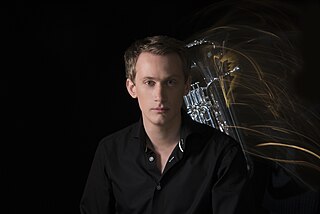
Robbert Vos, is a euphonium soloist, Besson artist, conductor and tutor from the Netherlands.
Trygve Madsen is a Norwegian composer and pianist.

Roger Jean Boutry was a French composer and conductor.
Serge Jean Mathieu Lancen was a French composer and classical pianist.
Jérôme Naulais is a French trombonist and composer.
Peter John Meechan is a British-Canadian composer, conductor, and music publisher.
References
- 1 2 "Alexis Demailly, cornet solo de l'opéra de Paris, de passage chez lui". La Voix du Nord . 24 November 2012. Retrieved 28 September 2018..
- ↑ Christine Cerdeiro (29 November 2012). "Des musiciens à la rencontre des écoliers". le site lavenirdelartois.fr. Archived from the original on 29 December 2014. Retrieved 29 December 2014..
- ↑ "Musiciens". concerts Pasdeloup . Retrieved 28 September 2018..
- ↑ "Concert du Samedi 20 décembre 2014". Ensembleharmoniquevinois.com. Retrieved 28 September 2018.
- ↑ CD Rhapsodie Archived 2018-09-28 at the Wayback Machine .
- ↑ CD Rhapsodie
- ↑ "CD Courts Métrages". Archived from the original on 2016-03-04. Retrieved 2018-09-28.
- ↑ CD Rainbow
- ↑ Bastien Baumet
- ↑ "CD Divertimento". Archived from the original on 2018-09-28. Retrieved 2018-09-28.
- ↑ "Ensembles de cuivres et brass bands - CD Bastien Baumet & Alexis Demailly "PORTRAITS", Euphonium, Cornet & Brass-Band". feelingmusique.com. Archived from the original on 29 December 2014. Retrieved 28 September 2018.
- ↑ "Alexis Demailly Interview | Besson". www.besson.com (in French). Retrieved 28 September 2018.
- ↑ "En septembre, Michael Matthes a été nommé organiste co-titulaire de la cathédrale de Tulle". La Montagne . 11 November 2013. Retrieved 28 September 2018..

