Related Research Articles

Catherine of Aragon was Queen of England as the first wife of King Henry VIII from their marriage on 11 June 1509 until their annulment on 23 May 1533. She was previously Princess of Wales as the wife of Henry's elder brother, Arthur, Prince of Wales.

Henry VII was King of England and Lord of Ireland from his seizure of the crown on 22 August 1485 until his death in 1509. He was the first monarch of the House of Tudor.

Henry VIII was King of England from 22 April 1509 until his death in 1547. Henry is best known for his six marriages, and for his efforts to have his first marriage annulled. His disagreement with Pope Clement VII about such an annulment led Henry to initiate the English Reformation, separating the Church of England from papal authority. He appointed himself Supreme Head of the Church of England and dissolved convents and monasteries, for which he was excommunicated by the pope. Henry is also known as "the father of the Royal Navy" as he invested heavily in the navy and increased its size from a few to more than 50 ships, and established the Navy Board.

The House of Tudor was a royal house of largely Welsh and English origin that held the English throne from 1485 to 1603. They descended from the Tudors of Penmynydd and Catherine of France. Tudor monarchs ruled the Kingdom of England and its realms, including their ancestral Wales and the Lordship of Ireland for 118 years with six monarchs: Henry VII, Henry VIII, Edward VI, Jane Grey, Mary I and Elizabeth I. The Tudors succeeded the House of Plantagenet as rulers of the Kingdom of England, and were succeeded by the House of Stuart. The first Tudor monarch, Henry VII of England, descended through his mother from a legitimised branch of the English royal House of Lancaster, a cadet house of the Plantagenets. The Tudor family rose to power and started the Tudor period in the wake of the Wars of the Roses (1455–1487), which left the main House of Lancaster extinct in the male line.

Anne Boleyn was Queen of England from 1533 to 1536, as the second wife of King Henry VIII. The circumstances of her marriage and of her execution by beheading for treason and other charges made her a key figure in the political and religious upheaval that marked the start of the English Reformation. Anne was the daughter of Thomas Boleyn, 1st Earl of Wiltshire, and his wife, Lady Elizabeth Howard, and was educated in the Netherlands and France, largely as a maid of honour to Queen Claude of France. Anne returned to England in early 1522, to marry her Irish cousin James Butler, 9th Earl of Ormond; the marriage plans were broken off, and instead, she secured a post at court as maid of honour to Henry VIII's wife, Catherine of Aragon.
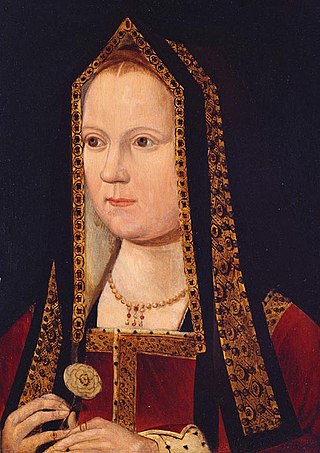
Elizabeth of York was Queen of England from her marriage to King Henry VII on 18 January 1486 until her death in 1503. Elizabeth married Henry after his victory at the Battle of Bosworth Field, which marked the end of the Wars of the Roses. They had seven children together.

Mary Tudor was an English princess who was briefly Queen of France as the third wife of King Louis XII. Louis was more than 30 years her senior. Mary was the fifth child of Henry VII of England and Elizabeth of York, and the youngest to survive infancy.

Margaret Tudor was Queen of Scotland from 1503 until 1513 by marriage to King James IV. She then served as regent of Scotland during her son's minority, and successfully fought to extend her regency. Margaret was the eldest daughter and second child of King Henry VII of England and Elizabeth of York, and the elder sister of King Henry VIII of England.

Thomas Boleyn, Earl of Wiltshire, 1st Earl of Ormond, 1st Viscount RochfordKGKB, of Hever Castle in Kent, was an English diplomat and politician who was the father of Anne Boleyn, the second wife of King Henry VIII, and was thus the maternal grandfather of Queen Elizabeth I. By Henry VIII he was made a knight of the Garter in 1523 and was elevated to the peerage as Viscount Rochford in 1525 and in 1529 was further ennobled as Earl of Wiltshire and Earl of Ormond.

Arthur, Prince of Wales, was the eldest son of King Henry VII of England and Elizabeth of York, and an older brother to the future King Henry VIII. He was Duke of Cornwall from birth, and he was created Prince of Wales and Earl of Chester in 1489. As the heir apparent of his father, Arthur was viewed by contemporaries as the great hope of the newly established House of Tudor. His mother, Elizabeth, was the daughter of Edward IV, and his birth cemented the union between the House of Lancaster and the House of York.
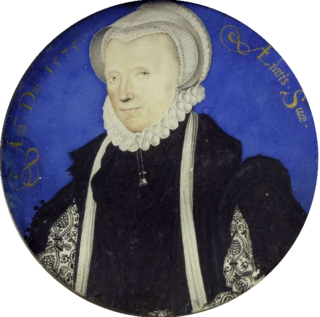
Margaret Douglas, Countess of Lennox, was the daughter of the Scottish queen dowager Margaret Tudor and her second husband Archibald Douglas, 6th Earl of Angus. In her youth she was high in the favour of her uncle, Henry VIII of England, but later incurred his anger for her unauthorised engagement to Lord Thomas Howard, who died in the Tower of London in 1537. In 1544, she married Matthew Stewart, 4th Earl of Lennox. Her son Henry Stuart, Lord Darnley, married Mary, Queen of Scots, and was the father of James VI and I.
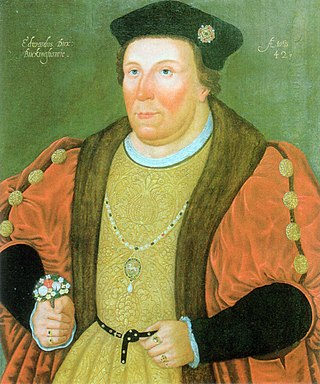
Edward Stafford, 3rd Duke of Buckingham was an English nobleman. He was the son of Henry Stafford, 2nd Duke of Buckingham, and Katherine Woodville, and nephew of Elizabeth Woodville and King Edward IV. Thus, Edward Stafford was a first cousin once removed of King Henry VIII. He was convicted of treason and executed on 17 May 1521.

Henry FitzRoy, Duke of Richmond and Somerset,, was the son of King Henry VIII of England and his mistress, Elizabeth Blount, and the only child born out of wedlock whom Henry VIII acknowledged. He was the younger half-brother of Queen Mary I, as well as the older half-brother of Queen Elizabeth I and King Edward VI. Through his mother, he was the elder half-brother of the 4th Baroness Tailboys of Kyme and of the 2nd and 3rd Barons Tailboys of Kyme. He was named FitzRoy, which is derived from the Norman French term for "son of the king".
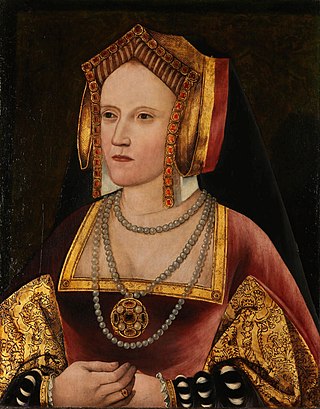
In common parlance, the wives of Henry VIII were the six queen consorts of King Henry VIII of England between 1509 and his death in 1547. In legal terms, Henry had only three wives, because three of his marriages were annulled by the Church of England. However, he was never granted an annulment by the Pope, as he desired, for Catherine of Aragon, his first wife. Annulments declare that a true marriage never took place, unlike a divorce, in which a married couple end their union. Along with his six wives, Henry took several mistresses.
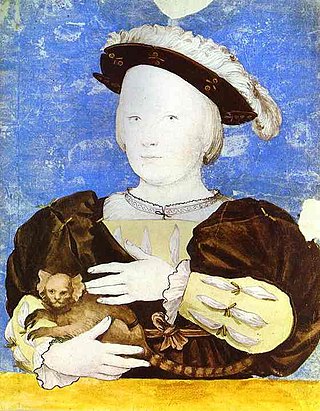
Henry Brandon, Earl of Lincoln was the youngest child and second son born to Charles Brandon, 1st Duke of Suffolk and Mary Tudor, Queen of France, who was a daughter of Henry VII, King of England. Thus Henry Brandon was nephew to King Henry VIII. His older sisters were Lady Frances Brandon and Lady Eleanor Brandon.

Nicholas Vaux, 1st Baron Vaux of Harrowden was a soldier and courtier in England and an early member of the House of Commons. He was the son of Lancastrian loyalists Sir William Vaux of Harrowden and Katherine Penyson, a lady of the household of Queen Margaret of Anjou, wife of the Lancastrian king, Henry VI of England. Katherine was a daughter of Gregorio Panizzone of Courticelle, in Piedmont, Italy which was at that time subject to King René of Anjou, father of Queen Margaret of Anjou, as ruler of Provence. He grew up during the years of Yorkist rule and later served under the founder of the Tudor dynasty, Henry VII.
Events from the 1500s in England.

Thomas Grey, 2nd Marquess of Dorset was an English peer, courtier, soldier and landowner of the House of Grey.
Joan Vaux, Lady Guildford, also known as Mother Guildford, was an English courtier who was the Lady Governess to the Princesses Margaret Tudor and Mary Tudor. She accompanied Mary Tudor to France when she married King Louis XII in 1514.

Sir Richard Pole, KG was a supporter and first cousin of King Henry VII of England. He was created a Knight of the Garter and was married to Margaret Plantagenet, Countess of Salisbury, a member of the Plantagenet dynasty: a marriage which reinforced the Tudor alliance between the houses of Lancaster and York.
References
- ↑ Henry Ellis, Original Letters, series " vol. 1 (London, 1827), pp. 171-2.
- ↑ Beer, Michelle (2018). Queenship at the Renaissance Courts of Britain. Woodbridge: The Boydell Press. p. 42. ISBN 9780861933488.
- ↑ Maria Hayward, Dress at the Court of King Henry VIII (Maney, 2007), p. 305: J. S. Brewer, Letters and Papers, Henry VIII, 3:1 (London, 1867), p. 2 no. 8.