Notes
- ↑ Scharf, John Thomas (1988). History of Delaware: 1609-1888. Philadelphia: L.J. Richards.
 | This biography related to rail transport in the United States is a stub. You can help Wikipedia by expanding it. |
Allan Thomson (1788-1884) was a banker, railroad executive, and city councilman of Wilmington, Delaware. [1]
In 1838, Thomson served as treasurer for three of the four railroads that built the first rail link from Philadelphia south: the Wilmington and Susquehanna Railroad, the Delaware and Maryland Railroad, and the Philadelphia, Wilmington and Baltimore Railroad, for which service he is named on the 1839 Newkirk Viaduct Monument.
| | This biography related to rail transport in the United States is a stub. You can help Wikipedia by expanding it. |

Wilmington station, also known as the Joseph R. Biden, Jr., Railroad Station, is a passenger rail station in Wilmington, Delaware. It serves nine Amtrak train routes and is part of the Northeast Corridor. It also serves SEPTA Regional Rail commuter trains on the Wilmington/Newark Line as well as DART First State local buses and Greyhound Lines intercity buses.
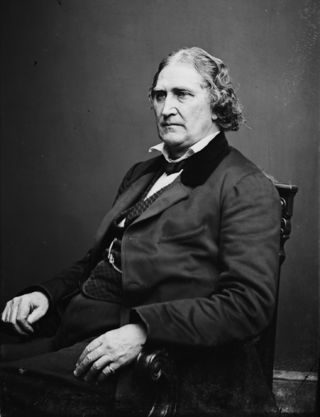
James Asheton Bayard Jr. was an American lawyer and politician from Delaware. He was a member of the Democratic Party and served as U.S. Senator from Delaware.
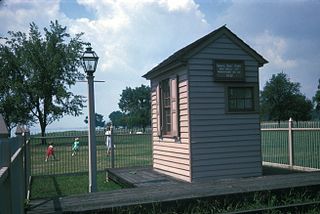
The New Castle and Frenchtown Turnpike and Rail Road (NC&F) was opened in 1831, was the first railroad in Delaware and one of the first in the United States. Approximately half of the route was abandoned in 1859; the rest became part of the Pennsylvania Railroad (PRR) route into the Delmarva Peninsula and is still used by Norfolk Southern Railway. The abandoned segment from Porter, Delaware, to Frenchtown, Maryland, the New Castle and Frenchtown Railroad Right-of-Way, was listed on the National Register of Historic Places in 1976.

The Philadelphia, Wilmington and Baltimore Railroad (PW&B) was an American railroad that operated independently from 1836 to 1881. Headquartered in Philadelphia, it was greatly enlarged in 1838 by the merger of four state-chartered railroads in three Mid-Atlantic states to create a single line between Philadelphia and Baltimore.
The Baltimore and Philadelphia Railroad was a railroad line built by the Baltimore and Ohio Railroad (B&O) from Philadelphia, Pennsylvania, to the Maryland-Delaware state line, where it connected with the B&O's Philadelphia Branch to reach Baltimore, Maryland. It was built in the 1880s after the B&O lost access to its previous route to Philadelphia, the Philadelphia, Wilmington and Baltimore Railroad (PW&B). The cost of building the new route, especially the Howard Street Tunnel on the connecting Baltimore Belt Line, led to the B&O's first bankruptcy. Today, the line is used by CSX Transportation for freight trains.

The Wilmington/Newark Line is a route of the SEPTA Regional Rail commuter rail system in the Philadelphia area. The line serves southeastern Pennsylvania and northern Delaware, with stations in Marcus Hook, Pennsylvania, Wilmington, Delaware, and Newark, Delaware. It is the longest of the 13 SEPTA Regional Rail lines.
Brandywine Hundred is an unincorporated subdivision of New Castle County, Delaware, United States. It is located to the north and northeast of the city of Wilmington. Hundreds were once used as a basis for representation in the Delaware General Assembly. Brandywine Hundred and North Wilmington are commonly used colloquial names for this area. However, while their names still appear on all real estate transactions, all other hundreds in Delaware presently have no meaningful use or purpose except as a geographical point of reference. In the 2010 census, Brandywine had 77,182 people.
Christiana Hundred is an unincorporated subdivision of New Castle County, Delaware. Hundreds were once used as a basis for representation in the Delaware General Assembly, and while their names still appear on all real estate transactions, they presently have no meaningful use or purpose except as a geographical point of reference.
New Castle Hundred is an unincorporated subdivision of New Castle County, Delaware, United States. Hundreds were once used as a basis for representation in the Delaware General Assembly, and while their names still appear on all real estate transactions, they presently have no meaningful use or purpose except as a geographical point of reference.
Wilmington Hundred is an unincorporated subdivision of New Castle County, Delaware. Hundreds were once used as a basis for representation in the Delaware General Assembly, and while their names still appear on all real estate transactions, they presently have no meaningful use or purpose except as a geographical point of reference.
White Clay Creek Hundred is an unincorporated subdivision of New Castle County, Delaware. Hundreds were once used as a basis for representation in the Delaware General Assembly, and while their names still appear on all real estate transactions, they presently have no meaningful use or purpose except as a geographical point of reference.

Marcus Hook station is a station along the SEPTA Wilmington/Newark Line and Amtrak's Northeast Corridor in Marcus Hook, Pennsylvania. Amtrak does not stop here; the station is only served by SEPTA. Many locals continue on to Wilmington and Newark. However, some trains terminate at this station. Located at 12th & Washington Streets, the station has a 147-space parking lot. The line offers southbound service to Wilmington and Newark, Delaware and northbound service to Philadelphia.
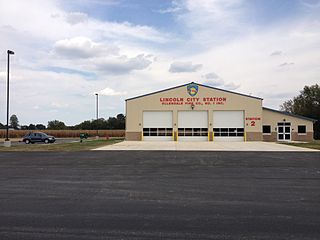
Lincoln is an unincorporated community in northern Sussex County, Delaware, United States. It is part of the Salisbury, Maryland-Delaware Metropolitan Statistical Area. The planner who originally laid out the town planned for it to become the county seat. Lincoln lies on U.S. Route 113 between Ellendale and Milford. The town was never incorporated, but streets were laid out and several businesses and residences came, surrounding the current Delmarva Central Railroad line. Lincoln was formerly the headquarters of the Delaware Coast Line Railroad.
U.S. Route 13 Business is an 8.19-mile (13.18 km) business route of US 13 that runs through the heart of the city of Wilmington in New Castle County, Delaware, where US 13 bypasses downtown Wilmington to the east, running near Interstate 495 (I-495) and the Delaware River. US 13 Bus. begins at I-495 and US 13 at the southern border of Wilmington and heads north toward the downtown area, where it splits into a one-way pair. Past downtown, the business route heads through the northeastern part of the city on North Market Street before continuing through suburban Brandywine Hundred on Philadelphia Pike. US 13 Bus. reaches its northern terminus at US 13 in Claymont. US 13 Bus. is a four-lane road for much of its length.

State Road is an unincorporated area in New Castle County, Delaware, United States. State Road is located at the intersection of U.S. Route 13 and U.S. Route 40, southwest of New Castle.
Mahlon Betts (1795–1867) was an American carpenter, railroad car builder, shipwright, businessman, banker, and legislator who helped found three of Wilmington, Delaware's major manufacturing enterprises: the Harlan and Hollingsworth Company, the Pusey and Jones Company, and the Betts Machine Company.
The Wilmington and Northern Railroad is a railway company that once owned a line from Reading, Pennsylvania to Wilmington, Delaware. The original main line from Wilmington to Birdsboro, Pennsylvania was built between 1869 and 1871 by its predecessor, the Wilmington and Reading Railroad. An extension from Birdsboro to High's Junction was completed in 1874. There the Wilmington and Reading connected with the Berks County Railroad and ran over its tracks to Reading. The Berks County Railroad was foreclosed on at the end of 1874 and reorganized as the Reading and Lehigh Railroad, under the control of the Philadelphia and Reading Rail Road. The Wilmington and Reading also experienced financial difficulties and was itself foreclosed on in 1876. It was reorganized in 1877 as the Wilmington and Northern. After the reorganization, the railroad was closely affiliated with the Reading, but retained its own organization and officers until 1898. In that year, the Reading bought a majority of the company's stock and incorporated it into its own system. The main line from Birdsboro to Wilmington became the Wilmington and Northern Branch, while the extension above Birdsboro was incorporated into the Reading Belt Line. The Wilmington and Northern continued to exist as a paper railroad within the Reading system. The portion of the Wilmington and Northern north of Modena, Pennsylvania was sold to Conrail at its formation in 1976. The line south of Modena was retained by the Wilmington and Northern, which leased and then sold it piecemeal to other railroads between 1981 and 2005. As of 2021, the Wilmington and Northern still survived as a subsidiary of Reading International, Inc.

The Delaware, Maryland, and Virginia Railroad is a defunct American railroad that operated passenger service from Broad Street Station in Philadelphia, Pennsylvania to Franklin City, Virginia. At the latter city, steamship connections could be made to Chincoteague, Virginia on the Atlantic Ocean-side exterior islands. The railroad was formed in 1883 through a consolidation of the Junction and Breakwater Railroad and the Breakwater and Frankford Railroad. The Philadelphia, Wilmington and Baltimore Railroad took control in March 1891 after the Delaware, Maryland, and Virginia Railroad approached default on two mortgages totaling $600,000. The Delaware General Assembly met with Delaware, Maryland, and Virginia Railroad directors and those of the Philadelphia, Wilmington, and Baltimore Railroad in order to avoid the default and keep the rail lines open. The Delaware, Maryland, and Virginia Railroad shareholders remained minority owners of the line until 1919, when they were unable to meet financial obligations, and the minority shares were sold to the Pennsylvania Railroad.

The Delaware Railroad was the major railroad in the US state of Delaware, traversing almost the entire state north to south. It was planned in 1836 and built in the 1850s. It began in Porter and was extended south through Dover, Seaford and finally reached Delmar on the border of Maryland in 1859. Although operated independently, in 1857 it was leased by and under the financial control of the Philadelphia, Wilmington, and Baltimore Railroad. In 1891, it was extended north approximately 14 miles (23 km) with the purchase of existing track to New Castle and Wilmington. With this additional track, the total length was 95.2 miles (153.2 km).
Isaac S. Flint was an Underground Railroad station master, lecturer, farmer, and a teacher. He saved Samuel D. Burris, a conductor on the Underground Railroad, from being sold into slavery after having been caught helping runaway enslaved people.