
Aloe is a genus containing over 560 species of flowering succulent plants. The most widely known species is Aloe vera, or "true aloe". It is called this because it is cultivated as the standard source for assorted pharmaceutical purposes. Other species, such as Aloe ferox, are also cultivated or harvested from the wild for similar applications.

Goldenrod is a common name for many species of flowering plants in the sunflower family, Asteraceae, commonly in reference to the genus Solidago.

Agarwood, aloeswood, eaglewood or gharuwood is a fragrant dark resinous wood used in incense, perfume, and small carvings. It is formed in the heartwood of aquilaria trees when they become infected with a type of mold. Prior to infection, the heartwood is odourless, relatively light and pale coloured; however, as the infection progresses, the tree produces a dark aromatic resin, called aloes or agar as well as gaharu, jinko, oud, or oodhaguru, in response to the attack, which results in a very dense, dark, resin-embedded heartwood. The resin-embedded wood is valued in East and South Asian cultures for its distinctive fragrance, and thus is used for incense and perfumes.
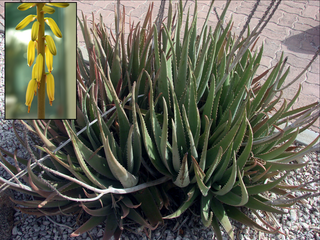
Aloe vera is a succulent plant species of the genus Aloe. It is widely distributed, and is considered an invasive species in many world regions.
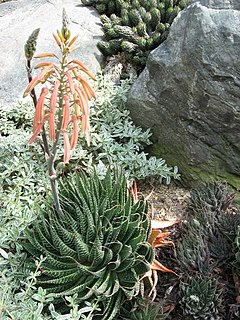
Aristaloe is a genus of evergreen flowering perennial plants in the family Asphodelaceae from Southern Africa. Its sole species is Aristaloe aristata, known as guinea-fowl aloe or lace aloe.

Gonialoe variegata, also known as tiger aloe and partridge-breasted aloe, is a species of flowering plant in the family Asphodelaceae. It is an evergreen succulent perennial indigenous to South Africa and Namibia. It is common in cultivation.

Bursera is a genus with about 100 described species of flowering shrubs and trees varying in size up to 25 m (82 ft) high. It is the type genus for Burseraceae. The trees are native to the Americas, from the southern United States south through to northern Argentina, in tropical and warm temperate forest habitats. It is named after the 17th-century Danish botanist Joachim Burser.

Aloidendron barberae, formerly Aloe bainesii and Aloe barberae, also known as the tree aloe, is a species of succulent plant in the genus Aloidendron. It is native to South Africa northwards to Mozambique. In its native climes this slow-growing tree can reach up to 60 feet (18 m) high and 36 inches (0.91 m) in stem diameter. Aloidendron barberae is Africa's largest aloe-like plant. The tree aloe is often used as an ornamental plant. Its tubular flowers are rose pink (green-tipped); it flowers in winter and in its natural environment is pollinated by sunbirds.

Gonialoe dinteri, the Namibian partridge aloe, is a species of flowering plant in the Asphodelaceae family. It is native to arid areas of Angola and Namibia.

Aloin, also known as barbaloin, is a bitter, yellow-brown colored compound noted in the exudate of at least 68 Aloe species at levels from 0.1 to 6.6% of leaf dry weight, and in another 17 species at indeterminate levels [Reynolds, 1995b]. It is used as a stimulant-laxative, treating constipation by inducing bowel movements. The compound is present in what is commonly referred to as the aloe latex that exudes from cells adjacent to the vascular bundles, found under the rind of the leaf and in between it and the gel. When dried, it has been used as a bittering agent in commerce [21 CFR 172.510. Scientific names given include Aloe perryi, A. barbadensis, A. ferox, and hybrids of A. ferox with A. africana and A. spicata.]. Aloe is listed in federal regulations as a natural substance that may be "safely used in food" when used "in the minimum quantity required to produce their intended physical or technical effect and in accordance with all the principles of good manufacturing practice." This food application is generally limited to use in quite small quantities as a flavoring in alcoholic beverages and may usually be identified only as a "natural flavor."
A. vulgaris may refer to:

Agave is a genus of monocots native to the hot and arid regions of the Americas, although some Agave species are also native to tropical areas of South America. The genus is primarily known for its succulent and xerophytic species that typically form large rosettes of strong, fleshy leaves. Agave now includes species formerly placed in a number of other genera, such as Manfreda, ×Mangave, Polianthes and Prochnyanthes.
Herring gull is a common name for several birds in the genus Larus, all formerly treated as a single species.

Kumara plicatilis, formerly Aloe plicatilis, the fan-aloe, is a succulent plant endemic to a few mountains in the Fynbos ecoregion, of the Western Cape in South Africa. The plant has an unusual and striking fan-like arrangement of its leaves. It may grow as a large multistemmed shrub or as a small tree. It is one of the two species in the genus Kumara.

Aloiampelos striatula, formerly Aloe striatula, the hardy aloe or striped-stemmed aloe, is a sturdy succulent plant that naturally occurs on the summits of mountains along the south of the Karoo region of South Africa. Tough and hardy, with bright yellow flowers, it is also cultivated as a garden ornamental.

Tulista is a small genus of succulent plants endemic to South Africa. They were formerly included within the genus Haworthia.

Gonialoe is a small genus of three succulent plant species, indigenous to South Africa, Namibia and Angola. They were formerly included within the related genus Aloe. The three species are Gonialoe variegata, Gonialoe sladeniana, Gonialoe dinteri.

Aloeae is a tribe of succulent plants in the subfamily Asphodeloideae of the family Asphodelaceae, consisting of the aloes and their close relatives. The taxon may also be treated as the subfamily Alooideae by those botanists who retain the narrower circumscription of Asphodelaceae adopted prior to the APG III system. Typically, plants have rosettes of more or less succulent leaves, with or without a distinct stem. Their flowers are arranged in racemes and tend to be either small and pale, pollinated by insects, or larger and more brightly coloured, pollinated by birds. As of 2017, 11 genera are recognized, most created since 2010 by splitting off another five genera from Aloe and another two from Haworthia. Only two genera, Aloe and Aloidendron, are native outside southern Africa, extending northwards to the Arabian Peninsula. Seven genera are restricted to South Africa, some with small ranges. Members of the Aloeae are cultivated by succulent plant enthusiasts; Aloe species especially are used in temperate climates as ornamental garden plants. Some species are used in traditional medicine. Aloe vera and Aloe ferox are cultivated for their extracts, whose uses include moisturizers and emollients in cosmetics.
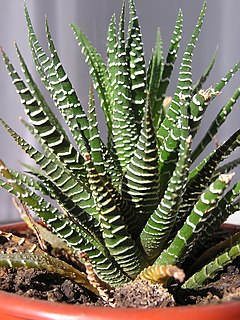
Haworthiopsis is a genus of succulent plants in the subfamily Asphodeloideae. The genus was previously included in Haworthia. Species in the genus are typically short perennial plants, with leaves often arranged in a rosette and frequently having raised white markings. The two-lipped flowers are borne on a tall stalk and are small – less than 17 mm (0.7 in) long – and pale in colour. Many species are cultivated as house plants or by succulent enthusiasts.
× Gonimara is a genus of hybrid plants, from a mixture of species from the Gonialoe and Kumara genera. Only a single hybrid is recorded for this mixture however, × Gonimaracorderoyi, an unusual and reputedly very attractive aloe hybrid, recorded as being produced by pollination between Gonialoe variegata and Kumara plicatilis.

