
Aloe, also written Aloë, is a genus containing over 550 species of flowering succulent plants. The most widely known species is Aloe vera, or "true aloe". It is called this because it is cultivated as the standard source for assorted pharmaceutical purposes. Other species, such as Aloe ferox, are also cultivated or harvested from the wild for similar applications.

Asphodeloideae is a subfamily of the monocot family Asphodelaceae in the order Asparagales. It has previously been treated as a separate family, Asphodelaceae sensu stricto. The family Asphodelaceae has now been proposed to be a nomen conservandum, and the proposal has been recommended for ratification in 2017. In that case, Asphodelaceae will have priority over Xanthorrhoeaceae. This is reflected in the APG IV family lists.
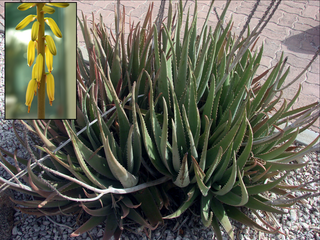
Aloe vera is a succulent plant species of the genus Aloe. An evergreen perennial, it originates from the Arabian Peninsula, but grows wild in tropical, semi-tropical, and arid climates around the world. It is cultivated for agricultural and medicinal uses. The species is also used for decorative purposes and grows successfully indoors as a potted plant.
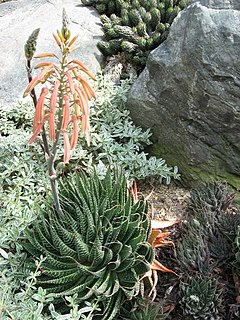
Aristaloe is a genus of evergreen flowering perennial plants in the family Asphodelaceae from Southern Africa. Its sole species is Aristaloe aristata, known as guinea-fowl aloe or lace aloe.

Gonialoe variegata, also known as tiger aloe and partridge-breasted aloe, is a species of flowering plant in the family Asphodelaceae. It is an evergreen succulent perennial indigenous to South Africa and Namibia. It is common in cultivation.

Aloe arborescens, the krantz aloe or candelabra aloe, is a species of flowering succulent perennial plant that belongs to the genus Aloe, which it shares with the well known and studied Aloe vera. The specific epithet arborescens means "tree-like". Aloe arborescens is valued by gardeners for its succulent green leaves, large vibrantly-colored flowers, winter blooming, and attraction for birds, bees, and butterflies.

Aloidendron barberae, formerly Aloe bainesii and Aloe barberae, also known as the tree aloe, is a species of succulent plant in the genus Aloidendron. It is native to South Africa northwards to Mozambique. In its native climes this slow-growing tree can reach up to 60 feet (18 m) high and 36 inches (0.91 m) in stem diameter. Aloidendron barberae is Africa's largest aloe-like plant. The tree aloe is often used as an ornamental plant. Its tubular flowers are rose pink (green-tipped); it flowers in winter and in its natural environment is pollinated by sunbirds.

Aloe succotrina, the Fynbos aloe, is an aloe which is endemic to Cape Town and the south-western corner of the Western Cape, South Africa.

Aloe polyphylla, the spiral aloe, kroonaalwyn, lekhala kharetsa, or many-leaved aloe, is a species of flowering plant in the genus Aloe that is endemic to the Kingdom of Lesotho in the Drakensberg mountains. An evergreen succulent perennial, it is well known for its strikingly symmetrical, five-pointed spiral growth habit.

Aloe erinacea is a rare species of succulent plant in the genus Aloe, from arid areas of Namibia.

Aloe emodin is an anthraquinone and a variety of emodin present in aloe latex, an exudate from the aloe plant. It has a strong stimulant-laxative action. Aloe emodin is not carcinogenic when applied to the skin, although it may increase the carcinogenicity of some kind of radiation.

Aloe maculata is a Southern African species of aloe. Local people in South Africa know it informally as the "Bontaalwyn" in Afrikaans, or "Lekhala" in the Sesotho language.

Aloe striata, with the common name coral aloe, is a small, stemless South African Aloe species.

Aloe ferox, commonly known as bitter aloe, is a species of flowering plant in the family Asphodelaceae. This woody aloe is indigenous to southern Africa. It is one of several Aloe species used to make bitter aloes, a purgative medication, and also yields a non-bitter gel that can be used in cosmetics.

Kumara plicatilis, formerly Aloe plicatilis, the fan-aloe, is a succulent plant endemic to a few mountains in the Fynbos ecoregion, of the Western Cape in South Africa. The plant has an unusual and striking fan-like arrangement of its leaves. It may grow as a large multistemmed shrub or as a small tree. It is one of the two species in the genus Kumara.

Aloe perfoliata, the rubble aloe or mitre aloe, is a hardy creeping aloe, found in rocky, mountainous areas throughout the Western Cape, South Africa.

Aloe broomii, known as the mountain aloe or snake aloe on account of its odd inflorescence, is a species of flowering plant in the genus Aloe, found in southern Africa.

Aloe petricola belongs to the genus Aloe in the family Asphodelaceae, and is commonly known as a stone aloe. This particular aloe is a flowering species with unique and distinct inflorescences, which make the plant easy to identify and distinguish from other Aloe plants. Aloe petricola is very popular for gardening because of its beautiful and radiant colors. Like many Aloe species, Aloe petricola is used for medical purposes, as it aids in healing wounds and minor burns.
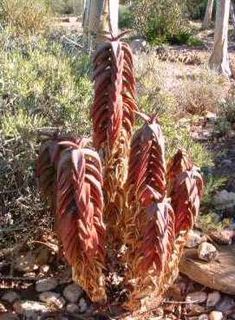
Aloe pearsonii is a very distinctive and unusual species of aloe, that is naturally endemic to the arid Richtersveld area on the border between South Africa and Namibia.

Aloeae is a tribe of succulent plants in the subfamily Asphodeloideae of the family Asphodelaceae, consisting of the aloes and their close relatives. The taxon may also be treated as the subfamily Alooideae by those botanists who retain the narrower circumscription of Asphodelaceae adopted prior to the APG III system. Typically, plants have rosettes of more or less succulent leaves, with or without a distinct stem. Their flowers are arranged in racemes and tend to be either small and pale, pollinated by insects, or larger and more brightly coloured, pollinated by birds. As of 2017, 11 genera are recognized, most created since 2010 by splitting off another five genera from Aloe and another two from Haworthia. Only two genera, Aloe and Aloidendron, are native outside southern Africa, extending northwards to the Arabian Peninsula. Seven genera are restricted to South Africa, some with small ranges. Members of the Aloeae are cultivated by succulent plant enthusiasts; Aloe species especially are used in temperate climates as ornamental garden plants. Some species are used in traditional medicine. Aloe vera and Aloe ferox are cultivated for their extracts, whose uses include moisturizers and emollients in cosmetics.

