Related Research Articles

Mahbubul Haque Khan, known as Azam Khan, was a Bangladeshi singer-songwriter, record producer, and lead singer for the pop-rock band Uccharon. He was also a freedom fighter who took part in the Liberation War of Bangladesh in 1971. He is considered to be one of the greatest artists in the history of Bangladeshi folk music and a founding figure of Bangla rock.
Lt. Col. Abu Taher BU was a Bangladeshi military officer and war hero. He first served in the Pakistan Army, and later defected to the Bangladesh Army during the Bangladesh Liberation War. He crossed into India around early August and reported to the Indian authorities. After a week screening at Dehradun, India, Taher reported to Kolkata, Bangladesh Provincial government at 8 Theatre Rd. He was ordered to report to Sector 11 of Mukti Bahini under command of Major Ziaur Rahman, he became the sector commander after him. He served in BDF from end of August to 2 November 1971. He was awarded the medal Bir Uttom for his gallantry in the liberation war. He was released from military service by Indian military medical board in Pune, India after his leg was amputated. After independence, he was inducted into the Bangladesh Army for administrative retirement with legacy rank of lieutenant colonel. After settling in with family, the government of Bangladesh appointed him with employment at Kumilla. Later Taher turned into a political activist and leader of the left-wing Jatiyo Samajtantrik Dal.

Abul Fateh was a Bangladeshi diplomat, statesman and Sufi who was one of the founding fathers of South Asian diplomacy after the Second World War, having been the founder and inaugural Director of Pakistan's Foreign Service Academy and subsequently becoming Bangladesh's first Foreign Secretary when it gained its independence in 1971. He was Bangladesh's senior-most diplomat both during the 'Liberation War' period of its Mujibnagar administration as well as in peacetime.

Chief of Army Staff (CAS) of Bangladesh Army, also known as Army Chief, is the commander of the Bangladesh Army. The Chief of Army staff has been a four-star rank since 2007. Prior to that, the Chief of Army Staff was a three-star rank from 1978 to 2007. During the liberation war of Bangladesh in 1971, Maj. Gen. M. A. Rab was the Chief of Staff of the Bangladesh Army under the combined command of Bangladesh Forces which served as the origins of Bangladesh Armed Forces and General M. A. G. Osmani was the Commander-in-Chief. After the War of Independence, Bangladesh Army was officially reverted to the Ministry of Defense in 1972, and Maj. Gen. K. M. Shafiullah was appointed the Chief of Army Staff. The incumbent Chief of Army Staff is General Waker-Uz-Zaman.

Ekushey Padak is the second highest civilian award in Bangladesh, introduced in memory of the martyrs of the Bengali Language Movement of 1952. The award is given to recognize contributions in a number of fields, including culture, education, and economics. The Ministry of Cultural Affairs administers the award.
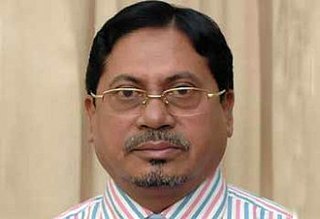
Muhammad Kamaruzzaman was a Bangladeshi politician and journalist who served as the senior assistant secretary general of Bangladesh Jamaat-e-Islami and was convicted of war crimes during the 1971 independence war of Bangladesh. He was executed by hanging at Dhaka Central Jail at 22:01 on 11 April 2015.
Ferdousi Mazumder is a Bangladeshi film, television and stage actress. She was awarded Ekushey Padak (1998), Independence Day Award (2020) and Bangla Academy Literary Award (2020) by the government of Bangladesh. As of 2009, on stage she has given over 1200 performances of about 35 plays, mostly for her own group, Theatre. Director Abdullah Al Mamun called her "one of the most sought after actresses of the golden era of BTV dramas".

Jagannath University (JnU) is a public university located in Sadarghat, Dhaka, the capital of Bangladesh. Founded as Dhaka Brahma School in 1858 and renamed Jagannath School in 1872, the institution was taken over by the Pakistani government in 1968, while Bangladesh was still a part of Pakistan. It opened graduate and post-graduate programmes in 1975 and was approved as a full public university in 2005.
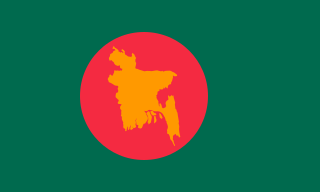
Independence and National Day is celebrated on 26 March as a national holiday in Bangladesh. It commemorates the country's declaration of independence from Pakistan in the early hours of 26 March 1971.

Bangladesh and Pakistan are both South Asian Muslim-majority countries. Following the end of British rule in India, the two countries formed a single state for 24 years. The Bangladesh Liberation War in 1971 resulted in the secession of East Pakistan as the People's Republic of Bangladesh. Pakistan recognized Bangladesh in 1974. Today, bilateral relations between Bangladesh and Pakistan are considered to be cordial.

The 7th March Speech of Bangabandhu, or the 7/3 Speech, was a public speech given by Sheikh Mujibur Rahman, the founding leader of Bangladesh on 7 March 1971 at the Ramna Race Course in Dhaka to a gathering of over one million (1,000,000) people. It was delivered during a period of escalating tensions between East Pakistan and the powerful political and military establishment of West Pakistan. In the speech, Bangabandhu informally declared the independence of Bangladesh, proclaiming: "The struggle this time, is a struggle for our liberty. The struggle this time, is a struggle for our independence." He announced a civil disobedience movement in the province, calling for "every house to turn into a fortress".

Kazi Nuruzzaman Bir Uttom was a Bangladeshi war hero and secular nationalist, who served as one of the principal commanders of the Mukti Bahini during the Bangladesh Liberation War. He also rejected Bir Uttam award as a tribute to all the unknown, unrecognized martyrs of the war.

A. K. M. Abdur Rouf was the founder-curator of the Bangladesh Film Archive (BFA). He was awarded Ekushey Padak in 2010 for his contribution to arts and Independence Day Award in 2016 in recognition of his outstanding contributions to the nation by the government of Bangladesh.
K.M. Shehabuddin was the first Bangladeshi diplomat, and is known for defecting from the Pakistani Foreign Service before the formation of the Mujibnagar government.
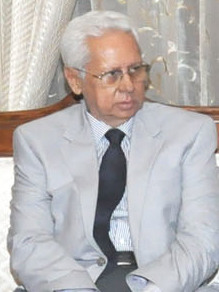
Syed Muazzem Ali was a Bangladeshi foreign service officer and career diplomat. In 2020, he was posthumously conferred the Padma Bhushan award, the third-highest civilian honour of India. In 2022, he was awarded the Ekushey Padak, the second most important award for civilians in Bangladesh.
AKM Samsul Haque Khan was Bengali-Pakistani civil servant who was killed in the Bangladesh Liberation war and is considered a martyr in Bangladesh. He was awarded the Independence Day Award, the highest civilian award in Bangladesh, in 2010.
Md Mozammel Haque Khan is the former senior secretary and the former commissioner of the Anti-Corruption Commission. He is president of both the Bangladesh Scouts and the Bangladesh Karate Federation.
Munsi Kabir Uddin Ahmed was the superintendent of police of Comilla District who was killed in the Bangladesh Liberation War. He was killed for refusing to give the Pakistan Army based in Comilla Cantonment the police armory. He was posthumously awarded the Independence Day Award, the highest civilian award, in 2014.
Mohammad Shamsul Haque was a Bengali police officer who was killed in the Bangladesh Liberation War in Chittagong by the Pakistan military. He was the superintendent of Police of Chittagong District in 1971. He was posthumously awarded the Independence Award, the highest civilian award in Bangladesh, in 2013.
References
- ↑ "Asaduzzaman Noor and Shykh Seraj to receive Independence Day Awards". bdnews24.com. Retrieved 2024-02-18.
- ↑ Shehabuddin, Sarah. "Remembering Bangladesh's First Diplomat". bdnews24.com. Retrieved 2024-02-18.
- 1 2 "Defected diplomats of 1971 to be remembered in golden letters". Dhaka Tribune . 18 April 2022. Retrieved 17 February 2024.
- ↑ Khan, Mozammel H. (2015-04-17). "Portrait of a patriot". The Daily Star. Retrieved 2024-02-18.
- ↑ Khan, Mozammel H. (2018-03-26). "Why should a hero remain unsung?". The Daily Star. Retrieved 2024-02-18.
- ↑ "18 receive Swadhinata Padak". Prothomalo. 2018-03-25. Retrieved 2024-02-18.