
Tamar the Great reigned as the Queen of Georgia from 1184 to 1213, presiding over the apex of the Georgian Golden Age. A member of the Bagrationi dynasty, her position as the first woman to rule Georgia in her own right was emphasized by the title mepe ("king"), afforded to Tamar in the medieval Georgian sources.

The Book of Kells is an illuminated manuscript and Celtic Gospel book in Latin, containing the four Gospels of the New Testament together with various prefatory texts and tables. It was created in a Columban monastery in either Ireland or Scotland, and may have had contributions from various Columban institutions from each of these areas. It is believed to have been created c. 800 AD. The text of the Gospels is largely drawn from the Vulgate, although it also includes several passages drawn from the earlier versions of the Bible known as the Vetus Latina. It is regarded as a masterwork of Western calligraphy and the pinnacle of Insular illumination. The manuscript takes its name from the Abbey of Kells, County Meath, which was its home for centuries.

Textus Receptus refers to the succession of printed editions of the Greek New Testament, including Erasmus' Novum Instrumentum omne (1516), the printed editions of Stephanus, Beza, Elzevir and Scrivener among some others.

The flag of Georgia, also known as the five-cross flag, is one of the national symbols of Georgia. Originally a banner of the medieval Kingdom of Georgia, it was repopularised in the late 20th and early 21st centuries during the Georgian national revival.
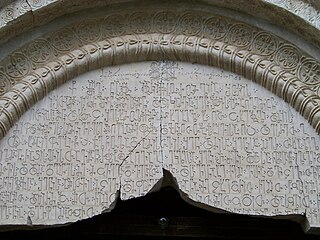
The Georgian scripts are the three writing systems used to write the Georgian language: Asomtavruli, Nuskhuri and Mkhedruli. Although the systems differ in appearance, their letters share the same names and alphabetical order and are written horizontally from left to right. Of the three scripts, Mkhedruli, once the civilian royal script of the Kingdom of Georgia and mostly used for the royal charters, is now the standard script for modern Georgian and its related Kartvelian languages, whereas Asomtavruli and Nuskhuri are used only by the Georgian Orthodox Church, in ceremonial religious texts and iconography.
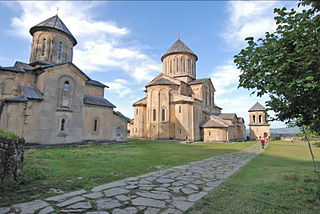
Gelati is a medieval monastic complex near Kutaisi in the Imereti region of western Georgia. One of the first monasteries in Georgia, it was founded in 1106 by King David IV of Georgia as a monastic and educational center.

The Vani Gospels is an illuminated manuscript of the Four Gospels in the Georgian nuskhuri script dating from the end of the 12th–early 13th centuries. The manuscript was composed at the queen Tamar of Georgia's request by the Georgian monk John the Unworthy at the Rhomana Monastery at Constantinople. It was later brought to Georgia and kept first at the Shorata Monastery (Meskheti), then in Vani and eventually at the Gelati Monastery at Kutaisi.

The Anchiskhati Basilica of St Mary is the oldest surviving church in Tbilisi, Georgia. It belongs to the Georgian Orthodox Church and dates from the sixth century.

The Kingdom of Georgia, also known as the Georgian Empire, was a medieval Eurasian monarchy that was founded in c. 1008 AD. It reached its Golden Age of political and economic strength during the reign of King David IV and King Tamar the Great from the 11th to 13th centuries. Georgia became one of the pre-eminent nations of the Christian East, and its pan-Caucasian empire and network of tributaries stretched from Eastern Europe to Anatolia and northern frontiers of Iran, while Georgia also maintained religious possessions abroad, such as the Monastery of the Cross in Jerusalem and the Monastery of Iviron in Greece. It is the principal historical precursor of present-day Georgia.

The Zakarid dynasty, also Zakarids or Zakarians were a noble dynasty, rulers of Zakarid Armenia (1201–1350) under the suzerainty of the Kingdom of Georgia, and from 1256 under the control of the Mongol Ilkhanate of Persia. Their dynastic name was formed in honour of Zakare, the famous servant of the Georgian King Tamar. They were also known by their Georgian nickname Mkhargrdzeli. A family legend says that this name was a reference to their Achaemenid ancestor Artaxerxes II the "Longarmed". According to Cyril Toumanoff / Encyclopædia Iranica, they were an offshoot of the Armenian Pahlavuni family. The Zakarians considered themselves Armenians.
The Georgian National Centre of Manuscripts, located in Tbilisi, Georgia, is a repository of ancient manuscripts, of historical documents and of the private archives of eminent public figures. The centre was established on 30 June 1958 on the basis of the collection in the Department of Manuscripts at the Georgian National Museum. The founder and the first director of the Institute was Professor Ilia Abuladze, a Corresponding Member of the Georgian Academy of Sciences. The collection of the National Centre of Manuscripts comprises manuscripts, historical documents, early printed books, rare publications and heirlooms. The Centre carries out various projects related to scientific research, exhibitions and restoration. Specialists working at and with the Centre engage in the description, systematization, study and publication of the material housed at the Centre, as well as in the production of data bases dealing with this material. The Centre also has rich academic library and includes rooms dedicated in memory of Korneli Kekelidze, Ivane Javakhishvili, Ilia Abuladze, Niko Berdzenishvili, Elene Metreveli and Shalva Amiranashvili.
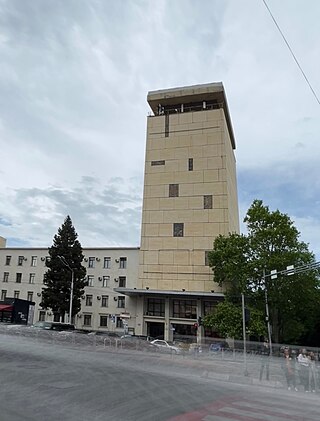
The National Archives of Georgia is the legal entity of public law under the Ministry of Justice of the nation of Georgia. The National Archives holds written documents, film documents, photos, and audio records, with a collection totaling more than five million items. The documents in the Archives are official, and their preservation has been established by law. Some of the preserved documents include texts from the First Republic, scientific archives, the parish books that hold information about the christening and the death of citizens, the gospel of the 9th century, Anchi gospel, Kings' deeds, private letters, verdicts, other legal monuments, photos from the 19th century, first film documents, and the documents of different state or private structures.

The Garima Gospels are three ancient Ethiopic manuscripts containing all four canonical Gospel Books, as well as some supplementary material like lists of Gospel chapters. Garima 2, the earliest, is believed to be the earliest surviving complete illuminated Christian manuscript. Monastic tradition holds that the first two were composed close to the year 500, a date supported by recent radiocarbon analysis; samples from Garima 2 proposed a date of c. 390–570, while counterpart dating of samples from Garima 1 proposed a date of c. 530–660. The third manuscript is thought to date to a later period. The artwork in the manuscripts of the Garima Gospels also demonstrates their affinity to Christian artwork in late antique Coptic Egypt, Nubia, and Himyar (Yemen).

The Ancha Icon of the Savior, known in Georgia as Anchiskhati, is a medieval Georgian encaustic icon, traditionally considered to be the Keramidion, a "holy tile" imprinted with the face of Jesus Christ miraculously transferred by contact with the Image of Edessa (Mandylion). Dated to the 6th-7th century, it was covered with a chased silver riza and partly repainted in the following centuries. The icon derives its name from the Georgian monastery of Ancha in what is now Turkey, whence it was brought to Tbilisi in 1664. The icon is now kept at the National Art Museum of Georgia in Tbilisi.

The Bishopric of Ancha was one of the principal territorial jurisdictions of the medieval Georgian Orthodox Church in the province of Klarjeti, with its cathedral church at Ancha. It came in existence between the 7th and 9th centuries and had disappeared by the middle of the 17th century after the Ottoman conquest of the area. The bishopric was a vibrant center of Georgian Christian culture and played a role in the regional politics. The cathedral of Ancha housed a celebrated gilded icon of the Savior, which was transferred, in 1664, to the Georgian capital of Tbilisi, in a church henceforth known as Anchiskhati, "the icon of Ancha".
The Surameli were a noble family in the medieval Kingdom of Georgia, with notable members from the 12th century to the 14th. At the height of their influence and prestige in the 13th century, the Surameli were hereditary eristavi ("duke") of Kartli and msakhurt-ukhutsesi of Georgia.
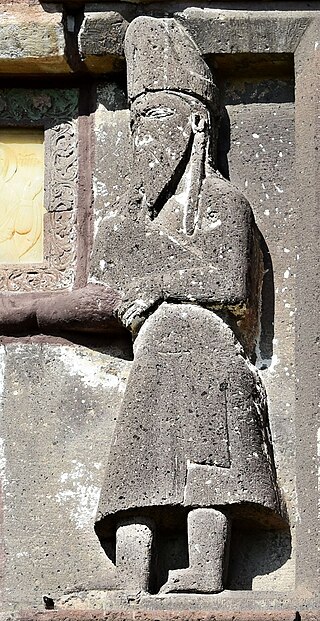
Zakare II Zakarian or Zakaria II Mkhargrdzeli, was an Armenian prince and a Court official of the Kingdom of Georgia holding the office of amirspasalar (Commander-in-Chief) of the Georgian army for Queen Tamar of Georgia, during the late 12th and early 13th centuries. He was a member of the Zakarid dynasty, and ruler of feudal lands in the Kingdom of Georgia.
The Jruchi monastery of Saint George is a ruined Georgian Orthodox monastic church in the western Georgian region of Imereti. Founded in the 10th or 11th century, it was remodeled and rebuilt several times until it acquired its final architectural style by 1846. The church was almost completely destroyed in the 1991 Racha earthquake, only a portion of its wall remaining standing amid a rubble. The monastery is inscribed on the list of the Immovable Cultural Monuments of National Significance of Georgia.

Paul's epistles are Paul the Apostle's letters, which are among the most important parts of New Testament. In those letters are told old Christian dogmas, which preceded the development of the religion. The first versions of The epistles are preserved in the form of manuscripts. They are created between X-XIV centuries in various churches and monasteries. Under those circumstances, they differ from each other both sides in content (structural) and morphological-orthographic. As soon as the state symbols were formed in Georgia, the country chose the European path, striving for its values. In the second and third centuries, Christianity evolved in Europe, which changed their political life as well. Therefore, for Georgia, Christianity was not only a precondition for religion but also for political stability.

The Alaverdi Gospels is a Georgian gospel manuscript copied in the Georgian monastery of Black Mountain Kalipos in 1054 by the calligraphers Giorgi and John Dvali. It is the only Georgian manuscript to contain a mandylion, an impression of the face of the Savior on a shroud. The cover, composed of leather and metal, is adorned with a painted icon of Jesus Christ. This icon was subsequently set into a silver-chased frame embellished with precious stones and cloisonné enamel images of St. George, crafted in the 11th-12th century AD. Holy objects were traditionally stored in the sockets on the cover. The cover itself dates back to the late Middle Ages.
