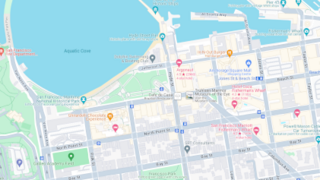
Google Maps is a web mapping platform and consumer application offered by Google. It offers satellite imagery, aerial photography, street maps, 360° interactive panoramic views of streets, real-time traffic conditions, and route planning for traveling by foot, car, bike, air and public transportation. As of 2020, Google Maps was being used by over one billion people every month around the world.

Motorola Mobility LLC, marketed as Motorola, is an American consumer electronics manufacturer primarily producing smartphones and other mobile devices running Android. Headquartered at Merchandise Mart in Chicago, Illinois, it is a subsidiary of the Chinese technology company Lenovo.

Android 13 is the thirteenth major release and the 20th version of Android, the mobile operating system developed by the Open Handset Alliance led by Google. It was released to the public and the Android Open Source Project (AOSP) on August 15, 2022. The first devices to ship with Android 13 were the Pixel 7 and 7 Pro.
Android is a mobile operating system based on a modified version of the Linux kernel and other open-source software, designed primarily for touchscreen mobile devices such as smartphones and tablets. Android has historically been developed by a consortium of developers known as the Open Handset Alliance, but its most widely used version is primarily developed by Google. It was unveiled in November 2007, with the first commercial Android device, the HTC Dream, being launched in September 2008.
Dalvik is a discontinued process virtual machine (VM) in the Android operating system that executes applications written for Android. Dalvik was an integral part of the Android software stack in the Android versions 4.4 "KitKat" and earlier, which were commonly used on mobile devices such as mobile phones and tablet computers, and more in some devices such as smart TVs and wearables. Dalvik is open-source software, originally written by Dan Bornstein, who named it after the fishing village of Dalvík in Eyjafjörður, Iceland.
Google I/O, or simply I/O, is an annual developer conference held by Google in Mountain View, California. The name "I/O" is taken from the number googol, with the "I" representing the first digit "1" in a googol and the "O" representing the second digit "0" in the number. The format of the event is similar to Google Developer Day.
Cherrypal was a California-based marketer of Chinese-manufactured consumer-oriented computers. It marketed a range of models with a diversity of CPU-types, structures, features, and operating systems. In 2018, Cherrypal let their domain name registration lapse, indicating that the company is no longer in business.
The Android Package with the file extension apk is the file format used by the Android operating system, and a number of other Android-based operating systems for distribution and installation of mobile apps, mobile games and middleware. A file using this format can be built from source code written in either Java or Kotlin.
Droid or DROID may refer to:
The version history of the Android mobile operating system began with the public release of its first beta on November 5, 2007. The first commercial version, Android 1.0, was released on September 23, 2008.
The operating system is developed by Google on a yearly cadence since at least 2011. New major releases are announced at Google I/O in May while still in beta testing with the stable version usually released to the public between August and October.

Android software development is the process by which applications are created for devices running the Android operating system. Google states that "Android apps can be written using Kotlin, Java, and C++ languages" using the Android software development kit (SDK), while using other languages is also possible. All non-Java virtual machine (JVM) languages, such as Go, JavaScript, C, C++ or assembly, need the help of JVM language code, that may be supplied by tools, likely with restricted API support. Some programming languages and tools allow cross-platform app support. Third party tools, development environments, and language support have also continued to evolve and expand since the initial SDK was released in 2008. The official Android app distribution mechanism to end users is Google Play; it also allows staged gradual app release, as well as distribution of pre-release app versions to testers.
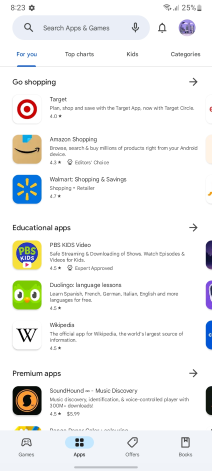
Google Play, also known as the Google Play Store or Play Store and formerly known as Android Market, is a digital distribution service operated and it's developed by Google. It serves as the official app store for certified devices running on the Android operating system and its derivatives, as well as ChromeOS, allowing users to browse and download applications developed with the Android software development kit and published through Google. Google Play has also served as a digital media store, offering games, music, books, movies, and television programs. Content that has been purchased on Google Play Movies & TV and Google Play Books can be accessed on a web browser and through the Android and iOS apps.
Nexus 7 is a series of Android-based mini tablet computers co-developed by Google, and may refer to:
Kotlin is a cross-platform, statically typed, general-purpose high-level programming language with type inference. Kotlin is designed to interoperate fully with Java, and the JVM version of Kotlin's standard library depends on the Java Class Library, but type inference allows its syntax to be more concise. Kotlin mainly targets the JVM, but also compiles to JavaScript or native code via LLVM. Language development costs are borne by JetBrains, while the Kotlin Foundation protects the Kotlin trademark.

Android Auto is a mobile app developed by Google to mirror features of a smartphone on a car's dashboard information and entertainment head unit.
Asus Transformer is a series of 2-in-1 convertibles, detachables and hybrid tablet computers, designed and manufactured by Asus, consisting of three major lineups.

Human Mobile Devices (HMD), formally HMD Global, is a Finnish mobile phone manufacturer. The company is made up of the mobile phone business that the Nokia Corporation sold to Microsoft in 2014, then bought back in 2016. HMD began marketing Nokia-branded smartphones and feature phones on 1 December 2016. The company has exclusive rights to the Nokia brand for mobile phones through a licensing agreement. The HMD brand was initially only used for corporate purposes and does not appear in advertising, whereas the name "Nokia Mobile" is used on social media. As it was launched, the abbreviation HMD stood for Hon Hai Mobile Devices. This was in reference to the main shareholder at the time of its creation: the Taiwanese group Foxconn. In January 2024, HMD rebranded to 'Human Mobile Devices', and will use their own branding on future devices alongside that of Nokia.
