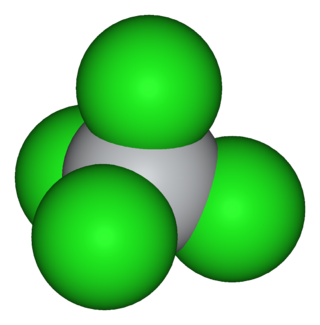
Titanium tetrachloride is the inorganic compound with the formula TiCl4. It is an important intermediate in the production of titanium metal and the pigment titanium dioxide. TiCl4 is a volatile liquid. Upon contact with humid air, it forms thick clouds of titanium dioxide and hydrochloric acid, a reaction that was formerly exploited for use in smoke machines. It is sometimes referred to as "tickle" or "tickle 4", as a phonetic representation of the symbols of its molecular formula.
In chemistry, a nitride is a chemical compound of nitrogen. Nitrides can be inorganic or organic, ionic or covalent. The nitride anion, N3- ion, is very elusive but compounds of nitride are numerous, although rarely naturally occurring. Some nitrides have a found applications, such as wear-resistant coatings (e.g., titanium nitride, TiN), hard ceramic materials (e.g., silicon nitride, Si3N4), and semiconductors (e.g., gallium nitride, GaN). The development of GaN-based light emitting diodes was recognized by the 2014 Nobel Prize in Physics. Metal nitrido complexes are also common.
In materials science, the sol–gel process is a method for producing solid materials from small molecules. The method is used for the fabrication of metal oxides, especially the oxides of silicon (Si) and titanium (Ti). The process involves conversion of monomers in solution into a colloidal solution (sol) that acts as the precursor for an integrated network of either discrete particles or network polymers. Typical precursors are metal alkoxides. Sol–gel process is used to produce ceramic nanoparticles.

In chemistry, melon is a compound of carbon, nitrogen, and hydrogen of still somewhat uncertain composition, consisting mostly of heptazine units linked and closed by amine groups and bridges. It is a pale yellow solid, insoluble in most solvents.
A non-carbon nanotube is a cylindrical molecule often composed of metal oxides, or group III-Nitrides and morphologically similar to a carbon nanotube. Non-carbon nanotubes have been observed to occur naturally in some mineral deposits.
Nanomaterial-based catalysts are usually heterogeneous catalysts broken up into metal nanoparticles in order to enhance the catalytic process. Metal nanoparticles have high surface area, which can increase catalytic activity. Nanoparticle catalysts can be easily separated and recycled. They are typically used under mild conditions to prevent decomposition of the nanoparticles.
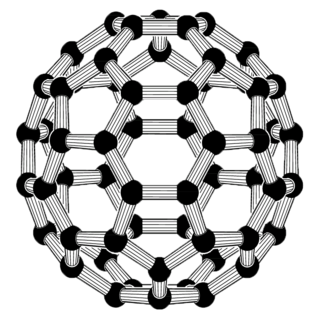
Nanocomposite is a multiphase solid material where one of the phases has one, two or three dimensions of less than 100 nanometers (nm) or structures having nano-scale repeat distances between the different phases that make up the material.
Nanoporous materials consist of a regular organic or inorganic bulk phase in which a porous structure is present. Nanoporous materials exhibit pore diameters that are most appropriately quantified using units of nanometers. The diameter of pores in nanoporous materials is thus typically 100 nanometers or smaller. Pores may be open or closed, and pore connectivity and void fraction vary considerably, as with other porous materials. Open pores are pores that connect to the surface of the material whereas closed pores are pockets of void space within a bulk material. Open pores are useful for molecular separation techniques, adsorption, and catalysis studies. Closed pores are mainly used in thermal insulators and for structural applications.
As the world's energy demand continues to grow, the development of more efficient and sustainable technologies for generating and storing energy is becoming increasingly important. According to Dr. Wade Adams from Rice University, energy will be the most pressing problem facing humanity in the next 50 years and nanotechnology has potential to solve this issue. Nanotechnology, a relatively new field of science and engineering, has shown promise to have a significant impact on the energy industry. Nanotechnology is defined as any technology that contains particles with one dimension under 100 nanometers in length. For scale, a single virus particle is about 100 nanometers wide.
The Stöber process is a chemical process used to prepare silica particles of controllable and uniform size for applications in materials science. It was pioneering when it was reported by Werner Stöber and his team in 1968, and remains today the most widely used wet chemistry synthetic approach to silica nanoparticles. It is an example of a sol-gel process wherein a molecular precursor is first reacted with water in an alcoholic solution, the resulting molecules then joining together to build larger structures. The reaction produces silica particles with diameters ranging from 50 to 2000 nm, depending on conditions. The process has been actively researched since its discovery, including efforts to understand its kinetics and mechanism – a particle aggregation model was found to be a better fit for the experimental data than the initially hypothesized LaMer model. The newly acquired understanding has enabled researchers to exert a high degree of control over particle size and distribution and to fine-tune the physical properties of the resulting material in order to suit intended applications.
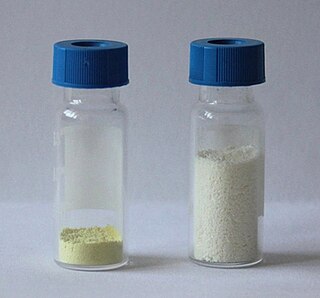
Graphitic carbon nitride (g-C3N4) is a family of carbon nitride compounds with a general formula near to C3N4 (albeit typically with non-zero amounts of hydrogen) and two major substructures based on heptazine and poly(triazine imide) units which, depending on reaction conditions, exhibit different degrees of condensation, properties and reactivities.
Niveen M. Khashab is a Lebanese chemist and an associate Professor of chemical Sciences and engineering at King Abdullah University of Science and Technology in Saudi Arabia since 2009. She is a laureate of the 2017 L'Oréal-UNESCO Awards for Women in Science "for her contributions to innovative smart hybrid materials aimed at drug delivery and for developing new techniques to monitor intracellular antioxidant activity." She is also a fellow of the Royal Chemical Society, and a member of the American Chemical Society.

Yitzhak Mastai is a Chemistry Professor at Bar Ilan University specializing in chirality at the nanoscale and in nanotechnology.

DUT-5 (DUT ⇒ Dresden University of Technology) is a material in the class of metal-organic frameworks (MOFs). Metal-organic frameworks are crystalline materials, in which metals are linked by ligands (linker molecules) to form repeating three-dimensional structures known as coordination entities. The DUT-5 framework is an expanded version of the MIL-53 structure and consists of Al3+ metal centers and biphenyl-4,4'-dicarboxylate (BPDC) linker molecules. It consists of inorganic [M-OH] chains, which are connected by the biphenyl-4,4'-dicarboxylate linkers to four neighboring inorganic chains. The resulting structure contains diamond-shaped micropores extending in one dimension.
Ester H. Segal is an Israeli nanotechnology researcher and professor in the Department of Biotechnology and Food Engineering at the Technion - Israel Institute of Technology, where she heads the Laboratory for Multifunctional Nanomaterials. She is also affiliated with the Russell Berrie Nanotechnology Institute at the Technion - Israel Institute of Technology. Segal is a specialist in porous silicon nanomaterials, as well as nanocomposite materials for active packaging technologies to extend the shelf life of food.
Katharina Landfester is a German chemist who is a professor at the Max Planck Institute for Polymer Research. Her research considers the physical properties of droplets, polymerisation in emulsion and the synthesis of nanoparticles.

Regina Palkovits is a German chemist who is a Professor of Chemistry at the RWTH Aachen University. Her research considers heterogenous catalysis. She was elected a Fellow of the North Rhine-Westphalian Academy of Sciences, Humanities and the Arts in 2020.
Sarah Helen Tolbert is an American chemist who is a professor in the department of chemistry and biochemistry at the University of California, Los Angeles. Her research considers self-assembled nanomaterials, which includes inorganic phases and colloidal materials.
Sahika Inal is a Turkish scientist who is an associate professor and Chair of the Organic Bioelectronics Laboratory at King Abdullah University of Science and Technology. She is interested in the use of organic electronic materials for monitoring health, and the design of biocompatible devices that can interface with the human body. In 2021, she was shortlisted for the Nature Portfolio Scientific Achievement award.
Arne Thomas is a German chemist who researches porous and nanostructured materials for catalytic applications.

