Related Research Articles
A lipogram is a kind of constrained writing or word game consisting of writing paragraphs or longer works in which a particular letter or group of letters is avoided. Extended Ancient Greek texts avoiding the letter sigma are the earliest examples of lipograms.
Oulipo is a loose gathering of (mainly) French-speaking writers and mathematicians who seek to create works using constrained writing techniques. It was founded in 1960 by Raymond Queneau and François Le Lionnais. Other notable members have included novelists Georges Perec and Italo Calvino, poets Oskar Pastior and Jean Lescure, and poet/mathematician Jacques Roubaud.

The Scottish Enlightenment was the period in 18th- and early-19th-century Scotland characterised by an outpouring of intellectual and scientific accomplishments. By the eighteenth century, Scotland had a network of parish schools in the Scottish Lowlands and five universities. The Enlightenment culture was based on close readings of new books, and intense discussions which took place daily at such intellectual gathering places in Edinburgh as The Select Society and, later, The Poker Club, as well as within Scotland's ancient universities.

Russian literature refers to the literature of Russia, its émigrés, and to Russian-language literature. Major contributors to Russian literature, as well as English for instance, are authors of different ethnic origins, including bilingual writers, such as Kyrgyz novelist Chinghiz Aitmatov. At the same time, Russian-language literature does not include works by authors from the Russian Federation who write exclusively or primarily in the native languages of the indigenous non-Russian ethnic groups in Russia, thus the famous Dagestani poet Rasul Gamzatov is omitted.

Angus Lindsay Ritchie Calder was a Scottish writer, historian, and poet. Initially studying English literature, he became increasingly interested in political history and wrote a landmark study on Britain during the Second World War in 1969 entitled The People's War. He subsequently wrote several other historical works but became increasingly interested in literature and poetry and worked primarily as a writer, though often holding a number of university teaching positions. A socialist, he was a prominent Scottish public intellectual during the 1970s and 1980s.

The Hogarth Press is a book publishing imprint of Penguin Random House that was founded as an independent company in 1917 by British authors Leonard Woolf and Virginia Woolf. It was named after their house in Richmond, in which they began hand-printing books as a hobby during the interwar period.
Intertextuality is the shaping of a text's meaning by another text, either through deliberate compositional strategies such as quotation, allusion, calque, plagiarism, translation, pastiche or parody, or by interconnections between similar or related works perceived by an audience or reader of the text. These references are sometimes made deliberately and depend on a reader's prior knowledge and understanding of the referent, but the effect of intertextuality is not always intentional and is sometimes inadvertent. Often associated with strategies employed by writers working in imaginative registers, intertextuality may now be understood as intrinsic to any text.
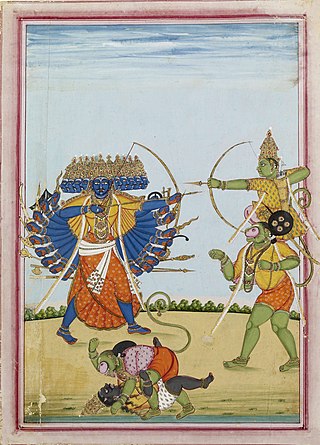
The Ramavataram, popularly referred to as Kamba Ramayanam, is a Tamil epic that was written by the Tamil poet Kambar during the 12th century. Based on Valmiki's Ramayana, the story describes the legend of King Rama of Ayodhya. However, the Ramavataram is different from the Sanskrit version in many aspects – both in spiritual concepts and in the specifics of the storyline. This historic work is considered by both Tamil scholars and the general public as one of the greatest literary works in Tamil literature.
Western literature, also known as European literature, is the literature written in the context of Western culture in the languages of Europe, and is shaped by the periods in which they were conceived, with each period containing prominent western authors, poets, and pieces of literature.

Hervé Le Tellier is a French writer and linguist, and a member of the international literary group Oulipo. He is its fourth president. Other notable members have included Raymond Queneau, Georges Perec, Italo Calvino, Jacques Roubaud, Jean Lescure and Harry Mathews. He won the 2020 Prix Goncourt for The Anomaly.
Old Norse literature refers to the vernacular literature of the Scandinavian peoples up to c. 1350. It chiefly consists of Icelandic writings.
Boris Slutsky is a Soviet poet, translator, Great Patriotic War veteran, major, member of the Soviet Union of Writers (1957).
Nationality words link to articles with information on the nation's poetry or literature.
Nationality words link to articles with information on the nation's poetry or literature.

Paul Fournel is a French writer, poet, publisher, and cultural ambassador. He was educated at the École normale supérieure of Saint-Cloud (1968–1972). Fournel wrote his master's thesis on Raymond Queneau and published the first book-length study of the Oulipo, Clefs pour la littérature potentielle. He joined the Oulipo, first as "slave," then as a full member, and he currently serves both as the Provisionally Definitive Secretary and the President of that group. He is also a regent of the College of 'Pataphysics.
Robert Crawford is a Scottish poet, scholar and critic. He is emeritus Professor of English at the University of St Andrews.

Plagiarism is the representation of another person's language, thoughts, ideas, or expressions as one's own original work. Although precise definitions vary depending on the institution, in many countries and cultures plagiarism is considered a violation of academic integrity and journalistic ethics, as well as social norms around learning, teaching, research, fairness, respect, and responsibility. As such, a person or entity that is determined to have committed plagiarism is often subject to various punishments or sanctions, such as suspension, expulsion from school or work, fines, imprisonment, and other penalties.
Paul Geoffrey Edwards was a wide-ranging literary scholar at the University of Edinburgh, appreciated for his "adventurous and unorthodox teaching".
References
- ↑ Terry, Philip (2020). The Penguin Book of Oulipo. UK: Penguin Classics (published 2019). pp. xvii. ISBN 978-0-241-37845-8.
- ↑ Wilken, Rowan; Clemens, Justin, eds. (2017). The afterlives of Georges Perec. Edinburgh: Edinburgh University Press. p. 165. ISBN 978-1-4744-0125-8.
- ↑ Maguire, Muireann (18 June 2021). Reading Backwards: An Advance Retrospective on Russian Literature. United Kingdom: Open Book Publishers. ISBN 9781800641228.
{{cite book}}: CS1 maint: date and year (link)
 | This poetry-related article is a stub. You can help Wikipedia by expanding it. |
 | This article about a literary movement is a stub. You can help Wikipedia by expanding it. |