Related Research Articles
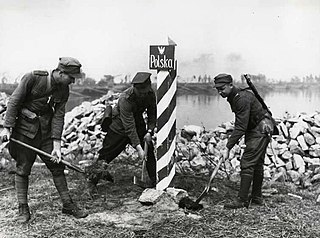
The Polish First Army was an army unit of the Polish Armed Forces in the East. It was formed in the Soviet Union in 1944, from the previously existing Polish I Corps in the Soviet Union, as part of the People's Army of Poland (LWP). The First Army fought westward, subordinated to the Soviet 1st Belorussian Front, during the offensive against Nazi Germany that led to the capture of Warsaw in January 1945, and the capture of Berlin in May 1945.

Stanisław Franciszek Sosabowski was a Polish general in World War II. He fought in the Polish Campaign of 1939 and at the Battle of Arnhem (Netherlands), as a part of Operation Market Garden, in 1944 as commander of the Polish 1st Independent Parachute Brigade.

Polish 5th Siberian Rifle Division was a Polish military unit formed in 1919 in Russia during the aftermath of World War I. The division fought during the Polish-Soviet War, but as it was attached to the White Russian formations, it is considered to have fought more in the Russian Civil War. Its tradition was continued in the Polish Army as the 30th Infantry Division.

The Battle of Stoczek was the first significant engagement between Russian and Polish forces during the Polish November Uprising. It took place on the 14th of February 1831 near the town of Stoczek Łukowski, near the Brest–Warsaw road. The Polish forces drove off two regiments of Russian mounted Jaegers, inflicting heavy casualties on them in the process.

General Stanisław Kopański was a Polish military commander, politician, diplomat, an engineer and one of the best-educated Polish officers of the time, serving with distinction during World War II. He is best known as the creator and commander of the Polish Independent Carpathian Brigade and Polish 3rd Carpathian Infantry Division.


Józef Konstanty Olszyna-Wilczyński was a Polish general and one of the high-ranking commanders of the Polish Army. A veteran of World War I, the Polish-Ukrainian War and the Polish-Soviet War, he was executed by the Soviets during the Invasion of Poland of 1939.

Władysław Bortnowski was a Polish historian, military commander and one of the highest ranking generals of the Polish Army. He is most famous for commanding the Pomorze Army in the Battle of Bzura during the invasion of Poland in 1939. He is also notable for serving as president of the Józef Piłsudski Institute of America between 1961 and 1962.

Wincenty Kowalski (1892–1984) was a Polish military commander and a general of the Polish Army. A veteran of both World War I and World War II, he fought in all the inter-war conflicts of Poland. During the Invasion of Poland of 1939 he commanded the Polish 1st Legions Infantry Division.
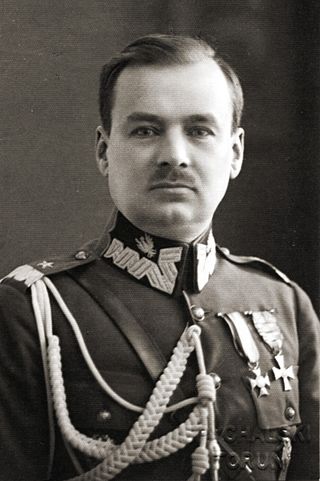
Wiktor Thommée (1881–1962) was a Polish military commander and a brigadier general of the Polish Army. A veteran of the Great War and the Russian Civil War, he is best known for his command over Piotrków Operational Group and the battle of the Bzura during the Invasion of Poland of 1939.
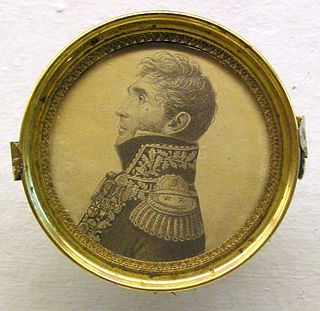
Stanisław Klicki of Prus (1775–1847) was a Polish military commander, aristocrat and a general of the Polish forces. For his service during the Napoleonic Wars, he was made a baron of the French Empire by Napoleon Bonaparte. During the November Uprising he commanded all Polish forces on the left bank of the Vistula River.

Franciszek Ksawery Latinik was a Polish military officer, Colonel of Austro-Hungarian Army and Major General of the Polish Army.
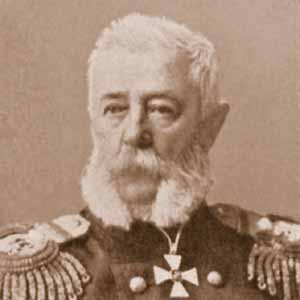
Count Alexander Nikolayevich Liders, better known as Alexander von Lüders, was a Russian general and Namestnik of the Kingdom of Poland of German extraction.
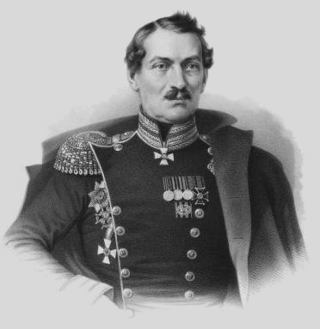
General Pavel Petrovich Liprandi was a Russian military officer of Spanish-Italian descent who participated in the Crimean War.
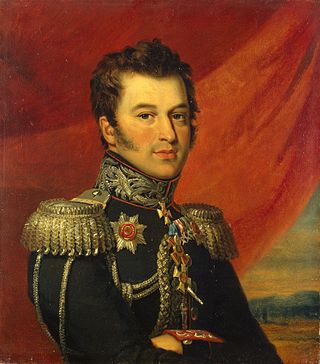
Paisi Sergeevich Kaysarov was a Russian general who served during the Napoleonic Wars.
Antoni Giełgud was a Polish-Lithuanian military officer, a general during the November Uprising.
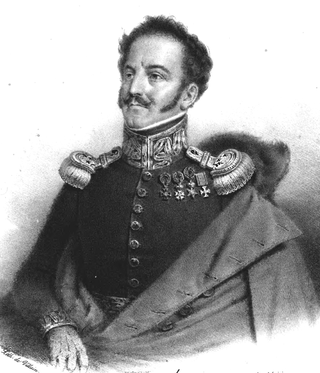
Jan Nepomucen Umiński of Cholewa (1778-1851) was a Polish military officer and a brigadier general of the Army of the Duchy of Warsaw. A veteran of the Kościuszko Uprising, Napoleonic Wars and the November Uprising, he died in exile in Wiesbaden.

Gustaw Paszkiewicz was a soldier of the Imperial Russian Army, and officer of the Polish Army. He entered the military service in 1914, at the age of 22, fighting as Russian soldier in World War I. Paszkiewicz was a soldier until 1952.
The 13th Belozersk Infantry Regiment, or 13th General Field Marshal Prince Volkonsky's Infantry Regiment, was an infantry regiment of the Russian Empire's Imperial Russian Army. It was known by different names for much of its existence but most of its designations included "Belozersk Infantry Regiment." Formed in 1708 in the reign of Czar Peter the Great and disbanded in 1918, the regiment fought in the Great Northern War, the Russian campaign of 1812, the War of the Sixth Coalition, the suppression of the Polish November Uprising, and the Crimean War, among other conflicts.

Fedor Sergeyevich Panyutin was a Russian general, Warsaw military governor, and member of the State Council.
References
Footnotes
Citations
- ↑ Strzeżek (1998), pp. 100–101.
- ↑ Czarzasty, ¶ 5 "Pierwszy polski grób zbiorowy…".
Bibliography
- (in Polish)Piotr Czarzasty (October 2014). PAP (corporate author) (ed.). "Francja. Polskie nekropolie - Montmartre, Pere Lachaise, Montmorency" [France, Polish cemeteries: Montparnasse, Pere Lachaise, Montmorency]. Gazeta Wyborcza. Retrieved 2014-11-04.
{{cite journal}}:|editor=has generic name (help) - (in Polish)Tomasz Strzeżek (1998). Kornelia Kompanowska (ed.). Warszawa 1831[Warsaw 1831]. Historyczne Bitwy. Warsaw: Dom Wydawniczy Bellona. ISBN 978-83-11-08793-4.
| International | |
|---|---|
| National | |

 | This biographical article related to the military of Poland is a stub. You can help Wikipedia by expanding it. |