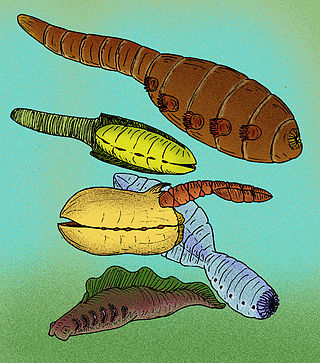
Vetulicolia is a phylum of animals encompassing several extinct species belonging to the Cambrian Period. The phylum was created by Degan Shu and his research team in 2001, and named after Vetulicola cuneata, the first species of the phylum described in 1987. The vetulicolian body comprises two parts: a voluminous anterior forebody, tipped with an anteriorly positioned mouth and lined with a row of five round to oval-shaped features on each lateral side, which have been interpreted as gills ; and a posterior section that primitively comprises seven segments and functions as a tail. All vetulicolians lack preserved appendages of any kind, having no legs, feelers or even eyes. The area where the anterior and posterior parts join is constricted.

A tunicate is a marine invertebrate animal, a member of the subphylum Tunicata. It is part of the Chordata, a phylum which includes all animals with dorsal nerve cords and notochords. The subphylum was at one time called Urochordata, and the term urochordates is still sometimes used for these animals. They are the only chordates that have lost their myomeric segmentation, with the possible exception of the 'seriation of the gill slits'.

Melastomataceae is a family of dicotyledonous flowering plants found mostly in the tropics comprising c. 175 genera and c. 5115 known species. Melastomes are annual or perennial herbs, shrubs, or small trees.
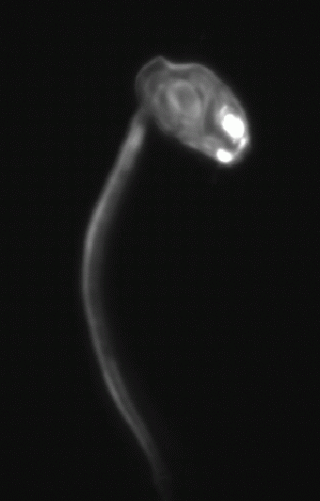
Larvaceans, class Appendicularia, are solitary, free-swimming tunicates found throughout the world's oceans. Like most tunicates, larvaceans are filter feeders. Unlike most other tunicates, they live in the pelagic zone, specifically in the photic zone, or sometimes deeper. They are transparent planktonic animals, generally less than 1 cm (0.39 in) in body length, excluding the tail.

Ascidiacea, commonly known as the ascidians, tunicates, and sea squirts, is a paraphyletic class in the subphylum Tunicata of sac-like marine invertebrate filter feeders. Ascidians are characterized by a tough outer "tunic" made of a polysaccharide.
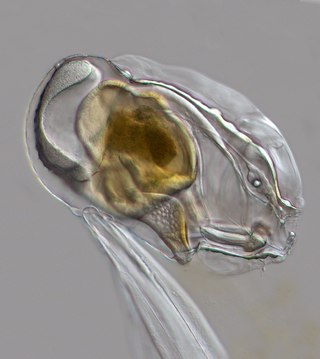
Oikopleura is a genus of tunicate in the class Appendicularia (larvaceans). It forms a mucus house every four hours at 20 degrees Celsius. This house has a coarse mesh to keep out big particles, and a fine mesh that collects the small particles, down to the nanoplankton that includes (pelagic) bacteria.
Turricula, turret in Latin, may refer to:
Appendicularia is a genus of plants in the family Melastomataceae.
Ceratocephala may refer to :
Carnarvonia may refer to:
Oikopleuridae is a family of larvacean tunicates.
Folia is a genus of larvacean tunicates in the family Oikopleuridae.

Bathochordaeus is a genus of larvacean tunicates in the family Oikopleuridae.
Appendicularia is a genus of larvaceans in the family Fritillariidae.
This page is based on this
Wikipedia article Text is available under the
CC BY-SA 4.0 license; additional terms may apply.
Images, videos and audio are available under their respective licenses.
