
Melastomataceae is a family of dicotyledonous flowering plants found mostly in the tropics comprising c. 175 genera and c. 5115 known species. Melastomes are annual or perennial herbs, shrubs, or small trees.

Tibouchina is a neotropical flowering plant genus in the family Melastomataceae. Species of this genus are subshrubs, shrubs or small trees and typically have purple flowers. They are native to Mexico, the Caribbean, and South America where they are found as far south as northern Argentina. Members of this genus are known as glory bushes, glory trees or princess flowers. The name Tibouchina is adapted from a Guianan indigenous name for a member of this genus. A systematic study in 2013 showed that as then circumscribed the genus was paraphyletic, and in 2019 the genus was split into a more narrowly circumscribed Tibouchina, two re-established genera Pleroma and Chaetogastra, and a new genus, Andesanthus.
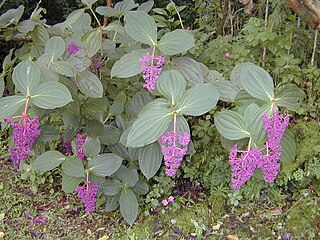
Medinilla is a genus of about 368 species of flowering plants in the family Melastomataceae, native to tropical regions of the Old World from Africa east through southeast Asia to Australia and the western Pacific Ocean. The genus was named after José de Medinilla y Pineda, governor of the Mariana Islands in 1820.
Appendicularia may refer to:

Monochaetum is a neotropical genus of shrubs and subshrubs with about 54 species. It occurs in warm temperate to tropical montane habitats from Mexico and Central America to the South American Andes of Colombia, Venezuela, Ecuador, and Peru with one species reaching the Guayana Highlands of Venezuela and Guyana.

Auguste François Marie Glaziou was a French landscape designer and botanist born in Lannion, Brittany.
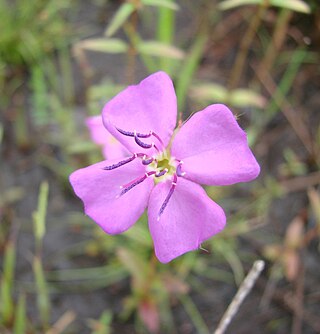
Pterolepis is a genus of flowering plant in the family Melastomataceae. Within Melastomataceae, it forms a clade with genus Pterogastra. Pterolepis contains some fifteen species, all of which are found in the Neotropical geographic realmm. Most species are concentrated in Brazil, with a few others across Central and South America.
Tigridiopalma is a genus of flowering plants belonging to the family Melastomataceae.
Marcetia is a genus of flowering plants belonging to the family Melastomataceae.
Oxyspora is a genus of flowering plants belonging to the family Melastomataceae.
Scorpiothyrsus is a genus of flowering plants belonging to the family Melastomataceae.
Rousseauxia is a genus of flowering plants belonging to the family Melastomataceae.
Neodriessenia is a genus of flowering plants belonging to the family Melastomataceae.
Plagiopetalum is a genus of flowering plants belonging to the family Melastomataceae.
Ernestia is a genus of plant in family Melastomataceae.

Huberia is a genus of flowering plants belonging to the family Melastomataceae.
Tibouchina striphnocalyx is a species of flowering plant in the family Melastomataceae, native to north Brazil, Colombia and Venezuela. It was first described in 1828 by Augustin de Candolle as Osbeckia striphnocalyx.

Chaetogastra herbacea, synonym Tibouchina herbacea, is a species of flowering plant in the family Melastomataceae, native to southern Brazil and north-eastern Argentina. It has been introduced to Hawaii. It was first described, as Arthrostemma herbaceum, by Augustin de Candolle in 1828.
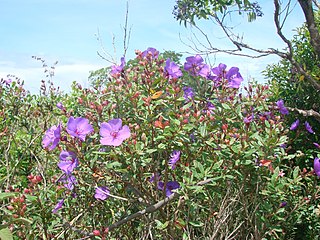
Pleroma trichopodum is a species of flowering plant in the family Melastomataceae, native to south and southeastern Brazil. It was first described by Augustin de Candolle in 1828. One of its synonyms is Tibouchina trichopoda.

Chaetogastra clinopodifolia is a species of flowering plant in the family Melastomataceae, native to south and southeastern Brazil. It was first described by Augustin de Candolle in 1828. One of its synonyms is Tibouchina clinopodifolia.


