
Pacific Islanders, Pasifika, Pasefika, Pacificans, or rarely Pacificers are the peoples of the Pacific Islands. As an ethnic/racial term, it is used to describe the original peoples—inhabitants and diasporas—of any of the three major subregions of Oceania or any other island located in the Pacific Ocean.
Arawa was one of the great ocean-going, voyaging canoes in Māori traditions that was used in the migrations that settled New Zealand.

Māori oral histories recount how their ancestors set out from their homeland in waka hourua, large twin-hulled ocean-going canoes (waka). Some of these traditions name a homeland called Hawaiki.
Mātaatua was one of the great voyaging canoes by which Polynesians migrated to New Zealand, according to Māori tradition. Māori traditions say that the Mātaatua was initially sent from Hawaiki to bring supplies of kūmara to Māori settlements in New Zealand. The Mātaatua was captained by Toroa, accompanied by his brother, Puhi; his sister, Muriwai; his son, Ruaihona; and daughter, Wairaka.

Māori mythology and Māori traditions are two major categories into which the remote oral history of New Zealand's Māori may be divided. Māori myths concern tales of supernatural events relating to the origins of what was the observable world for the pre-European Māori, often involving gods and demigods. Māori tradition concerns more folkloric legends often involving historical or semi-historical forebears. Both categories merge in whakapapa to explain the overall origin of the Māori and their connections to the world which they lived in.

Te Arawa is a confederation of Māori iwi and hapū of New Zealand who trace their ancestry to the Arawa migration canoe (waka). The tribes are based in the Rotorua and Bay of Plenty areas and have a population of around 60,117 according to the 2018 census, making the confederation the sixth biggest iwi in New Zealand. The Te Arawa iwi comprises 56 hapū (sub-tribes) and 31 marae.

Waiotapu is an active geothermal area at the southern end of the Okataina Volcanic Centre, just north of the Reporoa caldera, in New Zealand's Taupo Volcanic Zone. It is 27 kilometres south of Rotorua. Due to dramatic geothermal conditions beneath the earth, the area has many hot springs noted for their colourful appearance, in addition to the Lady Knox Geyser, Champagne Pool, Artist's Palette, Primrose Terrace and boiling mud pools. These can mostly be viewed through access by foot, and in addition to a paid and curated experience, naturally forming hot springs appear around the area. The geothermal area covers 18 square kilometres. Prior to European occupation the area was the homeland of the Ngāti Whaoa tribe who descended from those on the Arawa waka (canoe).

Papua New Guinea–United States relations refers to the diplomatic relations between Papua New Guinea and the United States of America. The two countries established diplomatic relations following Papua New Guinea's independence on September 16, 1975. The two nations belong to a variety of regional organizations, including the Asia-Pacific Economic Cooperation (APEC) forum; the ASEAN Regional Forum (ARF); the Pacific Community (SPC); and the South Pacific Regional Environmental Program (SPREP).
Ngāti Tahu – Ngāti Whaoa is a Māori iwi of New Zealand whose traditional territory lies between the Rotorua lakes and Lake Taupō, and is centred on Orakei Korako, on the Waikato River.
Ngāti Whakaue is a Māori iwi, of the Te Arawa confederation of New Zealand, tracing its descent from Whakaue Kaipapa, son of Uenuku-kopakō, and grandson of Tūhourangi. The tribe lives in the Rotorua district and descends from the Arawa waka. The Ngāti Whakaue village Ōhinemutu is within the township of Rotorua. The Ngāti Whakaue chief Pūkākī is depicted on the New Zealand 20 cent coin.
Te Uri o Uenukukōpako is a Māori iwi of the Te Arawa confederation in the Bay of Plenty of New Zealand.
In Māori tradition, Aotearoa was one of the great ocean-voyaging canoes that were used in the migrations that settled New Zealand. Aotearoa was captained by Mokotōrea or Mokoterea. It landed at Aotea on the Tasman Sea coast of the Waikato and was buried there.
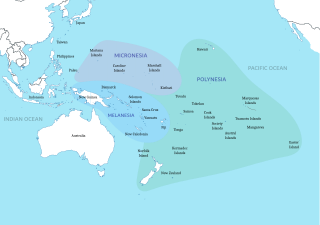
Polynesia is a subregion of Oceania, made up of more than 1,000 islands scattered over the central and southern Pacific Ocean. The indigenous people who inhabit the islands of Polynesia are called Polynesians. They have many things in common, including linguistic relations, cultural practices, and traditional beliefs. In centuries past, they had a strong shared tradition of sailing and using stars to navigate at night.
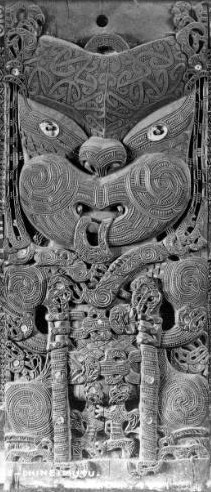
In Māori tradition of New Zealand, Tama-te-kapua, also spelt Tamatekapua and Tama-te-Kapua and also known as Tama, was the captain of the Arawa canoe which came to New Zealand from Polynesia in about 1350. A trickster, his theft of fruit from the orchard of the chieftain Uenuku escalated into a feud which forced him to leave the ancestral homeland of Hawaiki. On departure, he kidnapped Whakaotirangi, the wife of Ruaeo, and the priest Ngātoro-i-rangi. During the journey he was discovered sleeping with the wife of Ngātoro-i-rangi, who almost destroyed the canoe in revenge. When he arrived in New Zealand, he tricked the crew of the Tainui into believing that he had arrived before them. He staked claims to Mount Moehau in the Coromandel Peninsula and to Maketu in the central Bay of Plenty, where he settled. Shortly after this, he was defeated by the vengeful Ruaeo and feuded with his son Kahumatamomoe, departing to Moehau, where he died.

Ngāti Rongomai is a Māori iwi of New Zealand. They claim descent from Rangitihi's children Rakeiao, Kawatapuārangi and Apumoana, who came to reside on the southern shores of Lake Rotoiti. They are part of the greater Te Arawa confederation, descendants of the Māori people who arrived in New Zealand aboard the Arawa canoe.
Waitaha is a Māori iwi of New Zealand. The tribe lives in the Bay of Plenty region and descends from the Arawa waka.

Ngāti Whakahemo is a Māori iwi of New Zealand.
