 | This article relies largely or entirely on a single source .(January 2021) |
Armed Forces for a Federal Republic (FARF) were a rebel group in Chad in the 1990s. [1]
| | This article relies largely or entirely on a single source .(January 2021) |
Armed Forces for a Federal Republic (FARF) were a rebel group in Chad in the 1990s. [1]
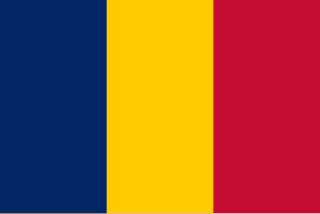
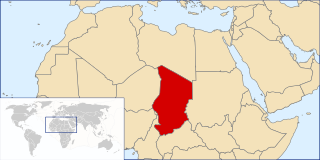
Chad, officially the Republic of Chad, is a landlocked country at the crossroads of North and Central Africa. It is bordered by Libya to the north, Sudan to the east, the Central African Republic to the south, Cameroon to the southwest, Nigeria to the southwest, and Niger to the west. Chad has a population of 16 million, of which 1.6 million live in the capital and largest city of N'Djamena.

N'Djamena is the capital and largest city of Chad. It is also a special statute region, divided into 10 districts or arrondissements.

Kilroy was here is a meme that became popular during World War II, typically seen in graffiti. Its origin is debated, but the phrase and the distinctive accompanying doodle became associated with GIs in the 1940s: a bald-headed man with a prominent nose peeking over a wall with his fingers clutching the wall.

The coat of arms of Chad was adopted in 1970. The center has a shield with jagged blue and yellow lines, with a sun rising over it. The shield is supported by a goat and a lion. Below the shield is a medal and a scroll with the national motto in French, Unité, Travail, Progrès. The shield supporters as well as the scroll feature a red arrow pointing upwards.
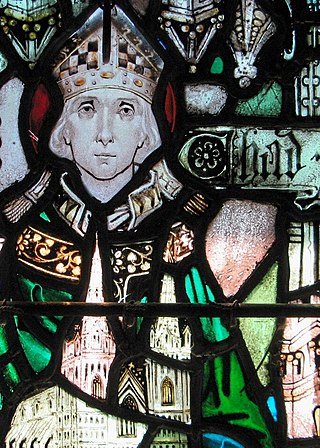
Chad of Mercia was a prominent 7th-century Anglo-Saxon Catholic monk who became abbot of several monasteries, Bishop of the Northumbrians and subsequently Bishop of the Mercians and Lindsey People. He was later canonised as a saint.

Central Africa is a subregion of the African continent comprising various countries according to different definitions. Middle Africa is an analogous term used by the United Nations in its geoscheme for Africa and consists of the following countries: Angola, Burundi, Cameroon, Central African Republic, Chad, Democratic Republic of the Congo, Republic of the Congo, Equatorial Guinea, Gabon, Rwanda, and São Tomé and Príncipe. These eleven countries are members of the Economic Community of Central African States (ECCAS). Six of those countries are also members of the Economic and Monetary Community of Central Africa (CEMAC) and share a common currency, the Central African CFA franc.

N'guigmi is a city and Commune of fifteen thousand in the easternmost part of Niger, very near to Lake Chad – lying on its shore until the lake retreated. It is a crossroads for the traditional camel caravans of the Toureg and for traders plying North and South across the Sahara.
The National Assembly was the parliament of Chad. It had 188 members, elected for a four-year term. It had 25 single-member constituencies and 34 multi-member constituencies. On 20 April 2021, after Idriss Déby was killed, a coup occurred which dissolved the National Assembly and its functions were assumed by the Transitional Military Council, a junta led by Deby’s son.
The Chadian–Libyan War was a series of military campaigns in Chad between 1978 and 1987, fought between Libyan and allied Chadian forces against Chadian groups supported by France, with the occasional involvement of other foreign countries and factions.
Chad has sent athletes to every Summer Olympic Games held between 1964 and 1972 and from 1984 to 2020, Chad never won an Olympic medal. No athletes from Chad have competed in any Winter Olympic Games.

The Toyota War or Great Toyota War, which took place in 1987 in Northern Chad and on the Chad–Libya border, was the last phase of the Chadian–Libyan conflict. It takes its name from the Toyota pickup trucks, primarily the Toyota Hilux and the Toyota Land Cruiser, used to provide mobility for the Chadian troops as they fought against the Libyans, and as technicals. The 1987 war resulted in a heavy defeat for Libya, which, according to American sources, lost one tenth of its army, with 7,500 men killed and US$1.5 billion worth of military equipment destroyed or captured. Chadian forces only suffered 1,000 deaths.

Chadian Arabic, also known as Shuwa Arabic, Baggara Arabic, Western Sudanic Arabic, or West Sudanic Arabic (WSA), is a variety of Arabic and the first language of 1.6 million people, both town dwellers and nomadic cattle herders. The majority of its speakers live in southern Chad. Its range is an east-to-west oval in the Sahel. Nearly all of this territory is within Chad or Sudan. It is also spoken elsewhere in the vicinity of Lake Chad in the countries of Cameroon, Nigeria, Niger. Finally, it is spoken in slivers of the Central African Republic, and South Sudan. In addition, this language serves as a lingua franca in much of the region. In most of its range, it is one of several local languages and often not among the major ones.
Yedina, also known as Buduma (Boudouma), is a Chadic language of the Biu–Mandara branch spoken around Lake Chad in western Chad and neighbouring Cameroon and Nigeria.
Vulpes riffautae is an extinct species of fox from the late Miocene of Chad. Fossils of V. riffautae potentially represent the earliest record of the dog family, Canidae, in the Old World. V. riffautae was intermediate in size between Rüppell's fox and the fennec fox. The Mandible is narrow and shallow. Just before the posterior root of p2, the symphysis terminates. The masseteric fossa is rather deep. The posterior smaller mental foramen is located below the posterior root of p3, while the anterior larger mental foramen is located between the root of p1 and the anterior root of p2.
Maba is a Maban language spoken in Chad and Sudan. It is divided into several dialects, and serves as a local trade language. Maba is closely related to the Masalit language.
The Djurab Desert is a desert in northern Chad. Part of the greater Sahara desert, it makes up much of the area of Chad's Borkou region.

The Chadian passport is issued to citizens of Chad for international travel. The Chadian passport is written in three languages; French, English and Arabic.
Cannabis in Chad is illegal.

The COVID-19 pandemic in Chad is part of the ongoing worldwide pandemic of coronavirus disease 2019 caused by severe acute respiratory syndrome coronavirus 2. The virus was confirmed to have reached Chad in March 2020. As the third least developed nation in the world, according to the HDI in 2019, Chad has faced unique economic, social, and political challenges under the strain of the COVID-19 pandemic.
Capital punishment was abolished for all crimes in Chad on April 28, 2020, following a unanimous vote by the National Assembly of Chad. Prior to 2020, Chad's 003/PR/2020 "anti-terrorism" law maintained the death penalty for terrorism-related offenses. Chad's new penal code, which was adopted in 2014 and promulgated in 2017, had abolished capital punishment for all other crimes.
 | This Chad-related article is a stub. You can help Wikipedia by expanding it. |
 | This article about African politics is a stub. You can help Wikipedia by expanding it. |