
Abbas I, commonly known as Abbas the Great, was the fifth shah of Safavid Iran from 1588 to 1629. The third son of Shah Mohammad Khodabanda, he is generally considered one of the greatest rulers of Iranian history and the Safavid dynasty.

The Nakhchivan Autonomous Republic is a landlocked exclave of the Republic of Azerbaijan. The region covers 5,502.75 km2 (2,124.62 sq mi) with a population of 459,600. It is bordered by Armenia to the east and north, Iran to the southwest, and Turkey to the west. It is the sole autonomous republic of Azerbaijan, governed by its own elected legislature.

A khachkar or Armenian cross-stone is a carved, memorial stele bearing a cross, and often with additional motifs such as rosettes, interlaces, and botanical motifs. Khachkars are characteristic of medieval Christian Armenian art.
Iranian Armenians, also known as Persian Armenians, are Iranians of Armenian ethnicity who may speak Armenian as their first language. Estimates of their number in Iran range from 70,000 to 500,000. Areas with a high concentration of them include Tabriz, Tehran, Salmas and Isfahan's Jolfa quarter.

New Julfa is the Armenian quarter of Isfahan, Iran, located along the south bank of the Zayanderud.
Julfa, formerly Jugha, is a city and the capital of the Julfa District of the Nakhchivan Autonomous Republic of Azerbaijan.
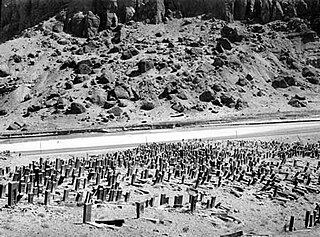
The Armenian cemetery in Julfa was a cemetery near the town of Julfa, in the Nakhchivan exclave of Azerbaijan that originally housed around 10,000 funerary monuments. The tombstones consisted mainly of thousands of khachkars—uniquely decorated cross-stones characteristic of medieval Christian Armenian art. The cemetery was still standing in the late 1990s, when the government of Azerbaijan began a systemic campaign to destroy the monuments.

Armenian architecture comprises architectural works with an aesthetic or historical connection to the Armenian people. It is difficult to situate this architectural style within precise geographical or chronological limits, but many of its monuments were created in the regions of historical Armenia, the Armenian Highlands. The greatest achievement of Armenian architecture is generally agreed to be its medieval churches and seventh century churches, though there are different opinions precisely in which respects.
Gülüstan is a village and municipality in the Julfa District of Nakhchivan, Azerbaijan. It is located 5 km in the north-west from the district center, on the right bank of the Aras River.

Armenians had a historic presence in Nakhchivan. According to an Armenian tradition, Nakhchivan was founded by Noah, of the Abrahamic religions. During the Soviet era, Nakhchivan saw a significant demographic shift. The Armenian population saw a great reduction in their numbers throughout the years repatriating to Armenia. Nakhchivan's Armenian population gradually decreased to around 0%. Still some Armenian political groupings of Armenia and the Armenian diaspora, claim that Nakhchivan should belong to Armenia. The Medieval Armenian cemetery of Jugha (Julfa) in Nakhchivan, regarded by Armenians as the biggest and most precious repository of medieval headstones marked with Christian crosses – khachkars, was completely demolished by 2006.
An Armenian cross is a symbol that combines a cross with a floral postament or elements. The cross of Armenian Christianity is combined with the Christian cross, and this design was often used for high crosses (khachkar) – a free-standing cross made of stone and often richly decorated.

Iranian Armenia (1502–1828) refers to the period of Eastern Armenia during the early modern and late modern era when it was part of the Iranian empire. Armenians have a history of being divided since the time of the Byzantine Empire and the Sassanid Empire, in the early 5th century. While the two sides of Armenia were sometimes reunited, this became a permanent aspect of the Armenian people.

The Sceriman family, also referred to as the Shahremanian, Shahremanean, Shahrimanian, Shehrimanian, Shariman, or Seriman family, were a wealthy Safavid merchant family of Armenian ethnicity. A Catholic family, they had their roots in early 17th-century New Julfa, and relatively quickly came to preside over branches all over the world, stretching from Italy in the west, to Pegu (Burma) in the east. Apart from being renowned as a trader's family, some Scerimans were high-ranking individuals in the Safavid state, including in its military, religious, and bureaucratic systems. Later, similar positions were obtained abroad, such as in the various Italian city-states and the Austro-Hungarian Empire. They especially became renowned in the Republic of Venice, where they were well integrated into its ruling class. Nevertheless, until their decline in the late 1790s and eventual inactivity in the 19th century, they remained bound to their original base in Iran.

Khachatur Kesaratsi was an Armenian archbishop in Safavid Iran. He is credited with the founding of the first printing press in Iran, in 1633, or 1636. In 1638, the first book was printed; a Saghmosaran (Psalter).
Literature in Iran encompasses a variety of literary traditions in the various languages used in Iran. Modern literatures of Iran include Persian literature, Azerbaijani literature, and Kurdish literature, among others.
The Battle of Sufiyan took place on 6 November 1605, during the Ottoman–Safavid War of 1603–1618. The Safavids, under King (Shah) Abbas I, beat a numerically superior, fully-fledged Ottoman army. It was one of King Abbas I's greatest military victories. According to Colin Imber: "For the Ottomans the battle of Sufiyan was a greater disaster than anything they had experienced in Hungary, where the war which had begun in 1593 had revealed Ottoman military deficiencies in the face of new European weapons and tactics."
Armenian cultural heritage in Azerbaijan refers to historic buildings and cultural traditions of Armenians who lived in what today conforms the territory of Azerbaijan. Armenians had a historic presence in Azerbaijan going back to at least the 9th century BC in Nakhchivan, which was part of the Kingdom of Urartu. Armenians also had presence in Baku dating back to the 7th century AD. Prior to calls for independence from Azerbaijan by Armenians of Nagorno Karabakh in what is now called the Republic of Artsakh, and the ensuing First Nagorno-Karabakh War, about 500,000 Armenians lived in Soviet Azerbaijan where they had an active cultural presence. Most Armenians have fled during the war and their numbers in Azerbaijan today is less than 1% of their pre-war figures. After the ceasefire of the First Nagorno-Karabakh War, there has been a marked increase of Anti-Armenian sentiment in Azerbaijan coupled with reports about destruction of Armenian cultural monuments there.
The Great Surgun was the forced deportation of the population from Eastern Armenia to the territory of the central and northern parts of Safavid Iran, which was carried out in 1604-1605 by the order of Shah Abbas the Great during the Ottoman–Safavid War (1603–1618).
Kangarlu is a Turkic tribe that resides in the Azerbaijan and Qom-Varamin regions of Iran. They were originally a clan of the prominent Ustajlu tribe of the Qizilbash tribal confederacy.
From antiquity, Armenian merchants have played a pivotal role in transcontinental trade across Eurasia. Positioned strategically along the vital trade route linking Europe and Asia, Armenia's geographical advantage has sustained its centrality of international trade in the economic life of Armenians until the close of the early modern period. Armenians historically served as merchants at the crossroads of Central Asia, India, China, and the Mediterranean, facing persistent attacks from various quarters vying for control over the pivotal trade routes.

