
The Thirty Years' War, from 1618 to 1648, was one of the most destructive conflicts in European history. Fought primarily in Central Europe, an estimated 4.5 to 8 million soldiers and civilians died from the effects of battle, famine, or disease, while parts of Germany reported population declines of over 50%. Related conflicts include the Eighty Years' War, the War of the Mantuan Succession, the Franco-Spanish War, the Torstenson War, the Dutch-Portuguese War, and the Portuguese Restoration War.

The Battle of Nördlingen, fought over two days from 5 to 6 September 1634, was a major battle of the Thirty Years' War. A Imperial-Spanish force led by the Cardinal-Infante Ferdinand and Ferdinand of Hungary inflicted a crushing defeat on the Swedish-German army led by Gustav Horn and Bernhard of Saxe-Weimar.

Ferdinand III was Archduke of Austria, King of Hungary and Croatia from 1625, King of Bohemia from 1627 and Holy Roman Emperor from 1637 to his death.

The Battle of White Mountain was an important battle in the early stages of the Thirty Years' War. It led to the defeat of the Bohemian Revolt and ensured Habsburg control for the next three hundred years.

Albrecht Wenzel Eusebius von Wallenstein, Duke of Friedland, also von Waldstein, was a Bohemian military leader and statesman who fought on the Catholic side during the Thirty Years' War (1618–1648). His successful martial career made him one of the richest and most influential men in the Holy Roman Empire by the time of his death. Wallenstein became the supreme commander of the armies of Holy Roman Emperor Ferdinand II and was a major figure of the Thirty Years' War.
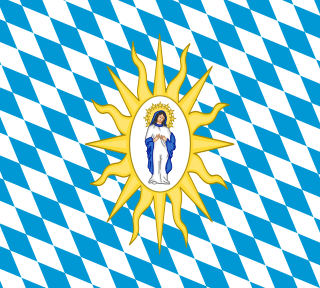
The Catholic League was a coalition of Catholic states of the Holy Roman Empire formed 10 July 1609. While initially formed as a confederation to act politically to negotiate issues vis-à-vis the Protestant Union, modelled on the more intransigent ultra-Catholic French Catholic League (1576), it was subsequently concluded as a military alliance "for the defence of the Catholic religion and peace within the Empire".

Matthias Gallas, Graf von Campo und Herzog von Lucera was an Italian professional soldier during the Thirty Years' War. He distinguished himself in the first half of the war in service of the Catholic League, in the War of the Mantuan Succession, and as one of Albrecht von Wallenstein's Generals. After carrying out the dismissal and elimination of Wallenstein, Gallas became acting supreme commander of the Imperial Army three times between 1634 and 1647 but he never held the function or authority of a Generalissimo.

Charles IV was Duke of Lorraine from 1624 until his death in 1675, with a brief interruption in 1634, when he abdicated under French pressure in favor of his younger brother, Nicholas Francis.

Ottavio Piccolomini, 1st Duke of Amalfi was an Italian nobleman whose military career included service as a Spanish general and then as a field marshal of the Holy Roman Empire.

Cardinal-Infante Ferdinand was a Spanish and Portuguese prince, Governor of the Spanish Netherlands, Cardinal of the Holy Catholic Church, Archduke of Austria, Archbishop of Toledo (1619–41), and a general during the Thirty Years' War, the Eighty Years' War, and the Franco-Spanish War. He is commonly considered the last great commander and strategist of the Spanish Empire, whose premature death in a critical moment helped bring about the end of Spanish hegemony in Europe. He is, as well, one of few generals undefeated on the battlefield.

The Battle of Lutter took place on 27 August 1626 during the Thirty Years' War, south of Salzgitter, in Lower Saxony. A combined Danish-German force led by Christian IV of Denmark was defeated by Johan Tzerclaes, Count of Tilly, commanding an army of the Catholic League loyal to Emperor Ferdinand II.

The Treaty of Fontainebleau was signed on 30 May 1631 during the Thirty Years' War, at the Palace of Fontainebleau. It was a pact of mutual assistance between Maximilian I, Elector of Bavaria, and France, for a period of eight years.

The Battle of La Marfée, also known as the Battle of Sedan, took place on 6 July 1641, during the 1635 to 1659 Franco-Spanish War, a related conflict of the Thirty Years War.

The Battle of Les Avins took place on 20 May 1635, outside the town of Les Avins, near Huy in modern Belgium, then part of the Bishopric of Liège. It was the first major engagement of the 1635 to 1659 Franco-Spanish War, a connected conflict of the Thirty Years' War.
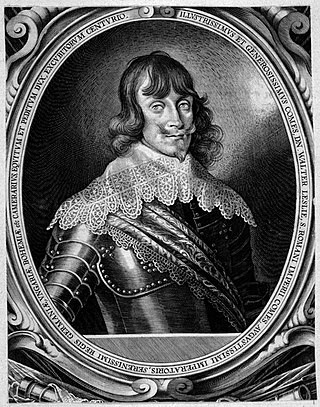
Count Walter Leslie was a Scottish soldier and diplomat. He gained the positions of Imperial Field Marshal, Count of the Holy Roman Empire, Governor on the Croatian-Slavonian Military Frontier, Imperial Ambassador to Naples, Rome in 1645 and to Constantinople in 1665–1666.

The siege of Rheinfelden of 1633 or the Spanish recapture of Rheinfelden(Spanish: La Expugnación de Rheinfelden) took place in late October 1633, during the Thirty Years' War.

Upper Alsace was a landgraviate of the Holy Roman Empire centred on Ensisheim and Landser, north of the County of Ferrette (Pfirt). The counts of Habsburg ruled the territory from the 1130s down to its cession to France in the 17th century.

The Battle of Strasbourg Bridge was fought during the Swedish phase of the Thirty Years' War near the Free city of Strasbourg, in the Holy Roman Empire. Having dealt a heavy defeat on the Swedish army at the Battle of Nördlingen in September, the armies of the Emperor, Spain and the Catholic League overran much of the Swedish-held southern Germany. As a result, the Swedish commander, Rheingrave Otto Louis, decided to retreat over the Rhine with his army, using the Strasbourg bridge.

Johann von Götzen was a Lüneburg nobleman and Generalfeldmarschall who fought during the Thirty Years' War. He was married to Elisabeth of the Falke family, with whom he had two sons: Johann Sigismund, Count of Götzen (1622–1622) and Johann Georg, Count of Götzen (1623–1679).

Adam Erdmann Trčka of Lípa was a Bohemian nobleman and lieutenant field marshal, who fought during the course of the Thirty Years' War. He became a close associate of Imperial Generalissimo Albrecht von Wallenstein. He was killed along with other loyal officers and Wallenstein himself, in the so-called Eger Bloodbath, a culmination of the internal purge within the Holy Roman army.