Related Research Articles
Agesilaus II was king of Sparta from c. 399 to 358 BC. Generally considered the most important king in the history of Sparta, Agesilaus was the main actor during the period of Spartan hegemony that followed the Peloponnesian War. Although brave in combat, Agesilaus lacked the diplomatic skills to preserve Sparta's position, especially against the rising power of Thebes, which reduced Sparta to a secondary power after its victory at Leuctra in 371 BC.
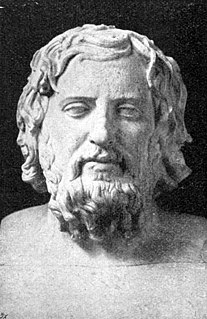
Xenophon of Athens was a Greek military leader, philosopher, and historian, born in Athens. At the age of 30, Xenophon was elected commander of one of the biggest Greek mercenary armies of the Achaemenid Empire, the Ten Thousand, that marched on and came close to capturing Babylon in 401 BC. As the military historian Theodore Ayrault Dodge wrote, "the centuries since have devised nothing to surpass the genius of this warrior". Xenophon established precedents for many logistical operations, and was among the first to describe strategic flanking maneuvers and feints in combat.

Lysander was a Spartan military and political leader. He destroyed the Athenian fleet at the Battle of Aegospotami in 405 BC, forcing Athens to capitulate and bringing the Peloponnesian War to an end. He then played a key role in Sparta's domination of Greece for the next decade until his death at the Battle of Haliartus.

Artaxerxes I was the fifth King of Kings of the Achaemenid Empire, from 465 to 424 BC. He was the third son of Xerxes I.
Ctesias, also known as Ctesias of Cnidus, was a Greek physician and historian from the town of Cnidus in Caria, then part of the Achaemenid Empire.

Cyrus the Younger was a Achaemenid prince and general. He ruled as satrap of Lydia and Ionia from 408 to 401 BC. Son of Darius II and Parysatis, he died in 401 BC in battle during a failed attempt to oust his elder brother, Artaxerxes II, from the Persian throne.

Tissaphernes was a Persian soldier and statesman, Satrap of Lydia and Ionia. His life is mostly known from the works of Thucydides and Xenophon. According to Ctesias, he was the son of Hidarnes III and therefore the great grandson of Hydarnes, one of the six conspirators who had supported the rise of Darius the Great.

Arses, known by his regnal name Artaxerxes II, was King of Kings of the Achaemenid Empire from 405/4 BC to 358 BC. He was the son and successor of Darius II and his mother was Parysatis.

The Battle of Cunaxa was fought in the late summer of 401 BC between the Persian king Artaxerxes II and his brother Cyrus the Younger for control of the Achaemenid throne. The great battle of the revolt of Cyrus took place 70 km north of Babylon, at Cunaxa, on the left bank of the Euphrates. The main source is Xenophon, a Greek soldier who participated in the fighting.
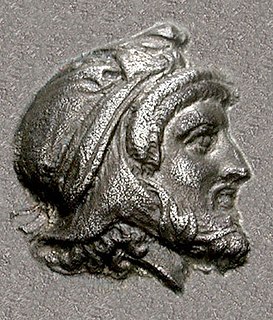
Pharnabazus II was a Persian soldier and statesman, and Satrap of Hellespontine Phrygia. He was the son of Pharnaces II of Phrygia and grandson of Pharnabazus I, and great-grandson of Artabazus I. He and his male ancestors, forming the Pharnacid dynasty, had governed the satrapy of Hellespontine Phrygia from its headquarters at Dascylium since 478 BC. He married Apama, daughter of Artaxerxes II of Persia, and their son Artabazus also became a satrap of Phrygia. According to some accounts, his granddaughter Barsine may have become Alexander the Great's concubine.

Cyrus II of Persia, commonly known as Cyrus the Great and also called Cyrus the Elder by the Greeks, was the founder of the Achaemenid Empire, the first Persian empire. Under his rule, the empire embraced all of the previous civilized states of the ancient Near East, expanded vastly and eventually conquered most of Western Asia and much of Central Asia. Spanning from the Mediterranean Sea and Hellespont in the west to the Indus River in the east, the empire created by Cyrus was the largest the world had yet seen. At its maximum extent under his successors, the Achaemenid Empire stretched from parts of the Balkans and Southeast Europe proper in the west to the Indus Valley in the east.

Datames, also known as Tarkamuwa, was an Iranian military leader, who served as the governor (satrap) of the Achaemenid satrapy of Cappadocia from 380 BC to 362 BC. A Carian by birth, he was the son of Camissares by a Paphlagonian mother. His father being satrap of Cilicia under Artaxerxes II, and high in the favour of that monarch, Datames became one of the king's bodyguards; and having in this capacity distinguished himself in the war against the Cadusii, was appointed to succeed his father in the government of his province. Here he distinguished himself both by his military abilities and his zeal in the service of the king; and reduced to subjection two officials who had revolted from Artaxerxes, Thyus, governor of Paphlagonia, and Aspis of Cataonia.

The Cadusii were an ancient Iranian or powerful Scythian tribe living in north-western Iran.
Parysatis was a powerful Persian Queen, consort of Darius II and had a large influence during the reign of Artaxerxes II.

Abrocomas was satrap of Syria for the Achaemenid king Artaxerxes II Mnemon. He may also have been satrap of Paphlagonia, with its capital at Sinope, according to the reading of some of the coinage of Sinope: the Aramaic reading "ˈbrkmw" has been identified as the name rendered in Greek as "Abrocomas", but this is not universally accepted.

Media is a region of north-western Iran, best known for having been the political and cultural base of the Medes. During the Achaemenid period, it comprised present-day Azerbaijan, Iranian Kurdistan and western Tabaristan. As a satrapy under Achaemenid rule, it would eventually encompass a wider region, stretching to southern Dagestan in the north. However, after the wars of Alexander the Great, the northern parts were separated due to the Partition of Babylon and became known as Atropatene, while the remaining region became known as Lesser Media.

Masistes was a Persian prince of the Achaemenid Dynasty, son of king Darius I and of his wife Atossa, and full brother of king Xerxes I. He was satrap (governor) of Bactria during his brother's reign, where he attempted to start a revolt in 478 BC.
Ariaeus was a Persian general who fought alongside Cyrus the Younger at the Battle of Cunaxa and later was involved in the assassination of Tissaphernes.

The Achaemenid Empire, also called the First Persian Empire, was an ancient Iranian empire founded by Cyrus the Great in 550 BC. Based in Western Asia, it was contemporarily the largest empire in history, spanning a total of 5.5 million square kilometres from the Balkans and ancient Egypt in the west to the Indus Valley in the east.

The Falcon of Sparta is an historical fiction novel by British author Conn Iggulden. It is loosely based on the Anabasis written in 370 BC by Xenophon.
References
- ↑ Plutarch's Lives. Translated from the Greek by Several Hands ... To which is Prefixt The Life of Plutarch. R. E. by Jacob Tonson. 1700. p. 472.
- ↑ Plutarch (1859). Plutarch's Lives. S. Low. p. 527.
- ↑ Plutarch (1881). Lives of Illustrious Men. Hurst. p. 745.
- ↑ Great Books of the Western World. Encyclopaedia Britannica, Incorporated. 1952. p. 849.
- ↑ Adams, Ced (1980). A View of Xenophon's Anabasis. Vantage Press. p. 7. ISBN 978-0-533-04293-7.
- ↑ Plutarch (1878). Plutarch's Lives: The Translation Called Dryden's. Little, Brown.
- ↑ Plutarch (1881). Lives of Illustrious Men. Hurst. p. 745.
- ↑ "Глава 9 | Симпосий Συμπόσιον". simposium.ru. Retrieved 2021-11-07.
- ↑ Dandamaev, M. A. (1989). A Political History of the Achaemenid Empire. BRILL. pp. 280–282. ISBN 978-90-04-09172-6.
- ↑ Chiglintsev, Evgeniy (2017). "Cyrus the Great: the Persian king in the context of world history. // Scientific notes of Kazan University. Humanities Series". Ученые Записки Казанского Университета. Серия: Гуманитарные Науки (in Russian). Kazan: Kazan Federal University. 159 (6): 1422–1431.
- ↑ Orlov, Vasily (2019). Persian aristocracy in the Achaemenid Empire (Thesis) (in Russian). Kazan: Kazan Federal University. pp. 312–313, 315–316.