
Rivendell is a valley in J. R. R. Tolkien's fictional world of Middle-earth, representing both a homely place of sanctuary and a magical Elvish otherworld. It is an important location in The Hobbit and The Lord of the Rings, being the place where the quest to destroy the One Ring began.

Arwen Undómiel is a fictional character in J. R. R. Tolkien's Middle-earth legendarium. She appears in the novel The Lord of the Rings. Arwen is one of the half-elven who lived during the Third Age; her father was Elrond half-elven, lord of the Elvish sanctuary of Rivendell, while her mother was the Elf Celebrian, daughter of the Elf-queen Galadriel, ruler of Lothlórien. She marries the Man Aragorn, who becomes King of Arnor and Gondor.
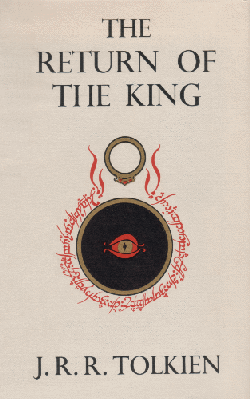
The Return of the King is the third and final volume of J. R. R. Tolkien's The Lord of the Rings, following The Fellowship of the Ring and The Two Towers. It was published in 1955. The story begins in the kingdom of Gondor, which is soon to be attacked by the Dark Lord Sauron.

The Lord of the Rings: The Two Towers is a 2002 epic fantasy adventure film directed by Peter Jackson from a screenplay by Fran Walsh, Philippa Boyens, Stephen Sinclair, and Jackson, based on 1954's The Two Towers, the second volume of the novel The Lord of the Rings by J. R. R. Tolkien. The sequel to 2001's The Lord of the Rings: The Fellowship of the Ring, the film is the second instalment in The Lord of the Rings trilogy. It features an ensemble cast including Elijah Wood, Ian McKellen, Liv Tyler, Viggo Mortensen, Sean Astin, Cate Blanchett, John Rhys-Davies, Bernard Hill, Christopher Lee, Billy Boyd, Dominic Monaghan, Orlando Bloom, Hugo Weaving, Miranda Otto, David Wenham, Brad Dourif, Karl Urban, and Andy Serkis.
Gaius Julius Solinus was a Latin grammarian, geographer, and compiler who probably flourished in the early 3rd century AD. Historical scholar Theodor Mommsen dates him to the middle of the 3rd century.
A half-elf is a mythological or fictional being, the offspring of an immortal elf and a mortal human. They are often depicted as very beautiful and endowed with magical powers; they may be presented as torn between the two worlds that they inhabit. Half-elves became known in modern times mainly through J. R. R. Tolkien's Middle-earth writings but have origins in Norse mythology. A half-elf appeared in Lord Dunsany's 1924 book The King of Elfland's Daughter.
Evening star may refer to:

The ARWEN 37 is a less-lethal launcher which fires a variety of 37mm less-lethal munitions which includes direct impact batons, chemical irritant delivery munitions and smoke delivery munitions. The ARWEN 37 has 5-round rotary drum magazine.
Evenstar is an old term for the "evening star" of astronomy, denoting the planet Venus or the planet Mercury.
The Lord of the Rings is a stage musical with music by A. R. Rahman, Värttinä, and Christopher Nightingale and lyrics and a book by Shaun McKenna and Matthew Warchus, based on the novel of the same name by J. R. R. Tolkien. It is the most prominent of several theatre adaptations of the novel. Set in the world of Middle-earth, the musical tells the tale of a humble hobbit who is asked to play the hero and undertake a treacherous mission to destroy an evil, magic ring without being seduced by its power.
Aragorn is a fictional character and a protagonist in J. R. R. Tolkien's The Lord of the Rings. Aragorn was a Ranger of the North, first introduced with the name Strider and later revealed to be the heir of Isildur, an ancient King of Arnor and Gondor. Aragorn was a confidant of the wizard Gandalf, and played a part in the quest to destroy the One Ring and defeat the Dark Lord Sauron. As a young man, Aragorn fell in love with the immortal elf Arwen, as told in The Tale of Aragorn and Arwen. Arwen's father, Elrond Half-elven, forbade them to marry unless Aragorn became King of both Arnor and Gondor.
Elrond Half-elven is a fictional character in J. R. R. Tolkien's Middle-earth legendarium. Both of his parents, Eärendil and Elwing, were half-elven, having both Men and Elves as ancestors. He is the bearer of the elven-ring Vilya, the Ring of Air, and master of Rivendell, where he has lived for thousands of years through the Second and Third Ages of Middle-earth. He was the Elf-king Gil-galad's herald at the end of the Second Age, saw Gil-galad and king Elendil fight the dark lord Sauron for the One Ring, and Elendil's son Isildur take it rather than destroy it.
In Greek mythology, the name Crete may refer to several figures, all of whom are associated with the homonymous island of Crete, and may have been considered its eponyms:
"The Tale of Aragorn and Arwen" is a story within the Appendices of J. R. R. Tolkien's The Lord of the Rings. It narrates the love of the mortal Man Aragorn and the immortal Elf-maiden Arwen, telling the story of their first meeting, their eventual betrothal and marriage, and the circumstances of their deaths. Tolkien called the tale "really essential to the story". In contrast to the non-narrative appendices it extends the main story of the book to cover events both before and after it, one reason it would not fit in the main text. Tolkien gave another reason for its exclusion, namely that the main text is told from the hobbits' point of view.
The roles of women in The Lord of the Rings have often been assessed as insignificant, or important only in relation to male characters in a story about men for boys. Meanwhile, other commentators have noted the empowerment of the three major women characters, Galadriel, Éowyn, and Arwen, and provided in-depth analysis of their roles within the narrative of The Lord of the Rings.
The presence of sexuality in The Lord of the Rings, a bestselling fantasy novel by J. R. R. Tolkien, has been debated, as it is somewhat unobtrusive. However, love and marriage appear in the form of the warm relationship between the hobbits Sam Gamgee and Rosie Cotton; the unreturned feelings of Éowyn for Aragorn, followed by her falling in love with Faramir, and marrying him; and Aragorn's love for Arwen, described in an appendix rather than in the main text, as "The Tale of Aragorn and Arwen". Multiple scholars have noted the symbolism of the monstrous female spider Shelob. Interest has been concentrated, too, on the officer-batman-inspired same-sex relationship of Frodo and his gardener Sam as they travel together on the dangerous quest to destroy the Ring. Scholars and commentators have interpreted the relationship in different ways, from close but not necessarily homosexual to plainly homoerotic, or as an idealised heroic friendship.
Tolkien's frame stories are the narrative devices that J. R. R. Tolkien chose to use throughout his Middle-earth writings, especially his legendarium, to make the works resemble a genuine mythology written and edited by many hands over a long period of time. He described in detail how his fictional characters wrote their books and transmitted them to others, and showed how later in-universe editors annotated the material.

Storm Arwen was a powerful extratropical cyclone that was part of the 2021–22 European windstorm season. It affected the United Kingdom, Ireland and France, bringing strong winds and snow. Storm Arwen caused at least three fatalities and widespread power outages. Damage was exacerbated by the fact that the strong winds came unusually from the north.
