 | This article needs additional citations for verification .(March 2014) |
Ashraf Khan Khattak | |
|---|---|
| Born | c. 1634 |
| Father | Khushal Khan Khattak |
Ashraf Khan Khattak was the eldest son of Khushal Khan Khattak and ruler of the Khattak clan for a time. [1]
| | This article needs additional citations for verification .(March 2014) |
Ashraf Khan Khattak | |
|---|---|
| Born | c. 1634 |
| Father | Khushal Khan Khattak |
Ashraf Khan Khattak was the eldest son of Khushal Khan Khattak and ruler of the Khattak clan for a time. [1]
He was born in about 1634 (H.1044). He became chieftain of the Khattak clan in 1693 after his father, Khushal, resigned after the war against the Mughal Emperor ended. He died in 1693, aged 60.
Ashraf endeavoured for some time to carry on the government of his clan, and also to perform his duties towards the Mughal Government, by aiding the Peshawar authorities in the administration of the affairs of that province; but he was opposed and thwarted in all his endeavours by his brother Bahram, the same who endeavoured to take the life of his father; who styles him “Bahram the Degenerate,” and “The Malignant ;“ and by whose machinations Ashraf was, at last, betrayed into the hands of Aurangzeb, in 1683. The affairs of the Dakhan having called for the presence of that monarch, who continued in that part of India for several years the Khattak chief was taken along with him, as a state prisoner; and was subsequently sent to the strong fortress of Bijapur, situated in what is, at present, termed the Southern Maharata country, where he continued to languish in exile for the remainder of his life. When Afzal Khan, his son, became firmly established in the chieftainship, he moved the remains of his father about 1,500 miles (2,400 km) from Bijapur to Sara’e, where the Khattak chiefs were usually interred.
Ashraf used to devote some of his leisure time to poetry, before he assumed the government of his clan, incited, doubtless, by the example of his brave old father, and his brothers Abd-ul-Kadir and Sadr Khan, who were also gifted with the “cacoëthes scribendi.” During his exile he wrote a great number of poems, and collected the whole, as they now stand, in the form of a Diwan, or Alphabetical Collection. According to the usual custom among Eastern poets, Ashraf assumed the name of “The Severed” or “Exiled;" and many of his poems, written in the most pathetic style, plainly tell where, and under what circumstances, they were composed. The original Diwan, or Collection, arranged and written by himself, at Bijapür, is still in the possession of his descendants.

Bahadur Shah II (born Mirza Abu Zafar Siraj-ud-din Muhammad, usually referred to by his poetic title Bahadur Shah Zafar, was the twentieth and last Mughal emperor and a Hindustani poet. He was the second son and the successor to his father, Akbar II, who died in 1837. He was a titular Emperor, as the Mughal Empire existed in name only and his authority was limited only to the walled city of Old Delhi. Following his involvement in the Indian Rebellion of 1857, the British deposed him and exiled him to Rangoon in British-controlled Burma in late 1858, after convicting him on several charges. The title of Empress of India was subsequently assumed by Queen Victoria.
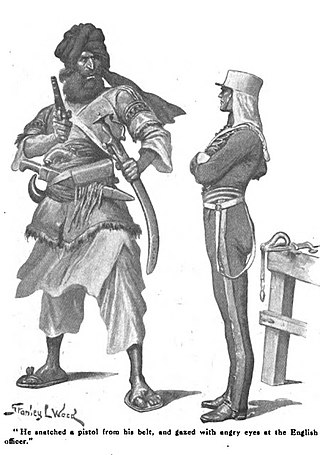
The Khattak tribe are a prominent Pashtun tribe located in the Khattak territory, which consists of Karak, Nowshera, Kohat districts of Khyber Pakhtunkhwa, Pakistan.
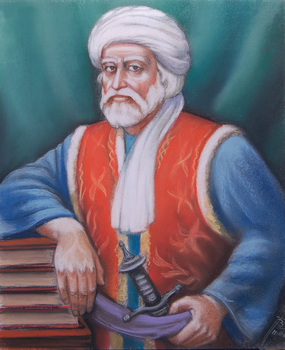
Khošāl Khān Khaṭak (Pashto: خوشال خان خټک; Urdu, Persian: خوشحال خان خٹک; 1613 – 20 February 1689), also known as Khushal Baba, was a 17th-century Pashtun poet, chief, and warrior. Khushal Khan served the Mughal Empire protecting them from Pashtun warriors over most of his lifespan. After being expelled from his tribal chiefdom and replaced with his son by his Mughal superiors, Khushal Khan turned against the Mughals. Afterwards, Khushal preached the union of all Pashtuns, and encouraged revolt against the Mughal Empire, promoting Pashtun nationalism in the last years of his life through poetry. Much of Khushal's poetry is in Pashto but some is also in Persian. Khushal is considered the "father of Pashto literature" and the national poet of Afghanistan.
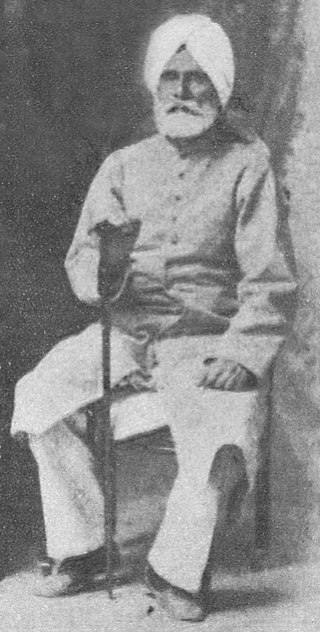
Altaf Hussain Hali, also known as Maulana Khawaja Hali, was an Urdu poet and writer.

Shahaji Bhonsale was a 17th century Indian military leader who served the Ahmadnagar Sultanate, the Bijapur Sultanate, and the Mughal Empire at various points in his career. As a member of the Bhonsle dynasty, Shahaji inherited the Pune and Supe jagirs (fiefs) from his father Maloji, who previously served the Ahmadnagar Sultanate. During the Mughal invasion of the Deccan, Shahaji joined the Mughal forces and served under Emperor Shah Jahan for a short period. After being deprived of his jagirs, he defected to the Bijapur Sultanate in 1632 and regained control over Pune and Supe. In 1638, he received the jagir of Bangalore after Bijapur's invasion of Kempe Gowda III's territories. Afterwards, he became the chief general of Bijapur and oversaw its expansion.

Mir Muhammad Taqi, known as Mir Taqi Mir, was an Urdu poet of the 18th century Mughal India and one of the pioneers who gave shape to the Urdu language itself. He was one of the principal poets of the Delhi School of the Urdu ghazal and is often remembered as one of the best poets of the Urdu language. His pen name (takhallus) was Mir. He spent the latter part of his life in the court of Asaf-ud-Daulah in Lucknow.

Khan Abdul Ghani Khan was a Pashtun Pashto language philosopher, poet, artist, writer and politician. He was a son of Abdul Ghaffar Khan, a prominent British Raj-era independence activist. Throughout his life as a poet in both British India and Pakistan, Khan was known by the titles Lewanay Pālsapay and Da īlam Samander.
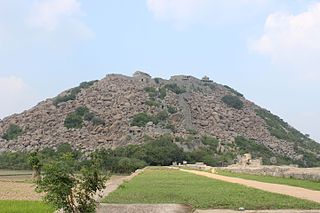
Gingee, also known as Senji or Jinji and originally called Singapuri, is a panchayat town in Viluppuram district in the Indian state of Tamil Nadu. Gingee is located between three hills covering a perimeter of 3 km, and lies west of the Sankaraparani River.

Abdur Rahmān Momand or Rahmān Bābā, was a renowned Pashtun Sufi Saint, member of Sufi Dervish and poet from Peshawar during the Mughal era. He, along with his contemporary Khushal Khan Khattak, is considered among the most popular poets of the Pashto language. His poetry expresses the mystical side of Islam, in line with his Sufi-oriented nature.

Zeb-un-Nissa was a Mughal princess and the eldest child of Emperor Aurangzeb and his chief consort, Dilras Banu Begum. She was also a poet, who wrote under the pseudonym of "Makhfi".
Mazari is a Baloch tribe in Pakistan. Mazari is derived from the Balochi word mazar, which means "Tiger" in the Balochi language. Rojhan-Mazari, a town in the Rajanpur District of the Punjab near the inter-provincial borders of Balochistan, Sindh and Punjab, is the stronghold and the headquarter of Mazari tribe.

Pashto literature refers to literature and poetry in Pashto language. The history of Pashto literature spreads over five thousands years having its roots in the oral tradition of Tappa. However, the first recorded period begins in 7th century with Amir Kror Suri. Later, Pir Roshan (1526–1574), who founded his own Sufi school of thoughts and began to preach his beliefs. He gave Pashto prose and poetry a new and powerful tone with a rich literary legacy. Khair-ul-Bayan, oft-quoted and bitterly criticized thesis, is most probably the first book on Sufism in Pashto literature. Among his disciples are some of the most distinguished poets, writers, scholars and sufis, like Arzani, Mukhlis, Mirza Khan Ansari, Daulat and Wasil, whose poetic works are well preserved. Akhund Darweza (1533–1615), a popular religious leader and scholar gave a powerful counterblast to Bayazid’s movement in the shape of Makhzanul Islam. He and his disciples have enriched the Pashto language and literature by writing several books of prose.
Afzal Khan Khattak was a Pashtun chief of the Khattak tribe, poet in Pashto, and author of Târikh-e morassa.
Akora Khattak or Sarai Akora is a town in the Jehangira tehsil of the Nowshera District in the Khyber Pakhtunkhwa province of Pakistan. Its location is adjacent to the Kabul River, which converges with the Indus River about 15 kilometres downstream. Neighbouring places are Nowshera Cantonment to the west and Jahangira town to the east.
Teri is Former Tehsil of Kohat now a village and Union Council in Karak District of Khyber Pakhtunkhwa, Pakistan. It is located at 33°18'0"N 71°6'0"E with an altitude of 634 metres (2,083 feet).
Shivaji was the founder of the Maratha Empire in the Indian subcontinent. This article describes Shivaji's life from his birth until the age of 19 years (1630–1649).
Aurangabad is one of the historical cities of the Deccan, India. It is well known for its literary and cultural traditions. As this city was the stronghold of the Mughals, a number of civil and military officers, men of letters, citizens, etc., from Delhi came here with the result that Aurangabad was so much influenced by the North Indian culture that it was considered to be the Delhi of the Deccan. Thus, till 1763, Aurangabad was the seat of Government and the capital of the Deccan. Afterwards when Hyderabad was made the capital, poets, literary men and learned people gradually left Aurangabad and this city lost its literary prominence. Still the city continued to produce men of literary genius well into the 20th century. Though, Aurangabad had gained its importance since the time of Malik Ambar, up to 1700 AD the literary achievements of that city in regard to the Urdu language are not traceable. The Urdu spoken in Aurangabad is Hyderabadi Urdu, which in itself is a form of Dakhini Urdu.
Lachi is one of the two tehsils in the Kohat District of Khyber Pakhtunkhwa province in Pakistan, located south of the district capital Kohat. It houses about 100,000 inhabitants, living in 1,161 square kilometres (448 sq mi). The tehsil is subdivided into nine union councils. About 40% of the working population is employed outside the tehsil.It is a rural area where most households' livelihood depends on remittances and subsistence farming. Education is provided through several private and government high schools, as well as a government degree college affiliated with Kohat University.
Malik Akorai, also known as Ako, was the first Chief of the Khattak tribe in the 16th century. Originally from Karbogha, he later moved to Khwarra due to a quarrel with his Karbogha relatives. Ako, with his tribe, engaged in conflicts with the neighboring Bangashes of Darsamand. Notably, Ako resisted Mughal Empire's forces and secured favorable terms, including a transit duty on cattle along the Peshawar-Attock road. He established Akora, which became the tribe's capital.
| International | |
|---|---|
| National | |
