
Assam is a state in northeastern India, south of the eastern Himalayas along the Brahmaputra and Barak River valleys. Assam covers an area of 78,438 km2 (30,285 sq mi). It is the second largest state in northeastern India by area and the largest in terms of population, with more than 31 million inhabitants. The state is bordered by Bhutan and Arunachal Pradesh to the north; Nagaland and Manipur to the east; Meghalaya, Tripura, Mizoram and Bangladesh to the south; and West Bengal to the west via the Siliguri Corridor, a 22-kilometre-wide (14 mi) strip of land that connects the state to the rest of India. Assamese and Boro for Bodoland Territorial Region are the official languages of Assam. Meitei (Manipuri) is recognised as an additional official language in Hojai district and for the Barak Valley region, alongside Bengali, which is also an official language in the Barak Valley.
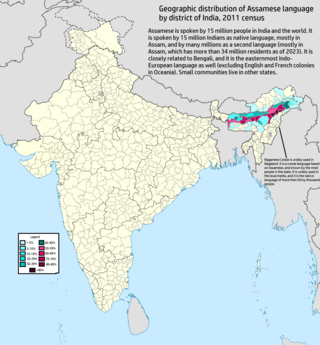
Assamese or Asamiya is an Indo-Aryan language spoken mainly in the north-eastern Indian state of Assam, where it is an official language. It serves as a lingua franca in parts of the Northeast India from a long time, in Arunachal Pradesh and Nagaland of India the Assamese language developed as a creole and pidgin language known as Nefamese and Nagamese creole which has become a lingua franca in Nagaland. It has over 15 million native speakers according to Ethnologue.

Dispur is the capital of the Indian state of Assam and is a suburb of Guwahati.

Golaghat district (Pron:ˌgəʊləˈgɑ:t) is an administrative district in the state of Assam in India. It attained district status in 1987. The district headquarters are located at Golaghat. The district occupies an area of3,502 km2 (1,352 sq mi) and lies 100 metres (330 ft) above sea level.

Jorhat is an administrative district of the Indian state of Assam situated in the central part of the Brahmaputra Valley. The district is bounded by Majuli on north, Nagaland state on the south, Sivasagar on the east and Golaghat on the west. On the north of the district, the river Brahmaputra forms the largest riverine island of the world. The administrative seat is at Jorhat city.

The history of Assam is the history of a confluence of people from the east, west, south and the north; the confluence of the Austroasiatic, Tibeto-Burman (Sino-Tibetan), Tai and Indo-Aryan cultures. Although invaded over the centuries, it was never a vassal or a colony to an external power until the third Burmese invasion in 1821, and, subsequently, the British ingress into Assam in 1824 during the First Anglo-Burmese War.

Jagiroad is a town in the state of Assam. Jagiroad located in Mayong Sub-Division, in Morigaon district. It is situated on the south bank of Kolong river.
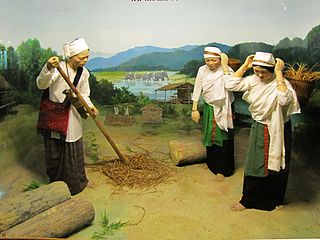
The Tai Khamti, also known as the Hkamti Shan or simply as Khamti, are a Tai ethnic group of India, China and Myanmar. The Tai-Khamti are followers of Theravada Buddhism. The Tai-Khamti have their own script for their language, known as 'Lik Tai', which originated from the Shan (Tai) script of Myanmar. Their mother tongue is known as Khamti language. It is a Tai language, closely related to Thai and Lao.

The People of Assam inhabit a multi-ethnic, multi-linguistic and multi-religious society. They speak languages that belong to four main language groups: Tibeto-Burman, Indo-Aryan, Tai-Kadai, and Austroasiatic. The large number of ethnic and linguistic groups, the population composition, and the peopling process in the state has led to it being called an "India in miniature".

The culture of Assam is traditionally a hybrid one, developed due to cultural assimilation of different ethno-cultural groups under various political-economic systems in different periods of its history.
Assam silk denotes the three major types of indigenous wild silks produced in Assam—golden muga, white pat and warm eri silk. The Assam silk industry, now centered in Sualkuchi, is a labor-intensive industry.
The Assamese people are a socio-ethnic linguistic identity that has been described at various times as nationalistic or micro-nationalistic. This group is often associated with the Assamese language, the easternmost Indo-Aryan language, and Assamese people mostly live in the Brahmaputra Valley region of Assam, where they are native and constitute around 56% of the Valley's population. The use of the term precedes the name of the language or the people. It has also been used retrospectively to the people of Assam before the term "Assamese" came into use. They are an ethnically diverse group formed after centuries of assimilation of Austroasiatic, Tibeto-Burman, Indo-Aryan and Tai populations, and constitute a tribal-caste continuum—though not all Assamese people are Hindus and ethnic Assamese Muslims numbering around 42 lakh (4,200,000) constitute a significant part of this identity. The total population of Assamese speakers in Assam is nearly 15.09 million which makes up 48.38% of the population of state according to the Language census of 2011.

Mekhela Sador is a traditional attire worn by women from Assam. Mekhela Sador is two-piece attire, the Mekhela and the Sador, and is generally made from silk such as Muga silk, Eri or Pat silk.

Udalguri district (Pron:ˌʊdʌlˈgʊəri), also known as Odalguri, is a district in the Bodoland Territorial Region of the state of Assam in Northeastern India. Udalguri town is the headquarters of the district.
Folk dances of Assam include the Bihu and the Bagurumba, the Bhortal, the Ojapali dance. Assam is home to many groups: Muslim, Indo-Aryan, Rabha, Bodo, Dimasa, Karbi, Mising, Sonowal Kacharis, Mishmi and Tiwa (Lalung) etc. These cultures come together to create an Assamese culture. Residents of the state of Assam are known as "Axomiya" (Assamese). Most tribes have their own language, although Assamese is the primary language of the state.
Assam is a state in northeastern India.

Jorhat is a major city in Upper Assam and a growing urban centre in the state of Assam in India.
Assam – 16th largest, 15th most populous and 26th most literate state of the 28 states of the democratic Republic of India. Assam is at 14th position in life expectancy and 8th in female-to-male sex ratio. Assam is the 21st most media exposed states in India. The Economy of Assam is largely agriculture based with 69% of the population engaged in it. Growth rate of Assam's income has not kept pace with that of India's during the Post-British Era; differences increased rapidly since the 1970s. While the Indian economy grew at 6 percent per annum over the period of 1981 to 2000, the same of Assam's grew only by 3.3 percent.
The Assamese Chinese, also known as the Zhongum people, are a small community of ethnic Chinese living in the town of Makum in Assam, India. Today, they are scattered throughout Assam. This group is primarily composed of descendants of Chinese immigrants who migrated to Assam in two distinct phases. The first phase involved the Zhongum forming alliances with the Dimasa kingdom, leading to the establishment of the Ming branch, known as Benghuo. The second phase saw another group of Zhongum arriving in Assam in 1850 when the British brought them for tea cultivation; these people are known as Juwai.

