Environment most often refers to:
Desktop publishing (DTP) is the creation of documents using dedicated software on a personal ("desktop") computer. It was first used almost exclusively for print publications, but now it also assists in the creation of various forms of online content. Desktop publishing software can generate page layouts and produce text and image content comparable to the simpler forms of traditional typography and printing. This technology allows individuals, businesses, and other organizations to self-publish a wide variety of content, from menus to magazines to books, without the expense of commercial printing.

A screen reader is a form of assistive technology (AT) that renders text and image content as speech or braille output. Screen readers are essential to people who are blind, and are useful to people who are visually impaired, illiterate, or have a learning disability. Screen readers are software applications that attempt to convey what people with normal eyesight see on a display to their users via non-visual means, like text-to-speech, sound icons, or a braille device. They do this by applying a wide variety of techniques that include, for example, interacting with dedicated accessibility APIs, using various operating system features, and employing hooking techniques.
A sandbox is a sandpit, a wide, shallow playground construction to hold sand, often made of wood or plastic.
Aide or AIDE may refer to:

A virtual keyboard is a software component that allows the input of characters without the need for physical keys. Interaction with a virtual keyboard happens mostly via a touchscreen interface, but can also take place in a different form when in virtual or augmented reality.
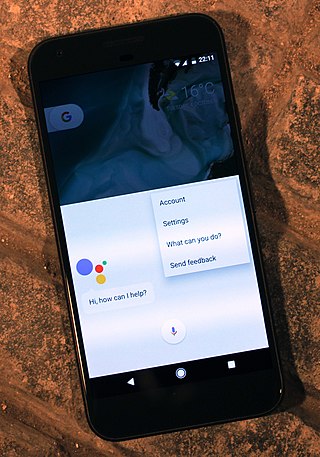
A virtual assistant (VA) is a software agent that can perform a range of tasks or services for a user based on user input such as commands or questions, including verbal ones. Such technologies often incorporate chatbot capabilities to simulate human conversation, such as via online chat, to facilitate interaction with their users. The interaction may be via text, graphical interface, or voice - as some virtual assistants are able to interpret human speech and respond via synthesized voices.
Assistance is an act of helping behavior.
Virtual agent may refer to:
A digital assistant may refer to:

Braina is a virtual assistant and speech-to-text dictation application for Microsoft Windows developed by Brainasoft. Braina uses natural language interface, speech synthesis, and speech recognition technology to interact with its users and allows them to use natural language sentences to perform various tasks on a computer. The name Braina is a short form of "Brain Artificial".
Mycroft was a free and open-source software virtual assistant that uses a natural language user interface. Its code was formerly copyleft, but is now under a permissive license. It was named after a fictional computer from the 1966 science fiction novel The Moon Is a Harsh Mistress.

Viv is a discontinued intelligent personal assistant created by the developers of Siri.

Google Assistant is a virtual assistant software application developed by Google that is primarily available on home automation and mobile devices. Based on artificial intelligence, Google Assistant can engage in two-way conversations, unlike the company's previous virtual assistant, Google Now.

A smart speaker is a type of loudspeaker and voice command device with an integrated virtual assistant that offers interactive actions and hands-free activation with the help of one "hot word". Some smart speakers can also act as a smart device that utilizes Wi-Fi and other protocol standards to extend usage beyond audio playback, such as to control home automation devices. This can include, but is not limited to, features such as compatibility across a number of services and platforms, peer-to-peer connection through mesh networking, virtual assistants, and others. Each can have its own designated interface and features in-house, usually launched or controlled via application or home automation software. Some smart speakers also include a screen to show the user a visual response.

Celia is an artificially intelligent virtual assistant developed by Huawei for their latest HarmonyOS and Android-based EMUI smartphones that lack Google Services and a Google Assistant. The assistant can perform day-to-day tasks, which include making a phone call, setting a reminder and checking the weather. It was unveiled on 7 April 2020 and got publicly released on 27 April 2020 via an OTA update solely to selected devices that can update their software to EMUI 10.1.

Home Assistant is free and open-source software used for home automation. It serves as an integration platform and smart home hub, allowing users to control smart home devices. The software emphasizes local control and privacy and is designed to be independent of any specific Internet of Things (IoT) ecosystem. Its interface can be accessed through a web-based user interface, by using companion apps for Android and iOS, or by voice commands via a supported virtual assistant, such as Google Assistant, Amazon Alexa, Apple Siri, and Home Assistant's own "Assist" using natural language.
This page is based on this
Wikipedia article Text is available under the
CC BY-SA 4.0 license; additional terms may apply.
Images, videos and audio are available under their respective licenses.

