Charles Dillon Perrine was an American astronomer at the Lick Observatory in California (1893-1909) who moved to Cordoba, Argentina to accept the position of Director of the Argentine National Observatory (1909-1936). The Cordoba Observatory under Perrine's direction made the first attempts to prove Einstein's theory of relativity by astronomical observation of the deflection of starlight near the Sun during the solar eclipse of October 10, 1912 in Cristina (Brazil), and the solar eclipse of August 21, 1914 at Feodosia, Crimea, Russian Empire. Rain in 1912 and clouds in 1914 prevented results.

Félix Aguilar Observatory is an astronomical observatory. It was established in 1953, in San Juan Province, Argentina. In 1974, it was renamed to Carlos Ulrrico Cesco Astronomical Station.

The El Leoncito Astronomical Complex is an astronomical observatory in the San Juan Province of Argentina. CASLEO is one of two observatories located within El Leoncito National Park, which is in a part of the country which rarely sees cloud cover. The other facility in the park is the Carlos U. Cesco Astronomical Station of the Félix Aguilar Observatory. CASLEO was established in 1983 by an agreement between National Scientific and Technical Research Council (CONICET) of Argentina, the Ministry of Science, Technology and Innovation (MINCYT) of Argentina, the National University of San Juan (UNSJ), the National University of La Plata (UNLP), and the National University of Córdoba (UNC). The facility was dedicated in 1986 and regular observations began in 1987.

The National Astronomical Observatory is an astronomical observatory in Baja California, Mexico.

The Spanish National Observatory is an astronomical observatory with several facilities in the Madrid area.

The Astronomical Observatory of Mallorca is an observatory just south of Costitx, Mallorca, Spain.

The Argentine National Observatory, today the Astronomical Observatory of Córdoba, was founded on 24 October 1871, by Argentine president Domingo F. Sarmiento and the North American astronomer Benjamin Apthorp Gould.
Erwin Schwab is a German amateur astronomer and discoverer of minor planets, who works at the GSI Helmholtz Centre for Heavy Ion Research, near Darmstadt, Germany. He has discovered and co-discovered more than 80 asteroids from the Starkenburg, Tzec Maun and Taunus observatories. As volunteer scientist for the European Space Agency (ESA) he recovered near-Earth objects and comets. From 2014 to 2021 he recovered 30 lost comets, which equates to about 25% of the worldwide proportion in that timespan. Using the Schmidt telescope at Calar Alto Observatory to search for a lost comet he discovered in 2019 a unique variable star – the first known eclipsing stream-fed intermediate polar, cataloged as J1832.4-1627

The Meade LX200 is a family of commercial telescopes produced by Meade Instruments launched in 1992 with 8" (20.32 cm) and a 10" (25.4 cm) Schmidt–Cassegrain models on computerized altazimuth mounts. Two larger models, a 12" (30.48 cm) and a 16" (40.64 cm), quickly followed. The original version was later informally named the "classic" LX200 as newer upgraded versions replaced it. The first of these was the LX200GPS, which featured global positioning system electronics. A 360 mm (14 in) LX200GPS was later added to the line.

The Quito Astronomical Observatory is a research institute of EPN, the National Polytechnic School in Quito, Ecuador. Its major research fields are astronomy and atmospheric physics.

La Alameda Park is a park in Quito.
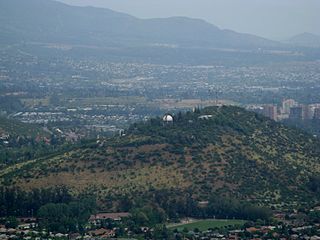
The National Astronomical Observatory of Chile is an astronomical observatory owned and operated by the Department of Astronomy of the University of Chile (UCh). It is located on Cerro Calán, a hill in the commune of Las Condes. The commune is an eastern suburb of Santiago located in Santiago Province of the Santiago Metropolitan Region. OAN was founded in 1852 and became a part of UCh in 1927. The facility on Cerro Calán was completed in 1962.

Tonantzintla Observatory is an astronomical observatory located in the municipality of San Andrés Cholula in the Mexican state of Puebla. It consists of two adjacent facilities: the National Astrophysical Observatory of Tonantzintla, operated by the National Institute of Astrophysics, Optics and Electronics (INAOE), and the National Astronomical Observatory - Tonantzintla, operated by the National Autonomous University of Mexico (UNAM). OANTON is located on the INAOE campus, which includes numerous other buildings. OAN - Tonantzintla is located immediately to the east on mostly unused property. The observatory is located 11 kilometres (6.8 mi) west of Puebla and 33 kilometres (21 mi) east of Popocatépetl, eruptions of which sometimes interfere with observing.

La Sagra Observatory is an astronomical observatory located in the province of Granada, Spain. It uses four robotic telescopes both designed and built by the scientists of the Observatorio Astronómico de Mallorca (OAM) who operate them remotely by telecontrol daily, discharging data from Mallorca using the Internet, to process them by means of algorithms designed "in house" which helped to detect asteroid 367943 Duende. among the other 1706 asteroids, with a 12th place in the ranking of asteroid discoveries. Its activities include, as part of its La Sagra Sky Survey, tracking small Solar System bodies, particularly near-Earth objects, and space debris.
The Instituto de Astronomía Teórica y Experimental (IATE) is a scientific institute funded by the Consejo Nacional de Investigaciones en Científicas y Técnicas (CONICET) and the Universidad Nacional de Córdoba (UNC), located in the city of Córdoba, Argentina, and dedicated to the study of different topics in astronomy. The headquarters of the institute are located at the Observatorio Astronómico de Córdoba.

Observatorio Astronómico de Forcarei

The Temisas Astronomical Observatory is an astronomical observatory on the island of Gran Canaria in the Canary Islands, Spain. It is located on Montaña de Arriba, Temisas, in the Agüimes municipality in the south-east of the island, at an altitude of 850 metres (2,790 ft).

The Astrophysical Observatory of Javalambre is a Spanish astronomical observatory located in the municipality of Arcos de las Salinas, Teruel. The facilities are located in the Pico del Buitre 1957 meters up in the Sierra de Javalambre. The observatory is managed by the Center for Physics Studies of the Cosmos of Aragon (CEFCA), dependent on the Department of Science, University and Knowledge Society Government of Aragon.
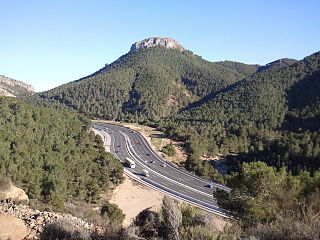
La Murta Observatory is an astronomical observatory located in the Spanish city of Murcia, more specifically in the Carrascoy mountains. It is municipal property and has the Observatory Code J76 of the MPC.1. The observatory is mainly dedicated to dissemination since 2001, the systematic monitorization of comets and asteroids in the Solar System.

The Astronomical Observatory of La Hita is an astronomical observatory located 9 kilometers from the urban center of the Toledo municipality of La Puebla de Almoradiel, Spain. The observatory, founded by Faustino Organero, is part of the La Hita Astronomical Complex and is managed by the AstroHita Foundation, which carries out research and dissemination work.