Audio signal processing is a subfield of signal processing that is concerned with the electronic manipulation of audio signals. Audio signals are electronic representations of sound waves—longitudinal waves which travel through air, consisting of compressions and rarefactions. The energy contained in audio signals is typically measured in decibels. As audio signals may be represented in either digital or analog format, processing may occur in either domain. Analog processors operate directly on the electrical signal, while digital processors operate mathematically on its digital representation.
In signal processing, data compression, source coding, or bit-rate reduction is the process of encoding information using fewer bits than the original representation. Any particular compression is either lossy or lossless. Lossless compression reduces bits by identifying and eliminating statistical redundancy. No information is lost in lossless compression. Lossy compression reduces bits by removing unnecessary or less important information. Typically, a device that performs data compression is referred to as an encoder, and one that performs the reversal of the process (decompression) as a decoder.

In information technology, lossy compression or irreversible compression is the class of data encoding methods that uses inexact approximations and partial data discarding to represent the content. These techniques are used to reduce data size for storing, handling, and transmitting content. The different versions of the photo of the cat on this page show how higher degrees of approximation create coarser images as more details are removed. This is opposed to lossless data compression which does not degrade the data. The amount of data reduction possible using lossy compression is much higher than using lossless techniques.
Waveform Audio File Format is an audio file format standard, developed by IBM and Microsoft, for storing an audio bitstream on PCs. It is the main format used on Microsoft Windows systems for uncompressed audio. The usual bitstream encoding is the linear pulse-code modulation (LPCM) format.
Compression may refer to:

An A-law algorithm is a standard companding algorithm, used in European 8-bit PCM digital communications systems to optimize, i.e. modify, the dynamic range of an analog signal for digitizing. It is one of two versions of the G.711 standard from ITU-T, the other version being the similar μ-law, used in North America and Japan.

In telecommunication and signal processing, companding is a method of mitigating the detrimental effects of a channel with limited dynamic range. The name is a portmanteau of the words compressing and expanding, which are the functions of a compander at the transmitting and receiving end respectively. The use of companding allows signals with a large dynamic range to be transmitted over facilities that have a smaller dynamic range capability. Companding is employed in telephony and other audio applications such as professional wireless microphones and analog recording.
Dynamic range is the ratio between the largest and smallest values that a certain quantity can assume. It is often used in the context of signals, like sound and light. It is measured either as a ratio or as a base-10 (decibel) or base-2 logarithmic value of the difference between the smallest and largest signal values.
The μ-law algorithm is a companding algorithm, primarily used in 8-bit PCM digital telecommunication systems in North America and Japan. It is one of two versions of the G.711 standard from ITU-T, the other version being the similar A-law. A-law is used in regions where digital telecommunication signals are carried on E-1 circuits, e.g. Europe.

Digital audio is a representation of sound recorded in, or converted into, digital form. In digital audio, the sound wave of the audio signal is typically encoded as numerical samples in a continuous sequence. For example, in CD audio, samples are taken 44,100 times per second, each with 16-bit sample depth. Digital audio is also the name for the entire technology of sound recording and reproduction using audio signals that have been encoded in digital form. Following significant advances in digital audio technology during the 1970s and 1980s, it gradually replaced analog audio technology in many areas of audio engineering and telecommunications in the 1990s and 2000s.

Automatic gain control (AGC) is a closed-loop feedback regulating circuit in an amplifier or chain of amplifiers, the purpose of which is to maintain a suitable signal amplitude at its output, despite variation of the signal amplitude at the input. The average or peak output signal level is used to dynamically adjust the gain of the amplifiers, enabling the circuit to work satisfactorily with a greater range of input signal levels. It is used in most radio receivers to equalize the average volume (loudness) of different radio stations due to differences in received signal strength, as well as variations in a single station's radio signal due to fading. Without AGC the sound emitted from an AM radio receiver would vary to an extreme extent from a weak to a strong signal; the AGC effectively reduces the volume if the signal is strong and raises it when it is weaker. In a typical receiver the AGC feedback control signal is usually taken from the detector stage and applied to control the gain of the IF or RF amplifier stages.

Dynamic range compression (DRC) or simply compression is an audio signal processing operation that reduces the volume of loud sounds or amplifies quiet sounds, thus reducing or compressing an audio signal's dynamic range. Compression is commonly used in sound recording and reproduction, broadcasting, live sound reinforcement and in some instrument amplifiers.
Electric power quality is the degree to which the voltage, frequency, and waveform of a power supply system conform to established specifications. Good power quality can be defined as a steady supply voltage that stays within the prescribed range, steady a.c. frequency close to the rated value, and smooth voltage curve waveform. In general, it is useful to consider power quality as the compatibility between what comes out of an electric outlet and the load that is plugged into it. The term is used to describe electric power that drives an electrical load and the load's ability to function properly. Without the proper power, an electrical device may malfunction, fail prematurely or not operate at all. There are many ways in which electric power can be of poor quality and many more causes of such poor quality power.

Clipping is a form of waveform distortion that occurs when an amplifier is overdriven and attempts to deliver an output voltage or current beyond its maximum capability. Driving an amplifier into clipping may cause it to output power in excess of its power rating.

The loudness war is a trend of increasing audio levels in recorded music, which reduces audio fidelity and — according to many critics — listener enjoyment. Increasing loudness was first reported as early as the 1940s, with respect to mastering practices for 7-inch singles. The maximum peak level of analog recordings such as these is limited by varying specifications of electronic equipment along the chain from source to listener, including vinyl and Compact Cassette players. The issue garnered renewed attention starting in the 1990s with the introduction of digital signal processing capable of producing further loudness increases.
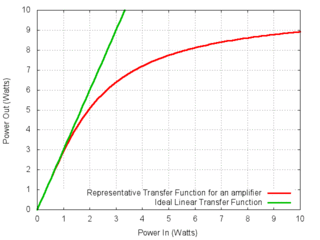
Gain compression is a reduction in differential or slope gain caused by nonlinearity of the transfer function of the amplifying device. This nonlinearity may be caused by heat due to power dissipation or by overdriving the active device beyond its linear region. It is a large-signal phenomenon of circuits.
Clipping is a form of distortion that limits a signal once it exceeds a threshold. Clipping may occur when a signal is recorded by a sensor that has constraints on the range of data it can measure, it can occur when a signal is digitized, or it can occur any other time an analog or digital signal is transformed, particularly in the presence of gain or overshoot and undershoot.
A Bitcrusher is an audio effect that produces distortion by reducing of the resolution or bandwidth of digital audio data. The resulting quantization noise may produce a "warmer" sound impression, or a harsh one, depending on the amount of reduction.

aptX is a family of proprietary audio codec compression algorithms owned by Qualcomm, with a heavy emphasis on wireless audio applications.
