A Holocaust memorial day or Holocaust remembrance day is an annual observance to commemorate the victims of the Holocaust, the genocide of six million Jews and of millions of other Holocaust victims by Nazi Germany and its collaborators. Many countries, primarily in Europe, have designated national dates of commemoration. In 2005, the United Nations instituted an international observance, International Holocaust Remembrance Day.
The March of the Living is an annual educational program which brings students from around the world to Poland, where they explore the remnants of the Holocaust. On Holocaust Memorial Day observed in the Jewish calendar, thousands of participants march silently from Auschwitz to Birkenau.

Czesława Kwoka was a Polish Catholic girl who was murdered at the age of 14 in Auschwitz. One of the thousands of minor child and teen victims of German World War II war crimes against ethnic Poles in German-occupied Poland, she is among those memorialized in an Auschwitz-Birkenau State Museum exhibit, "Block no. 6: Exhibition: The Life of the Prisoners".

The International Holocaust Remembrance Day, or the International Day in Memory of the Victims of the Holocaust, is an international memorial day on 27 January that commemorates the victims of the Holocaust, which resulted in the genocide of one third of the Jewish people, along with countless members of other minorities by Nazi Germany between 1933 and 1945, an attempt to implement its "final solution" to the Jewish question. 27 January was chosen to commemorate the date when the Auschwitz concentration camp was liberated by the Red Army in 1945.

Wilhelm Brasse was a Polish professional photographer and a prisoner in Auschwitz during World War II. He became known as the "famous photographer of Auschwitz concentration camp." His life and work were the subject of the 2005 Polish television documentary film The Portraitist (Portrecista), which first aired in the Proud to Present series on the Polish TVP1 on 1 January 2006.
The Portraitist is a 2005 Polish television documentary film about the life and work of Wilhelm Brasse, the famous "photographer of Auschwitz", made for TVP1, Poland, which first aired in its "Proud to Present" series on January 1, 2006. It also premiered at the Polish Film Festival, at the West London Synagogue, in London, on March 19, 2007.

Piotr Mateusz Andrzej Cywiński, is a Polish historian, medievalist and social activist. He has served as Director of the Auschwitz-Birkenau State Museum since 2006. From 2000 to 2010, he was the Director of the Catholic Intelligentsia Club (KIK) in Warsaw.

The Auschwitz-Birkenau State Museum is a museum on the site of the Nazi German Auschwitz concentration camp in Oświęcim, Poland.
The World Holocaust Forum is a series of events aimed at preserving the memory of the Holocaust. It is also known as the "Let My People Live!" Forum.
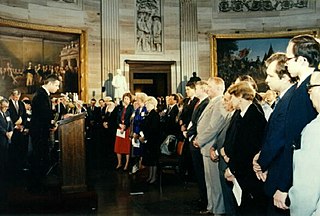
The Days of Remembrance of the Victims of the Holocaust (DRVH) is an annual eight-day period designated by the United States Congress for civic commemorations and special educational programs that help citizens remember and draw lessons from the Holocaust. The annual DRVH period normally begins on the Sunday before the Israeli observance of Yom HaShoah, Holocaust Memorial Day, and continues through the following Sunday, usually in April or May. A National Civic Commemoration is held in Washington, D.C., with state, city, and local ceremonies and programs held in most of the fifty states, and on U.S. military ships and stations around the world. The United States Holocaust Memorial Museum designates a theme for each year's programs, and provides materials to help support remembrance efforts.
Auschwitz-Birkenau Foundation, created in 2009 by Wladyslaw Bartoszewski, aims to gather and manage an endowment from which income shall finance the long-term, global preservation program of the Auschwitz-Birkenau Memorial Site.
Kazimierz Smoleń was a Polish political prisoner of the Nazi World War II KZ Auschwitz, and later a long-term director of Auschwitz-Birkenau State Museum.

The Majdanek State Museum is a memorial museum and education centre founded in the fall of 1944 on the grounds of the Nazi Germany Majdanek death camp located in Lublin, Poland. It was the first museum of its kind in the world, devoted entirely to the memory of atrocities committed in the network of concentration, slave-labor, and extermination camps and subcamps of KL Lublin during World War II. The museum performs several tasks including scholarly research into the Holocaust in Poland. It houses a permanent collection of rare artifacts, archival photographs, and testimony.
Elizabeth Ester Jaranyi was a survivor of Nazi concentration camps during the Holocaust and the memorist of The Flowers From My Mother's Garden.
Elly Kleinman is an American business executive and philanthropist best known as the founder and chief executive officer of the Americare Companies. He is the co-chairman of the Ohel Board of Directors, Chairman of Camp Kaylie Board of Trustees, and a former trustee of Maimonides Medical Center. In 2012 he was the chairman of 12th Siyum HaShas.

The March of the Living Digital Archive Project, begun in 2013, aims to gather Holocaust testimony from Canadian survivors who have participated in the March of the Living. Since 1988, Holocaust survivors have traveled to Poland with young students on the March of the Living to share their Holocaust stories in the locations they transpired.
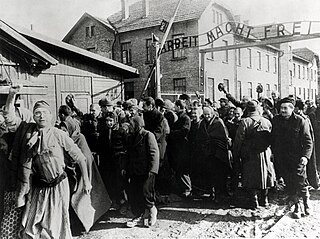
On 27 January 1945, Auschwitz—a Nazi concentration camp and extermination camp in occupied Poland where more than a million people were murdered as part of the Nazis' "Final Solution" to the Jewish question—was liberated by the Soviet Red Army during the Vistula–Oder Offensive. Although most of the prisoners had been forced onto a death march, about 7,000 had been left behind. The Soviet soldiers attempted to help the survivors and were shocked at the scale of Nazi crimes. The date is recognized as International Holocaust Remembrance Day.
Kalman Sultanik was a prominent Zionist figure who was active in numerous Jewish and Zionist organizations throughout his life. He was a member of the United States Holocaust Memorial Council, served on the Executive Committee of the Jewish Agency for Israel and became vice president of the World Jewish Congress as well as chairman of the World Zionist Organization American Section. He founded the Jerusalem Confederation House and led the World Confederation of United Zionists for decades. Sultanik was also active in assisting the Polish community of Holocaust survivors.
Maria Zalewska is a media, memory, and Holocaust scholar who focuses on the relationship between interactive technologies, visual culture, and Holocaust memory. She currently serves as the executive director of the Auschwitz-Birkenau Memorial Foundation, a New York-based non-profit organization.

Tova Friedman is a Jewish American therapist, social worker, author, and academic born in Poland. She is a Holocaust survivor who was sent to the Auschwitz concentration camp. Friedman taught at the Hebrew University of Jerusalem and later served as the director of the Jewish Family Service of Somerset and Warren Counties.
