
Moths are a polyphyletic group of insects that includes all members of the order Lepidoptera that are not butterflies, with moths making up the vast majority of the order. There are thought to be approximately 160,000 species of moth, many of which have yet to be described. Most species of moth are nocturnal, but there are also crepuscular and diurnal species.

The Sphingidae are a family of moths (Lepidoptera), commonly known as hawk moths, sphinx moths, and hornworms; it includes about 1,450 species. It is best represented in the tropics, but species are found in every region. They are moderate to large in size and are distinguished among moths for their rapid, sustained flying ability. Their narrow wings and streamlined abdomens are adaptations for rapid flight. The family was named by French zoologist Pierre André Latreille in 1802.

The geometer moths are moths belonging to the family Geometridae of the insect order Lepidoptera, the moths and butterflies. Their scientific name derives from the Ancient Greek geo γῆ or γαῖα "the earth", and metron μέτρων "measure" in reference to the way their larvae, or "inchworms", appear to "measure the earth" as they move along in a looping fashion. A very large family, it has around 23,000 species of moths described, and over 1400 species from six subfamilies indigenous to North America alone. A well-known member is the peppered moth, Biston betularia, which has been subject of numerous studies in population genetics. Several other geometer moths are notorious pests.

The Arctiinae are a large and diverse subfamily of moths, with around 11,000 species found all over the world, including 6,000 neotropical species. This group includes the groups commonly known as tiger moths, which usually have bright colours, footmen, which are usually much drabber, lichen moths, and wasp moths. Many species have "hairy" caterpillars that are popularly known as woolly bears or woolly worms. The scientific name of this subfamily refers to this hairiness. Some species within the Arctiinae have the word “tussock” in their common name due to people misidentifying them as members of the Lymantriinae based on the characteristics of the larvae.

The Ditrysia are a natural group or clade of insects in the lepidopteran order containing both butterflies and moths. They are so named because the female has two distinct sexual openings: one for mating, and the other for laying eggs.
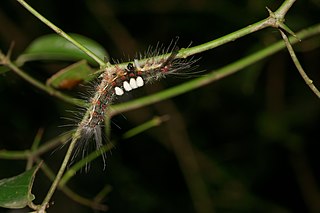
The Lymantriinae are a subfamily of moths of the family Erebidae.

Daniel Adam z Veleslavína, literally translated Daniel Adam of Veleslavín,, was a Czech lexicographer, publisher, translator, and writer.

The Lasiocampidae are a family of moths also known as eggars, snout moths, or lappet moths. Over 2,000 species occur worldwide, and probably not all have been named or studied.

The Coleophoridae are a family of small moths, belonging to the huge superfamily Gelechioidea. Collectively known as case-bearers, casebearing moths or case moths, this family is represented on all continents, but the majority are found in temperate areas of the Northern Hemisphere. They are most common in the Palearctic, and rare in sub-Saharan Africa, South America, and Australia; consequently, they probably originated in northern Eurasia. They are relatively common in houses, they seek out moist areas to rest and procreate.
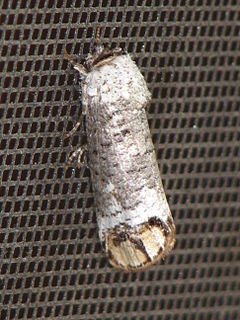
The Cossidae, the cossid millers or carpenter millers, make up a family of mostly large miller moths. This family contains over 110 genera with almost 700 known species, and many more species await description. Carpenter millers are nocturnal Lepidoptera found worldwide, except the Southeast Asian subfamily Ratardinae, which is mostly active during the day.
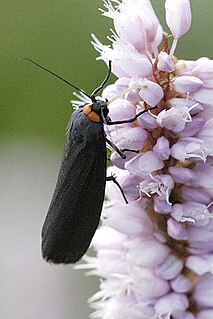
The Lithosiini are a tribe of lichen moths in the family Erebidae. The taxon was described by Gustaf Johan Billberg in 1820.
The Moth is the name of two American comic-book superhero characters. The first was created by artist Jim Mooney and an unknown writer for Fox Feature Syndicate in 1940, during the period fans and historians call the Golden Age of Comic Books. The second was created by writer-artist Steve Rude in 1998 for Dark Horse Comics.
Ava is a feminine given name in the English and in other languages. Its recent popularity may be linked to a number of celebrity babies of the 1990s, who were ultimately named after American actress Ava Gardner (1922—1990).
Aventina is a genus of moths of the family Noctuidae.

The Erebidae are a family of moths in the superfamily Noctuoidea. The family is among the largest families of moths by species count and contains a wide variety of well-known macromoth groups. The family includes the underwings (Catocala); litter moths (Herminiinae); tiger, lichen, and wasp moths (Arctiinae); tussock moths (Lymantriinae), including the arctic woolly bear moth ; piercing moths ; micronoctuoid moths (Micronoctuini); snout moths (Hypeninae); and zales, though many of these common names can also refer to moths outside the Erebidae. Some of the erebid moths are called owlets.
Aventin is an old and uncommon Russian male first name. Its feminine version is Aventina. The name is derived from Aventinus, which is the Latin name of the Aventine Hill, one of the hills on which the city of Rome was built.
Aventina is a Russian female first name. Its masculine version is Aventin.
