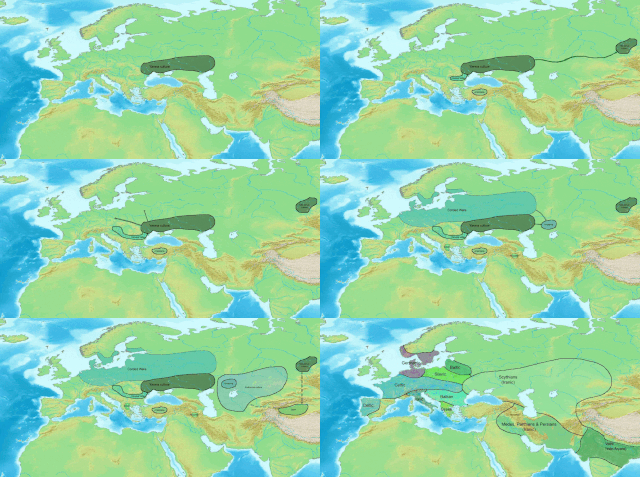
The Albanians are an ethnic group native to the Balkan Peninsula and are identified by a common Albanian ancestry, culture, history and language. They primarily live in Albania, Kosovo, North Macedonia, Montenegro, Serbia as well as in Croatia, Greece and Italy. They also constitute a diaspora with several communities established in the Americas, Europe and Oceania.

Enver Halil Hoxha was an Albanian communist politician who served as the head of state of Albania from 1944 until his death in 1985, as the First Secretary of the Party of Labour of Albania. He was chairman of the Democratic Front of Albania and commander-in-chief of the armed forces from 1944 until his death. He served as the 22nd Prime Minister of Albania from 1944 to 1954 and at various times served as foreign minister and defence minister as well.
The history of Albania forms a part of the history of Europe. During the classical times, Albania was home to several Illyrian tribes such as the Ardiaei, Albanoi, Amantini, Enchele, Taulantii and many others, but also Thracian and Greek tribes, as well as several Greek colonies established on the Illyrian coast. In the 3rd century BC, the area was annexed by Rome and became part of the Roman provinces of Dalmatia, Macedonia and Moesia Superior. Afterwards, the territory remained under Roman and Byzantine control until the Slavic migrations of the 7th century. It was integrated into the Bulgarian Empire in the 9th century.
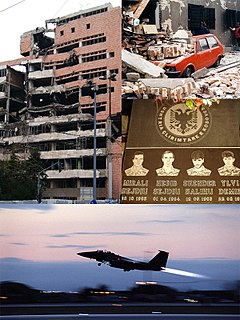
The Kosovo War was an armed conflict in Kosovo that started in late February 1998 and lasted until 11 June 1999. It was fought by the forces of the Federal Republic of Yugoslavia, which controlled Kosovo before the war, and the Kosovo Albanian rebel group known as the Kosovo Liberation Army (KLA), with air support from the North Atlantic Treaty Organisation (NATO) from 24 March 1999, and ground support from the Albanian army.
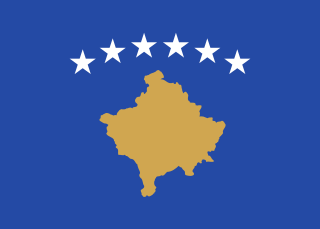
Kosovo, officially the Republic of Kosovo, is a partially recognized state and disputed territory in Southeastern Europe.

Tirana is the capital and largest city of the Republic of Albania.

The economy of Albania went through a process of transition from a centralized economy to a market-based economy on the principles of the free market. Albania is an Upper-middle-income country and a member of the North Atlantic Treaty Organisation (NATO), World Trade Organization (WTO), Organization for Security and Co-operation in Europe (OSCE) and Organization of the Black Sea Economic Cooperation (BSEC).

The lek is the official currency of Albania. It was formerly subdivided into 100 qindarka, but qindarka are no longer issued.

KF Tirana is an Albanian football club based in the country's capital city, Tirana. The men's football club is part of the multi-disciplinary sports club SK Tirana, and is the most successful in Albania, having won 51 recognized major domestic trophies. They play their home games at the Selman Stërmasi Stadium in Tirana and they play in the Albanian Superliga.

The Albania national football team is the men's football team that has represented Albania in international competition since 1946 and is controlled by the Albanian Football Association which is headquartered in the city of Tirana. The team is affiliated with UEFA and competes in the three major professional tournaments, the FIFA World Cup, UEFA European Championship and the UEFA Nations League.

The Parliament of Albania or Kuvendi is the unicameral representative body of the citizens of the Republic of Albania; it is Albania's legislature. The Parliament is composed of not less than 140 members elected to a four-year term on the basis of direct, universal, periodic and equal suffrage by secret ballot. The Parliament is presided over by a Speaker of the Parliament, who is assisted by at least one deputy speaker. The electoral system is based on party-list proportional representation. There are 12 multi-seat constituencies, corresponding to the country's administrative divisions.

The Albanian Superliga is a professional league for men's association football clubs. At the top of the Albanian football league system, it is the country's primary football competition. It is contested by 10 clubs, and operates on a system of promotion and relegation with the Albanian First Division. Seasons run from August to May, with teams playing 36 matches each.

The Vlora War or the War of 1920 was a series of battles between Italian forces garrisoned throughout the Vlorë region and Albanian nationalists, who were divided into small groups of fighters. The war lasted three months and had great impact in the struggle of Albania for the safeguard of its territories while Albanian borders and future were discussed in the Paris Peace Conference. The Vlora War is seen as a turning point in the establishment of Albanian independence.

Albanian Americans are Americans of full or partial Albanian ancestry and heritage in the United States. They trace their ancestry to the territories with a large Albanian population in the Balkans among others to Albania, Italy, Kosovo, Macedonia and Montenegro. They are adherents of different religions and are predominantly Christians, Muslims as well as Irreligious.

The Republic of Albania has been an official candidate for accession to the European Union (EU) since June 2014 and is on the current agenda for future enlargement of the EU.
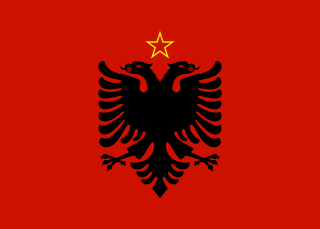
Albania, officially the People's Socialist Republic of Albania, was a Marxist-Leninist government that ruled Albania from 1946 to 1992. From 1944 to 1946, it was known as the Democratic Government of Albania and from 1946 to 1976 as the People's Republic of Albania.

The Italian protectorate of Albania, also known as Greater Albania, existed as a protectorate of the Kingdom of Italy. It was practically a union between Italy and Albania, officially led by Italy's King Victor Emmanuel III and its government: Albania was led by Italian governors, after being militarily occupied by Italy, from 1939 until 1943. During this time, Albania ceased to exist as an independent country and remained as an autonomous part of the Italian Empire led by Italian government officials, who intended to make Albania part of a Greater Italy by assimilating Albanians as Italians and colonizing Albania with Italian settlers from the Italian Peninsula to transform it gradually into an Italian land.

The German occupation of Albania occurred between 1943 and 1944 during World War II. Before the armistice between Italy and the Allied armed forces on 8 September 1943, Albania had been in a de jure personal union with and was de facto under the control of the Kingdom of Italy. After the armistice and the Italian exit from the Axis, German military forces entered Albania and it came under German occupation, creating the client-state, the Albanian Kingdom under Mehdi Frashëri.

Albanian is an Indo-European language spoken by the Albanians in the Balkans and the Albanian diaspora in the Americas, Europe and Oceania. It comprises an independent branch within the Indo-European languages and is not closely related to any other language in Europe.

