
A bone fracture is a medical condition in which there is a partial or complete break in the continuity of any bone in the body. In more severe cases, the bone may be broken into several fragments, known as a comminuted fracture. A bone fracture may be the result of high force impact or stress, or a minimal trauma injury as a result of certain medical conditions that weaken the bones, such as osteoporosis, osteopenia, bone cancer, or osteogenesis imperfecta, where the fracture is then properly termed a pathologic fracture.

The Segond fracture is a type of avulsion fracture from the lateral tibial plateau of the knee, immediately below the articular surface of the tibia.

An avulsion fracture is a bone fracture which occurs when a fragment of bone tears away from the main mass of bone as a result of physical trauma. This can occur at the ligament by the application of forces external to the body or at the tendon by a muscular contraction that is stronger than the forces holding the bone together. Generally muscular avulsion is prevented by the neurological limitations placed on muscle contractions. Highly trained athletes can overcome this neurological inhibition of strength and produce a much greater force output capable of breaking or avulsing a bone.
The rectus femoris muscle is one of the four quadriceps muscles of the human body. The others are the vastus medialis, the vastus intermedius, and the vastus lateralis. All four parts of the quadriceps muscle attach to the patella by the quadriceps tendon.

A brachial plexus injury (BPI), also known as brachial plexus lesion, is an injury to the brachial plexus, the network of nerves that conducts signals from the spinal cord to the shoulder, arm and hand. These nerves originate in the fifth, sixth, seventh and eighth cervical (C5–C8), and first thoracic (T1) spinal nerves, and innervate the muscles and skin of the chest, shoulder, arm and hand.

The ischium forms the lower and back region of the hip bone.
In real property law, avulsion refers to a sudden loss of land, which results from the action of water. It differs from accretion, which describes a gradual addition to land resulting from the action of water.

The triangular fibrocartilage complex (TFCC) is formed by the triangular fibrocartilage discus (TFC), the radioulnar ligaments (RULs) and the ulnocarpal ligaments (UCLs).
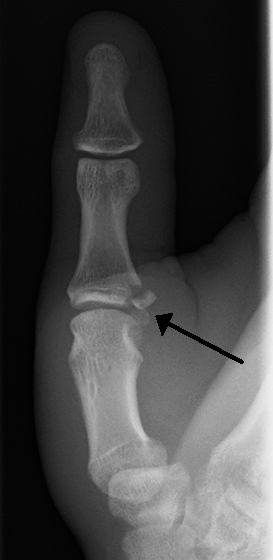
Gamekeeper's thumb is a type of injury to the ulnar collateral ligament (UCL) of the thumb. The UCL may be merely stretched, or it may be torn from its insertion site into the proximal phalanx of the thumb; in approximately 90% of cases part of the bone is actually avulsed from the joint. This condition is commonly observed among gamekeepers and Scottish fowl hunters, as well as athletes. It also occurs among people who sustain a fall onto an outstretched hand while holding a rod, frequently skiers grasping ski poles.
Biceps femoris tendon rupture can occur when the biceps femoris is injured in sports that require explosive bending of the knee as seen in sprinting. If the athlete is fatigued or has not warmed up properly he/she may suffer a hamstring strain/rupture, which is the tearing of the hamstring muscle. Avulsion of the biceps femoris tendon is the complete pulling away of the tendon from the bone. This most commonly occurs where the long head attaches to the ischial tuberosity. Injuries to biceps femoris are more common than to other hamstring muscles.
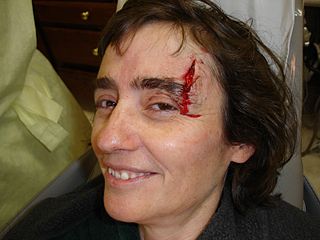
Emergency bleeding control describes actions that control bleeding from a patient who has suffered a traumatic injury or who has a medical condition that has caused bleeding. Many bleeding control techniques are taught as part of first aid throughout the world, though some more advanced techniques such as tourniquets, are often taught as being reserved for use by health professionals, or as an absolute last resort, to mitigate associated risks, such as potential loss of limbs. To manage bleeding effectively, it is important to be able to readily identify types of wounds and types of bleeding.

Jammed finger is a colloquialism referring to a variety of injuries to the joints of the fingers, resulting from axial loading beyond that which the ligaments can withstand. Common parts of the finger susceptible to this type of injury are ligaments, joints, and bones. The severity of the damage to the finger increases with the magnitude of the force exerted by the external object on the fingertip. Toes may become jammed as well, with similar results.
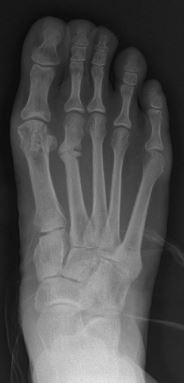
March fracture is the fracture of the distal third of one of the metatarsals occurring because of recurrent stress. It is more common in soldiers, but also occurs in hikers, organists, and people whose duties entail much standing. March fractures most commonly occur in the second and third metatarsal bones of the foot. It is a common cause of foot pain, especially when people suddenly increase their activities.
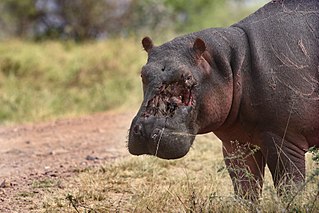
In medicine, an avulsion is an injury in which a body structure is torn off by either trauma or surgery. The term most commonly refers to a surface trauma where all layers of the skin have been torn away, exposing the underlying structures. This is similar to an abrasion but more severe, as body parts such as an eyelid or an ear can be partially or fully detached from the body.
Jersey finger, also known as rugby finger, is a finger-related tendon injury that is common in sport and can result in permanent loss of flexion of the end of the finger if not surgically repaired. The injury is common when one player grabs another's jersey with the tips of one or more fingers while that player is pulling or running away. It is the most common closed flexor tendon injury and occurs in the ring finger in 75% of cases.

Dental avulsion is the complete displacement of a tooth from its socket in alveolar bone owing to trauma. Normally, a tooth is connected to the socket by the periodontal ligament. When a tooth is knocked out, the ligament is torn.
Humeral avulsion of the glenohumeral ligament (HAGL) is defined as an avulsion of the inferior glenohumeral ligament from the anatomic neck of the humerus. In other words, it occurs when we have disruption of the ligaments that join the humerus to the glenoid. HAGL tends to occur in 7.5-9.3% of cases of anterior shoulder instability. Making it an uncommon cause of anterior shoulder instability. Avulsion of this ligamentous complex may occur in three sites: glenoid insertion (40%), the midsubstance (35%) and the humeral insertion (25%). Bony humeral avulsion of the glenohumeral ligament (BHAGL) refers when we have HAGL with bony fracture.

Orthopedic surgery is the branch of surgery concerned with conditions involving the musculoskeletal system. Orthopedic surgeons use both surgical and nonsurgical means to treat musculoskeletal injuries, sports injuries, degenerative diseases, infections, bone tumours, and congenital limb deformities. Trauma surgery and traumatology is a sub-specialty dealing with the operative management of fractures, major trauma and the multiply-injured patient.
The hyoid bone fracture is a very rare fracture of the hyoid bone, accounting for 0.002% of all fractures in humans. It is commonly associated with strangulation and rarely occurs in isolation. The fracture may be associated with gunshot injury, car accidents or induced vomiting. In 50% of strangulations and 27% of hangings, hyoid fractures occur.
A broken finger or finger fracture is a common type of bone fracture, affecting a finger. Symptoms may include pain, swelling, tenderness, bruising, deformity and reduced ability to move the finger. Although most finger fractures are easy to treat, failing to deal with a fracture appropriately may result in long-term pain and disability.

