 | Look up awang in Wiktionary, the free dictionary. |
Awang may refer to:
| Look up awang in Wiktionary, the free dictionary. |
Awang may refer to:

Abdul Hadi bin Awang is a Malaysian politician who has been President of the Pan-Malaysian Islamic Party (PAS), an Islamic political party in Malaysia, since 2002. He was Menteri Besar of Terengganu from 1999 to 2004, and he was the state assemblyman for Rhu Rendang and currently Member of Parliament for Marang, both in Terengganu. At the international level, he has been appointed as the Vice President of the International Union of Muslim Scholars.

Mohd Azizulhasni bin Awang is a Malaysian professional track cyclist. Nicknamed "The Pocket Rocketman" due to his small stature, he is the first Malaysian cyclist to win a medal at the UCI Track Cycling World Championships and at the Summer Olympics.
Hasbullah Awang is a Malaysian sports commentator. He worked as a sports commentator for Astro Arena from January 2014 until his death in February 2015. Formerly, he was a sports commentator at Radio Television Malaysia.
Datuk Dr. Awang Adek bin Hussin is a Malaysian politician and diplomat. He is the former Malaysian Ambassador to the United States. He was the Member of the Parliament of Malaysia for the Bachok constituency in Kelantan for one term from 2004 to 2008.

Awang Faroek Ishak is an Indonesian politician who was the Governor of East Kalimantan, Indonesia. Awang Faroek assumed office on December 2008, and his tenure ended in September 2018.
Awang bin Hassan was a Malaysian politician born in Muar, Johor.
Awang Bay is a bay in southeast Lombok, Indonesia, about 800 metres from the village of Ekas. It is a reputable surfing location. Cliffs overlook the bay from both sides.
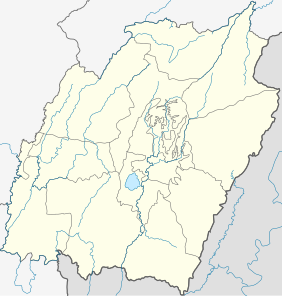
Awang Kasom is a village located north of Ukhrul in Ukhrul district, Manipur state, India. The village falls under Chingai sub division. National Highway 150 that connect Imphal-Kohima via Ukhrul and Jessami passes through the village. Awang Kasom is about 50 kilometers from Ukhrul; and is flanked by kuirei in the south, Peh in the west, Chingai in the north and poi in the east. Locally, the inhabitants speak Awang Kasom dialect that belongs to the Tibeto-Burman language family.
Awang are traditional dugout canoes of the Maranao people in the Philippines. They are used primarily in Lake Lanao for fishing or for transporting goods. They have long low hulls that are carved from single trunks of lauan and apitong trees. They have no outriggers but have a single sail. The prow and the stern are commonly elaborately decorated with painted designs and okir carvings, usually of the piyako and potiyok a rabong motifs. Some awang are also decorated with crown-like designs known as the panolong or kalandapon.
Awang, abbreviated as Awg. or Aw., is a commonly used honorific for the male commoners in Brunei.
 | This disambiguation page lists articles associated with the title Awang. If an internal link led you here, you may wish to change the link to point directly to the intended article. |
The history of Brunei concerns the settlements and societies located on the north coast of the island of Borneo, which has been under the influence of Indianised kingdoms and empires for much of its history. Local scholars assume that the Islamisation of Brunei started in the fifteenth century, with the formation of the Bruneian Empire, a thalassocracy which covered the northern part of Borneo and the southern Philippines. At the end of the 17th century, Brunei subsequently entered a period of decline brought on by Brunei Civil War, piracy, and European colonial expansion. Later, there was a brief war with Spain, in which Brunei lost Manila and evacuated their capital for a brief period until the Spanish withdrew. The empire lost much of its territory with the arrival of the Western powers, such as the Spanish in the Philippines and the British in Labuan, Sarawak, and North Borneo. The decline of the Bruneian Empire accelerated in the nineteenth century when Brunei gave much of its territory to the White Rajahs of Sarawak, resulting in its current small landmass and separation into two parts. Sultan Hashim Jalilul Alam Aqamaddin later appealed to the British to stop further annexation in 1888. In the same year, the British signed a "Treaty of Protection" and made Brunei a British protectorate until 1984 when it gained independence and prospered due to the discovery of oil.
The Malay language has a complex system of styles, titles and honorifics, which are used extensively in Brunei and Malaysia.
Datuk is a Malay title commonly used in Brunei and Malaysia, as well as a traditional title by Minangkabau people in Indonesia, and in East Timor. The title of the wife of Datuk is Datin.
Nasir al-Din, Nasir ad-Din or Nasiruddin was originally an honorific title and is an Arabic masculine given name. There are many variant spellings in English, which may refer to:

Crown Prince Haji Al-Muhtadee Billah is the eldest son of Sultan Hassanal Bolkiah and his wife Princess Saleha binti Mohammad Alam. He is the Crown Prince of Brunei Darussalam and is first in the line of succession to the Bruneian throne.

Limbang is a border town and the capital of Limbang District in the Limbang Division of northern Sarawak, East Malaysia, on the island of Borneo. It is located on the banks of the Limbang River, between the two halves of Brunei.
The 1999 Southeast Asian Games, officially known as the 20th Southeast Asian Games, was a Southeast Asian multi-sport event held in Bandar Seri Begawan, Brunei Darussalam. This was the first time Brunei hosted the Southeast Asian Games and also in Borneo island.
Sulaiman is an English transliteration of the Arabic name سليمان that means "man of peace" and corresponds to the English name Solomon. Solomon was the scriptural figure who was king of Israel and a Muslim prophet.

The Bisaya are an indigenous people of the north-west and the coast line of Borneo, Malaysia. They mostly live in Limbang division and Lawas district, more than 20 villages including Kg Batu Danau to name a few. In part of Sabah, Bisaya mostly live near the Beaufort district, the Padas River also Kuala Penyu in the Sabah region. There are also some Bisaya living in Kampung Manunggang, Sabah. Nowadays the Bisaya living in Sabah are Muslim, while the Bisaya living in Sarawak are mostly Christian. In Brunei, they are referred as Dusun, Jati Dusun and Bisaya. The Bisaya people are also regarded as a relatives of the Dayak people whereas Bisaya was not brought into Borneo instead they are aboriginal of the land.

Universiti Brunei Darussalam is the first university in Brunei. It was established in 1985 and has since become the largest university in the country in terms of student enrollment and curriculum offered.
Muhammad Shah established the Sultanate of Brunei and was its first sultan, possibly from 1363 to 1402. The genealogy of Muhammad Shah is unclear, and based on several historical sources and legends.

The Bruneian Empire or Empire of Brunei, also known as Sultanate of Brunei, was a Malay sultanate, centred in Brunei on the northern coast of Borneo island in Southeast Asia. Bruneian rulers converted to Islam around the 15th century, when it grew substantially since the fall of Malacca to the Portuguese, extending throughout coastal areas of Borneo and the Philippines, before it declined in the 17th century.
This article lists important figures and events in Malayan public affairs during the year 1952, together with births and deaths of significant Malayans.

The history of Sabah can be traced back to about 23–30,000 years ago when evidence suggests the earliest human settlement in the region existed. The history is interwoven with the history of Brunei and the history of Malaysia, which Sabah was previously part of and is currently part of respectively. The earliest recorded history of Sabah being part of any organised civilisation began in the early 15th century during the thriving era of the Sultanate of Brunei. Prior to this, early inhabitants of the land lived in predominantly tribal societies, although such tribal societies had continued to exist until the 1900s. The eastern part of Sabah was ceded to the Sultan of Sulu by the Sultan of Brunei in 1658 for the former helping a victory over Brunei enemies, but many sources stated it had not been ceded at all. By the late 19th century, both territories previously owned by Sultan of Brunei and Sultan of Sulu was granted to British syndicate and later emerged as British North Borneo under the management of the North Borneo Chartered Company. Sabah became a protectorate of the United Kingdom in 1888 and subsequently became a Crown colony from 1946 until 1963, during which time it was known as Crown Colony of North Borneo. On 16 September 1963, Sabah merged with Malaya, Sarawak and Singapore to form the Federation of Malaysia.
Abdul Jalil is a Muslim male given name, also used by Christians, and in modern usage, surname. It is built from the Arabic words Abd, al- and Jalil. The name means "servant of the Exalted", Al-Jalīl being one of the names of God in the Qur'an, which give rise to the Muslim theophoric names.
Mohammed Hasbullah bin Awang is a Malaysian footballer who plays and captain for Terengganu II in Malaysia Premier League as a defender.
Yang Dimuliakan Pehin Datu Indera Setia Major General (Rtd.) Dato Paduka Seri Haji Awang Sulaiman Bin Haji Awang Damit was a Bruneian soldier who served as the Commander of the Royal Brunei Armed Forces (RBAF) from 1990 until 1994.