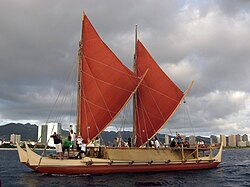
Awang are traditional dugout canoes of the Maranao and Maguindanao people in the Philippines. They are used primarily in Lake Lanao, the Pulangi River, and the Liguasan Marsh for fishing or for transporting goods. They have long low hulls that are carved from single trunks of lauan and apitong trees. They are propelled by paddling or by sail, and commonly have a pair of bamboo outriggers. The prow and the stern are elaborately decorated with painted designs and okir carvings, usually of the piyako and potiyok a rabong motifs. Some awang are also decorated with a carved prow extension known as the panolong or kalandapon.[1][2][3][4]
Modern awang became much shorter and far less ornate than the traditional awang after World War II. They are in danger of disappearing.[5]
↑"Awang". Museyo Kutawato. Retrieved 12 February 2020.
↑Sakili, Abraham P. (2003). Space and Identity: Expressions in the Culture, Arts and Society of the Muslims in the Philippines. p.210. ISBN9789718992135.
↑Gowring, Peter G. (1979). Muslim Filipinos: Heritage and Horizon. New Day Publishers. pp.146–147. ISBN9789711002404.
This page is based on this Wikipedia article Text is available under the CC BY-SA 4.0 license; additional terms may apply. Images, videos and audio are available under their respective licenses.