
Axel may refer to:
Axel may refer to:


Brian Anthony Boitano is an American figure skater from Sunnyvale, California. He is the 1988 Olympic champion, the 1986 and 1988 World Champion, and the 1985–1988 U.S. National Champion.
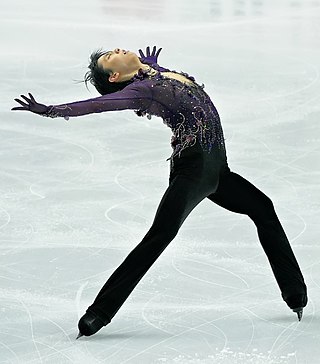
Figure skating is a sport in which individuals, pairs, or groups perform on figure skates on ice. It was the first winter sport to be included in the Olympic Games, when it was contested at the 1908 Olympics in London. The Olympic disciplines are men's singles, women's singles, pair skating, and ice dance; the four individual disciplines are also combined into a team event, which was first included in the Winter Olympics in 2014. The non-Olympic disciplines include synchronized skating, Theater on Ice, and four skating. From intermediate through senior-level competition, skaters generally perform two programs, which, depending on the discipline, may include spins, jumps, moves in the field, lifts, throw jumps, death spirals, and other elements or moves.
Figure skating jumps are an element of three competitive figure skating disciplines: men's singles, women's singles, and pair skating – but not ice dancing. Jumping in figure skating is "relatively recent". They were originally individual compulsory figures, and sometimes special figures; many jumps were named after the skaters who invented them or from the figures from which they were developed. It was not until the early part of the 20th century, well after the establishment of organized skating competitions, when jumps with the potential of being completed with multiple revolutions were invented and when jumps were formally categorized. In the 1920s Austrian skaters began to perform the first double jumps in practice. Skaters experimented with jumps, and by the end of the period, the modern repertoire of jumps had been developed. Jumps did not have a major role in free skating programs during international competitions until the 1930s. During the post-war period and into the 1950s and early 1960s, triple jumps became more common for both male and female skaters, and a full repertoire of two-revolution jumps had been fully developed. In the 1980s men were expected to complete four or five difficult triple jumps, and women had to perform the easier triples. By the 1990s, after compulsory figures were removed from competitions, multi-revolution jumps became more important in figure skating.

Roller skating is the act of travelling on surfaces with roller skates. It is a recreational activity, a sport, and a form of transportation. Roller rinks and skate parks are built for roller skating, though it also takes place on streets, sidewalks, and bike paths.
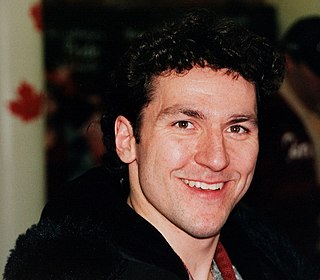
Elvis Stojko, is a Canadian figure skater. He was a three-time World champion, two-time Olympic silver medallist, and seven-time Canadian champion.
Quad as a word or prefix usually means 'four'. It may refer to:

Midori Ito is a retired Japanese figure skater. She is the 1989 World champion and the 1992 Olympic silver medalist. She is the first woman to land a triple-triple jump combination and a triple Axel in competition. At the 1988 Calgary Olympics, she became the first woman to land seven triple jumps in an Olympic free skating competition. She is widely recognised as one of the best figure skaters of all time.
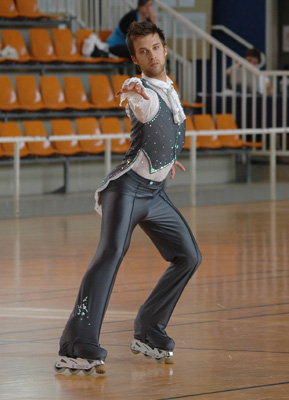
Artistic roller skating is a competitive sport similar to figure skating but where competitors wear roller skates instead of ice skates. Within artistic roller skating, there are several disciplines:
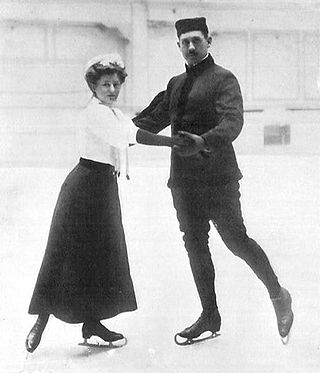
Pair skating is a figure skating discipline defined by the International Skating Union (ISU) as "the skating of two persons in unison who perform their movements in such harmony with each other as to give the impression of genuine Pair Skating as compared with independent Single Skating". The ISU also states that a pairs team consists of "one Woman and one Man". Pair skating, along with men's and women's single skating, has been an Olympic discipline since figure skating, the oldest Winter Olympic sport, was introduced at the 1908 Summer Olympics in London. The ISU World Figure Skating Championships introduced pair skating in 1908.
The ISU Judging System (or the International Judging System (IJS)), occasionally referred to as the Code of Points (COP) system, is the scoring system that has been used since 2004 to judge the figure skating disciplines of men's and ladies' singles, pair skating, ice dance, and synchronized skating. It was designed and implemented by the International Skating Union (ISU), the ruling body of the sport.
The following is a glossary of figure skating terms, sorted alphabetically.
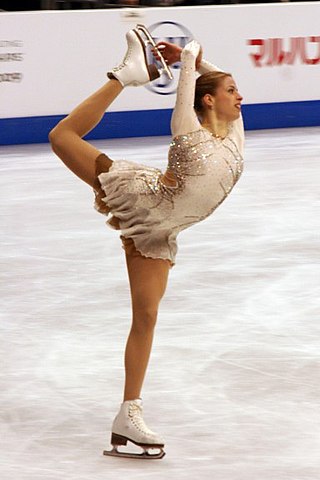
Single skating is a discipline of figure skating in which male and female skaters compete individually. Men's singles and women's singles are governed by the International Skating Union (ISU). Figure skating is the oldest winter sport contested at the Olympics, with men's and women's single skating appearing as two of the four figure skating events at the London Games in 1908.
The short program of figure skating is the first of two segments of competitions, skated before the free skating program. It lasts, for both senior and junior singles and pair skaters, 2 minutes and 40 seconds. In synchronized skating, for both juniors and seniors, the short program lasts 2 minutes and 50 seconds. Vocal music with lyrics is allowed for all disciplines since the 2014-2015 season. The short program for single skaters and for pair skaters consists of seven required elements, and there are six required elements for synchronized skaters.
The free skating segment of figure skating, also called the free skate and the long program, is the second of two segments of competitions, skated after the short program. Its duration, across all disciplines, is four minutes for senior skaters and teams, and three and one-half minutes for junior skaters and teams. Vocal music with lyrics is allowed for all disciplines since the 2014—2015 season. The free skating program, across all disciplines, must be well-balanced and include certain elements described and published by the International Skating Union (ISU).

Jozef Sabovčík is a Slovak figure skater who competed representing Czechoslovakia. He is the 1984 Olympic bronze medalist, a two-time European champion, and a six-time Czechoslovak national champion. His quad toe loop at the 1986 European Championships was originally approved as the first quad jump landed in competition, but a few weeks later it was deemed invalid due to a touchdown with his free foot.
British Ice Skating is the national governing body of ice skating within the United Kingdom. Formed in 1879, it is responsible for overseeing all disciplines of ice skating: figure skating ; synchronised skating; and speed skating.
A step sequence is a required element in all four disciplines of figure skating, men's single skating, women's single skating, pair skating, and ice dance. Step sequences have been defined as "steps and turns in a pattern on the ice". Skaters earn the most points in step sequences by performing steps and movements with "flair and personality", by turning in both directions, by using one foot and then the other, and by including up and down movements.
The Axel jump or Axel Paulsen jump, named after its inventor, Norwegian figure skater Axel Paulsen, is an edge jump performed in figure skating. It is the sport's oldest and most difficult jump, and the only basic jump in competition with a forward take-off, which makes it the easiest to identify. A double or triple Axel is required in both the short program and the free skating segment for junior and senior single skaters in all events sanctioned by the International Skating Union (ISU).

You Young is a South Korean figure skater. She is the 2020 Four Continents silver medalist, a four-time Grand Prix bronze medalist, a four-time Challenger series medalist, and a five-time South Korean national champion
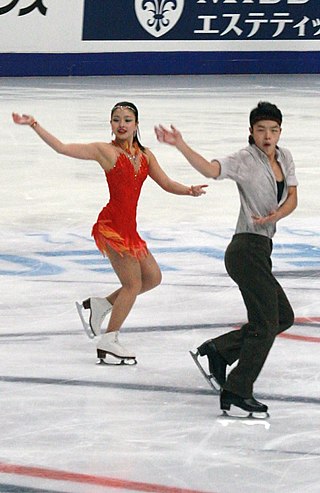
Ice dance, a discipline of figure skating, has required elements that make up a well-balanced rhythm dance program and free dance program, which must be performed during competitions. They include: the dance lift, the dance spin, the step sequence, turn sequences, and choreographic elements. The elements must be performed in specific ways, as described by published communications by the International Skating Union (ISU), unless otherwise specified. The ISU has also provided a list of illegal movements.