
The anus is an opening at the opposite end of an animal's digestive tract from the mouth. Its function is to control the expulsion of feces, the residual semi-solid waste that remains after food digestion, which, depending on the type of animal, includes: matter which the animal cannot digest, such as bones; food material after the nutrients have been extracted, for example cellulose or lignin; ingested matter which would be toxic if it remained in the digestive tract; and dead or excess gut bacteria and other endosymbionts.

Bryozoa are a phylum of simple, aquatic invertebrate animals, nearly all living in sedentary colonies. Typically about 0.5 millimetres long, they have a special feeding structure called a lophophore, a "crown" of tentacles used for filter feeding. Most marine bryozoans live in tropical waters, but a few are found in oceanic trenches and polar waters. The bryozoans are classified as the marine bryozoans (Stenolaemata), freshwater bryozoans (Phylactolaemata), and mostly-marine bryozoans (Gymnolaemata), a few members of which prefer brackish water. 5,869 living species are known. One genus is solitary; all the rest are colonial.

The peritoneum is the serous membrane forming the lining of the abdominal cavity or coelom in amniotes and some invertebrates, such as annelids. It covers most of the intra-abdominal organs, and is composed of a layer of mesothelium supported by a thin layer of connective tissue. This peritoneal lining of the cavity supports many of the abdominal organs and serves as a conduit for their blood vessels, lymphatic vessels, and nerves.

The Sipuncula or Sipunculida is a group containing about 162 species of bilaterally symmetrical, unsegmented marine worms. The name Sipuncula is from the genus name Sipunculus, and comes from the Latin siphunculus meaning a "small tube". Sipuncula seems to be closely related to Myzostomida, and Annelida.

The abdominal cavity is a large body cavity in humans and many other animals that contains many organs. It is a part of the abdominopelvic cavity. It is located below the thoracic cavity, and above the pelvic cavity. Its dome-shaped roof is the thoracic diaphragm, a thin sheet of muscle under the lungs, and its floor is the pelvic inlet, opening into the pelvis.
A body cavity is any space or compartment, or potential space, in an animal body. Cavities accommodate organs and other structures; cavities as potential spaces contain fluid.
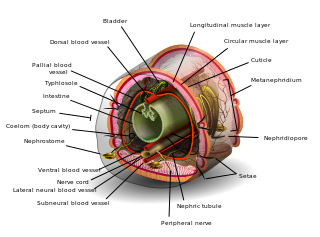
The coelom is the main body cavity in most animals and is positioned inside the body to surround and contain the digestive tract and other organs. In some animals, it is lined with mesothelium. In other animals, such as molluscs, it remains undifferentiated. In the past, and for practical purposes, coelom characteristics have been used to classify bilaterian animal phyla into informal groups.

The pleural cavity, pleural space, or interpleural space, is the potential space between the pleurae of the pleural sac that surrounds each lung. A small amount of serous pleural fluid is maintained in the pleural cavity to enable lubrication between the membranes, and also to create a pressure gradient.

The gestational sac is the large cavity of fluid surrounding the embryo. During early embryogenesis it consists of the extraembryonic coelom, also called the chorionic cavity. The gestational sac is normally contained within the uterus. It is the only available structure that can be used to determine if an intrauterine pregnancy exists until the embryo can be identified.

Balanoglossus is an ocean-dwelling(only Marine water dwelling, not fresh water dwelling) acorn worm (Enteropneusta) genus of great zoological interest because, being a Hemichordate, it is an "evolutionary link" between invertebrates and vertebrates. Balanoglossus is a deuterostome, and resembles the Ascidians or sea squirts, in that it possesses branchial openings, or "gill slits". It has notochord in the upper part of the body and has no nerve chord. It does have a stomochord, however, which is gut chord within the collar. Their heads may be as small as per 2.5 mm (1/10 in) or as large as 5 mm (1/5 in).
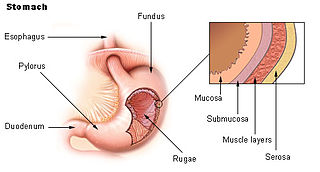
In anatomy, serous membrane is a smooth tissue membrane of mesothelium lining the contents and inside wall of body cavities, which secrete serous fluid to allow lubricated sliding movements between opposing surfaces. The serous membrane that covers internal organs is called a visceral membrane; while the one that covers the cavity wall is called the parietal membrane. Between the two opposing serosal surfaces is often a potential space, mostly empty except for the small amount of serous fluid.
Schizocoely is a process by which some animal embryos develop. The schizocoely mechanism occurs when secondary body cavities (coeloms) are formed by splitting a solid mass of mesodermal embryonic tissue.
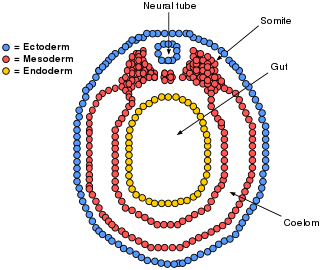
The lateral plate mesoderm is the mesoderm that is found at the periphery of the embryo. It is to the side of the paraxial mesoderm, and further to the axial mesoderm. The lateral plate mesoderm is separated from the paraxial mesoderm by a narrow region of intermediate mesoderm. The mesoderm is the middle layer of the three germ layers, between the outer ectoderm and innner endoderm.

Bilaminar blastocyst or bilaminar disc refers to the epiblast and the hypoblast, evolved from the embryoblast. These two layers are sandwiched between two balloons: the primitive yolk sac and the amniotic cavity.
In earlier conceptions of kidney biology, the nephrotome was a section of the mesoderm that gives rise to the pronephros and eventually to the rest of the kidney. Older texts describe the pronephros as forming through the fusion of multiple nephrotomes.
Enterocoely describes both the process by which some animal embryos develop and the origin of the cells involved. In enterocoely, a mesoderm is formed in a developing embryo, in which the coelom appears from pouches growing and separating from the digestive tract. As the incipient coelomic epithelium originates from archenteral diverticula, the endoderm therefore gives rise to the mesodermal cells.
In the development of the human embryo the intraembryonic coelom is a portion of the conceptus forming in the mesoderm during the third week of development. During the third week of development, the lateral plate mesoderm splits into a dorsal somatic mesoderm (somatopleure) and a ventral splanchnic mesoderm (splanchnopleure). The resulting cavity between the somatopleure and splanchnopleure is called the intraembryonic coelom. This space will give rise to the thoracic and abdominal cavities. The coelomic spaces in the lateral mesoderm and cardiogenic area are isolated. The isolated coelom begins to organize into a horseshoe shape. The spaces soon join together and form a single horseshoe-shaped cavity, the intraembryonic coelom which separates the mesoderm into two layers.
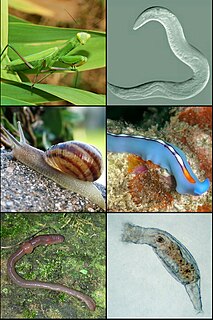
Protostomia is the clade of animals once thought to be characterized by the formation of the organism's mouth before its anus during embryonic development. This nature has since been discovered to be extremely variable among Protostomia's members, although the reverse is typically true of its sister clade, Deuterostomia. Some examples of protostomes are arthropods, molluscs, and tardigrades.

Xenacoelomorpha is a small phylum of bilaterian invertebrate animals, consisting of two sister groups: xenoturbellids and acoelomorphs. This new phylum was named in February 2011 and suggested based on morphological synapomorphies, which was then confirmed by phylogenomic analyses of molecular data.
The pulmonary pleurae are the two opposing layers of serous membrane overlying the lungs and the inside of the surrounding chest walls.


