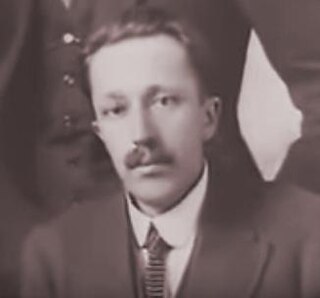
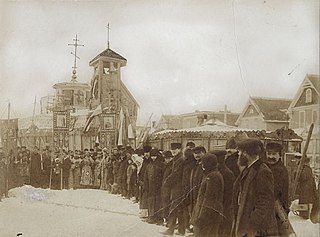
Benjamin B. Janz (25 September 1877 – 16 October 1964) was a minister of the Mennonite Brethren Church who was instrumental in assisting thousands of Mennonites in emigrating from the Soviet Union to Canada.

The Mennonite Brethren Church was established among Plautdietsch-speaking Russian Mennonites in 1860, and has congregations in more than 20 countries, representing about 500,000 believers as of 2019.
The Soviet Union, officially the Union of Soviet Socialist Republics (USSR), was a socialist state in Eurasia that existed from 30 December 1922 to 26 December 1991. Nominally a union of multiple national Soviet republics, its government and economy were highly centralized. The country was a one-party state, governed by the Communist Party with Moscow as its capital in its largest republic, the Russian Soviet Federative Socialist Republic. Other major urban centres were Leningrad, Kiev, Minsk, Alma-Ata, and Novosibirsk.

Canada is a country in the northern part of North America. Its ten provinces and three territories extend from the Atlantic to the Pacific and northward into the Arctic Ocean, covering 9.98 million square kilometres, making it the world's second-largest country by total area. Canada's southern border with the United States is the world's longest bi-national land border. Its capital is Ottawa, and its three largest metropolitan areas are Toronto, Montreal, and Vancouver. As a whole, Canada is sparsely populated, the majority of its land area being dominated by forest and tundra. Consequently, its population is highly urbanized, with over 80 percent of its inhabitants concentrated in large and medium-sized cities, many near the southern border. Canada's climate varies widely across its vast area, ranging from arctic weather in the north, to hot summers in the southern regions, with four distinct seasons.
Janz was born in Konteniusfeld, Molotschna, Russian Empire, in current-day Ukraine. He was baptized into the Mennonite Brethren Church on 10 August 1897. In 1905 he married Maria Rogalsky.
Molotschna Colony or Molochna Colony was a Russian Mennonite settlement in what is now Zaporizhia Oblast in Ukraine. Today the central village is called Molochansk and it has a population of under 10,000. The settlement is named after the Molochna River which forms its western boundary. Today the land falls mostly within the Tokmatskyi and Chernihivskyi Raions. The nearest large city is Melitopol to the southwest of Molochansk.

The Russian Empire, also known as Imperial Russia or simply Russia, was an empire that existed across Eurasia and North America from 1721, following the end of the Great Northern War, until the Republic was proclaimed by the Provisional Government that took power after the February Revolution of 1917.
Ukraine, sometimes called the Ukraine, is a country in Eastern Europe. Excluding Crimea, Ukraine has a population of about 42.5 million, making it the 32nd most populous country in the world. Its capital and largest city is Kiev. Ukrainian is the official language and its alphabet is Cyrillic. The dominant religions in the country are Eastern Orthodoxy and Greek Catholicism. Ukraine is currently in a territorial dispute with Russia over the Crimean Peninsula, which Russia annexed in 2014. Including Crimea, Ukraine has an area of 603,628 km2 (233,062 sq mi), making it the largest country entirely within Europe and the 46th largest country in the world.
Janz became a school teacher in the village of Tiege in current-day Ukraine. He became an ordained Mennonite minister in the Mennonite Brethren Church 1909. In 1920, Janz became the chair of the Union of Descendants of Dutch Lineage, the most prominent Mennonite political organization in the Soviet Union. During the famine of 1921, Janz helped negotiate permission for the entry of relief supplies from American Mennonite relief agencies. Janz was also asked by the Mennonite Brethren Church to negotiate the release of men who had been conscripted into the Red Army.

The United States of America (USA), commonly known as the United States or America, is a country composed of 50 states, a federal district, five major self-governing territories, and various possessions. At 3.8 million square miles, the United States is the world's third or fourth largest country by total area and is slightly smaller than the entire continent of Europe's 3.9 million square miles. With a population of over 327 million people, the U.S. is the third most populous country. The capital is Washington, D.C., and the largest city by population is New York City. Forty-eight states and the capital's federal district are contiguous in North America between Canada and Mexico. The State of Alaska is in the northwest corner of North America, bordered by Canada to the east and across the Bering Strait from Russia to the west. The State of Hawaii is an archipelago in the mid-Pacific Ocean. The U.S. territories are scattered about the Pacific Ocean and the Caribbean Sea, stretching across nine official time zones. The extremely diverse geography, climate, and wildlife of the United States make it one of the world's 17 megadiverse countries.
The Workers' and Peasants' Red Army, frequently shortened to Red Army was the army and the air force of the Russian Soviet Federative Socialist Republic, and, after 1922, the Union of Soviet Socialist Republics. The army was established immediately after the 1917 October Revolution. The Bolsheviks raised an army to oppose the military confederations of their adversaries during the Russian Civil War. Beginning in February 1946, the Red Army, along with the Soviet Navy, embodied the main component of the Soviet Armed Forces; taking the official name of "Soviet Army", until its dissolution in December 1991.
Beginning in 1922, Janz began negotiations with the Soviet government to allow emigration of Mennonites to Canada. In 1923, 3000 Mennonites emigrants left the Soviet Union largely as a result of Janz's efforts. In 1924, 5048 more emigrated. Janz remained as spokesman for the Mennonites in the Soviet Union until March 1926.
Janz and his family emigrated to Canada in 1926 when he learned from one of his Communist friends that the authorities had targeted him for arrest or assassination. Initially, Janz settled in Winnipeg, Manitoba, but in 1927 he purchased farmland in Coaldale, Alberta, where Janz became the leading Mennonite minister. Janz worked as a member of the Canadian Mennonite Board of Colonization and helped some additional Mennonites emigrate from the Soviet Union to Canada. While in Coaldale, Janz also helped found the Coaldale Bible School and the Coaldale Mennonite High School.

Winnipeg is the capital and largest city of the province of Manitoba in Canada. Centred on the confluence of the Red and Assiniboine rivers, it is near the longitudinal centre of North America, approximately 110 kilometres (70 mi) north of the Canada–United States border.

Manitoba is a province at the longitudinal centre of Canada. It is often considered one of the three prairie provinces and is Canada's fifth-most populous province with its estimated 1.3 million people. Manitoba covers 649,950 square kilometres (250,900 sq mi) with a widely varied landscape, stretching from the northern oceanic coastline to the southern border with the United States. The province is bordered by the provinces of Ontario to the east and Saskatchewan to the west, the territories of Nunavut to the north, and Northwest Territories to the northwest, and the U.S. states of North Dakota and Minnesota to the south.

Coaldale is a town in southern Alberta, Canada, located 11 km (6.8 mi) east of Lethbridge, along the Crowsnest Highway. Coaldale became a village in 1919 and then became incorporated as a town in 1952.
After World War II, Janz spent time in South America ministering to Mennonites and others who were displaced from Europe due to the war.

World War II, also known as the Second World War, was a global war that lasted from 1939 to 1945. The vast majority of the world's countries—including all the great powers—eventually formed two opposing military alliances: the Allies and the Axis. A state of total war emerged, directly involving more than 100 million people from over 30 countries. The major participants threw their entire economic, industrial, and scientific capabilities behind the war effort, blurring the distinction between civilian and military resources. World War II was the deadliest conflict in human history, marked by 50 to 85 million fatalities, most of whom were civilians in the Soviet Union and China. It included massacres, the genocide of the Holocaust, strategic bombing, premeditated death from starvation and disease, and the only use of nuclear weapons in war.

South America is a continent in the Western Hemisphere, mostly in the Southern Hemisphere, with a relatively small portion in the Northern Hemisphere. It may also be considered a subcontinent of the Americas, which is how it is viewed in the Spanish and Portuguese-speaking regions of the Americas. The reference to South America instead of other regions has increased in the last decades due to changing geopolitical dynamics.
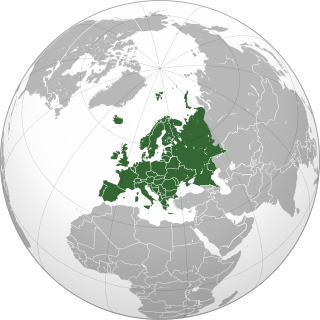
Europe is a continent located entirely in the Northern Hemisphere and mostly in the Eastern Hemisphere. It is bordered by the Arctic Ocean to the north, the Atlantic Ocean to the west and the Mediterranean Sea to the south. It comprises the westernmost part of Eurasia.
Janz died in Abbotsford, British Columbia, and was buried in Coaldale, Alberta. He was the father of six children.

Abbotsford is a city located in British Columbia, adjacent to the Canada–United States border, Greater Vancouver and the Fraser River. With an estimated population of 141,397 people it is the largest municipality in the province outside Metro Vancouver. Abbotsford-Mission has the third highest proportion of visible minorities among census metropolitan areas in Canada, after the Greater Toronto Area and the Greater Vancouver CMA. It is home to Tradex, the University of the Fraser Valley, and Abbotsford International Airport.

British Columbia is the westernmost province of Canada, located between the Pacific Ocean and the Rocky Mountains. With an estimated population of 5.016 million as of 2018, it is Canada's third-most populous province.