
Palermo is a city in southern Italy, the capital of both the autonomous region of Sicily and the Metropolitan City of Palermo, the city's surrounding metropolitan province. The city is noted for its history, culture, architecture and gastronomy, playing an important role throughout much of its existence; it is over 2,700 years old. Palermo is in the northwest of the island of Sicily, by the Gulf of Palermo in the Tyrrhenian Sea.

Baldassare Longhena was an Italian architect, who worked mainly in Venice, where he was one of the greatest exponents of Baroque architecture of the period.

Sicilian Baroque is the distinctive form of Baroque architecture which evolved on the island of Sicily, off the southern coast of Italy, in the 17th and 18th centuries, when it was part of the Spanish Empire. The style is recognisable not only by its typical Baroque curves and flourishes, but also by its grinning masks and putti and a particular flamboyance that has given Sicily a unique architectural identity.

Giovanni Battista Vaccarini was a Sicilian architect, notable for his work in the Sicilian Baroque style in his homeland during the period of massive rebuilding following the earthquake of 1693. Many of his principal works can be found in the area in and around Catania.
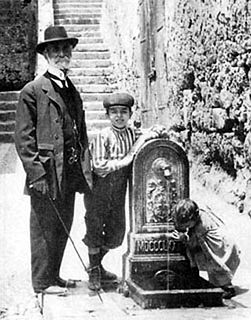
Giuseppe Pitrè was an Italian folklorist, medical doctor, professor, and senator for Sicily. As a folklorist he is credited with extending the realm of folklore to include all manifestations of popular life. He is also considered a forerunner in the field of medical history.

The Royal Palace of Turin is a historic palace of the House of Savoy in the city of Turin in Northern Italy. It was originally built in the 16th century and was later modernized by Christine Marie of France (1606–1663) in the 17th century, with designs by the Baroque architect Filippo Juvarra. The palace also includes the Palazzo Chiablese and the Chapel of the Holy Shroud, the latter of which was built to house the famous Shroud of Turin.

The Pepoli are an aristocratic banking family of Bologna, in northern Italy. They were lords of the city for thirteen years in the fourteenth century. A branch of the family moved to Trapani in Sicily and were granted several feudal lordships and baronies.
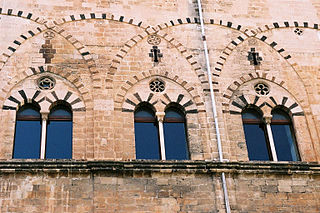
Palazzo Sclafani is a medieval former aristocratic palace located on Piazza della Vittoria #14, in Palermo, region of Sicily, Italy. Across the Piazza della Vittoria park rises the Palazzo dei Normanni and the street along the park leads in a block to the cathedral.
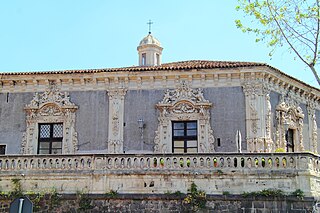
The Palazzo Biscari is a monumental private palace located on Via Museo Biscari in Catania, Sicily, southern Italy. The highly decorative interiors are open for guided tours, and used for social and cultural events.

Natale Masuccio, also known as Mesuccio or Tomasucci, was an Italian architect and Jesuit. He is regarded as one of the most important architects in Sicily during the transition between Mannerism and Baroque.

Giovan Battista Filippo Basile was an Italian architect.

Giuseppe Velasquez, Velasques or Velasco was an Italian painter, active in a Neoclassic style.
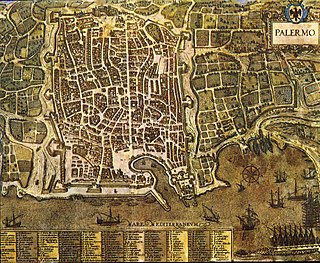
The Cassaro is the most ancient street of Palermo. From the late 16th century the street also had the name Via Toledo. Following the unification of Italy, it was officially renamed Via Vittorio Emanuele II, but the old and distinctive name is still in use. The street is rooted in the age of the foundation of Palermo by the Phoenicians. It provides access to a number of important sights, including the Royal Palace and the Cathedral, two UNESCO World Heritage Sites.
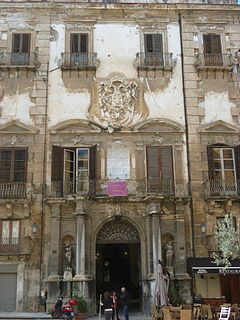
The Palazzo Alliata di Villafranca is former aristocratic mansion, now converted into a museum, located just off Via Vittorio Emanuele facing the Piazza Bologni which opens two blocks west of the Quattro Canti intersection, in the ancient quarter of the Albergaria of the city of Palermo, region of Sicily, Italy.

Simone De Wobreck was a 16th-century Flemish painter, whose known works all come from his long period in Sicily.
The Diocesan Museum of Palermo is a museum of religious art in Palermo on Sicily, housed in a number of rooms in the Palazzo Arcivescovile opposite Palermo Cathedral.

The Sicilian Renaissance forms part of the wider currents of scholarly and artistic development known as the Italian Renaissance. Spreading from the movement's main centres in Florence, Rome and Naples, when Renaissance Classicism reached Sicily it fused with influences from local late medieval and International Gothic art and Flemish painting to form a distinctive hybrid. The 1460s is usually identified as the start of the development of this distinctive Renaissance on the island, marked by the presence of Antonello da Messina, Francesco Laurana and Domenico Gagini, all three of whom influenced each other, sometimes basing their studios in the same city at the same time.
Giuseppe Palazzotto was an Italian architect, active in Catania, Sicily in a Baroque style. He was employed extensively during the flurry of reconstruction after the 1693 Sicily earthquake which nearly flattened his native city. He helped design the church and monastery of San Giuliano, Santa Chiara, Sant'Agostino, Palazzo Zappala, Palazzo del Senato, and the Palazzo Biscari.

Léon Dufourny was a French Neoclassical architect.

The Palazzo Forcella de Seta is a eclectic-style aristocratic palace located facing the Mediterranean in the ancient quarter of Kalsa of central Palermo, region of Sicily, Italy. The palace was built atop the base of the former defensive walls of the city, including the Vega bastion and in its center, an original city gate, Porta dei Greci (1553) through which via Romano Giuseppe runs through. Some refer to the entire structure as the gate. To the seaside, stretches part of the park Foro Italico. In front of the Northeast corner, in front of the seaside facade, is the Monument to Vincenzo Florio Sr..

