
Constantinople was the capital city of the Roman Empire (330–395), of the Eastern Roman (Byzantine) Empire, of the brief Crusader state known as the Latin Empire (1204–1261) and of the Ottoman Empire (1453–1923). In 1923 the capital of Turkey, the successor state of the Ottoman Empire, was moved to Ankara and the name Constantinople was officially changed to Istanbul. The city is located in what is now the European side and the core of modern Istanbul. The city is still referred to as Constantinople in Greek-speaking sources.

Praetor, also spelled prætor or pretor in English, was a title granted by the government of Ancient Rome to men acting in one of two official capacities: the commander of an army ; or an elected magistratus (magistrate), assigned various duties. The functions of the magistracy, the praetura (praetorship), are described by the adjective: the praetoria potestas, the praetorium imperium, and the praetorium ius, the legal precedents established by the praetores (praetors). Praetorium, as a substantive, denoted the location from which the praetor exercised his authority, either the headquarters of his castra, the courthouse (tribunal) of his judiciary, or the city hall of his provincial governorship.

The Capitolium or Capitoline Hill, between the Forum and the Campus Martius, is one of the Seven Hills of Rome.
The patricians were originally a group of ruling class families in ancient Rome. The distinction was highly significant in the Roman Kingdom, and the early Republic, but its relevance waned after the Conflict of the Orders, and by the time of the late Republic and Empire, membership in the patriciate was of only nominal significance.

The Roman provinces were the lands and people outside of Rome itself that were controlled by the Republic and later the Empire. Each province was ruled by a Roman who was appointed as governor. Although different in many ways, they were similar to the states in Australia or the United States, the regions in the United Kingdom or New Zealand, or the prefectures in Japan. Canada refers to some of its territory as provinces.
In ancient Rome a promagistrate was an ex-consul or ex-praetor whose imperium was extended at the end of his annual term of office or later. They were called proconsuls and propraetors. This was an innovation created during the Roman Republic. Initially it was intended to provide additional military commanders to support the armies of the consuls or to lead an additional army. With the acquisitions of territories outside Italy which were annexed as provinces, proconsuls and propraetors became provincial governors or administrators. A third type of promagistrate were the proquaestors.
The equites constituted the second of the property-based classes of ancient Rome, ranking below the senatorial class. A member of the equestrian order was known as an eques.
The Populares were a political faction in the late Roman Republic who favoured the cause of the plebeians.

The Byzantine Senate or Eastern Roman Senate was the continuation of the Roman Senate, established in the 4th century by Constantine I. It survived for centuries, but even with its already limited power that it theoretically possessed, the Senate became increasingly irrelevant until its eventual disappearance circa 14th century.

A proconsul was an official of ancient Rome who acted on behalf of a consul. A proconsul was typically a former consul. The term is also used in recent history for officials with delegated authority.
The Dominate or late Roman Empire is the name sometimes given to the "despotic" later phase of imperial government, following the earlier period known as the "Principate", in the ancient Roman Empire. This phase is more often called the Tetrarchy at least until 313 when the empire was reunited.
The Roman magistrates were elected officials in Ancient Rome.
The constitution of the Roman Republic was a set of unwritten norms and customs, which together with various written laws, guided the procedural governance of the Roman Republic. The constitution emerged from that of the Roman kingdom, evolved over the almost five hundred years of the Republic, and was transformed into the constitution of the Roman Empire.
The Roman Constitution was an uncodified set of guidelines and principles passed down mainly through precedent. The Roman constitution was not formal or even official, largely unwritten and constantly evolving. Having those characteristics, it was therefore more like the British and United States common law system than a sovereign law system like the English Constitutions of Clarendon and Great Charter or the United States Constitution, even though the constitution's evolution through the years was often directed by passage of new laws and repeal of older ones.
The Roman Senate was a political institution in ancient Rome. It was one of the most enduring institutions in Roman history, being established in the first days of the city of Rome. It survived the overthrow of the kings in 509 BC, the fall of the Roman Republic in the 1st century BC, the division of the Roman Empire in 395 AD, the fall of the Western Roman Empire in 476 AD, and the barbarian rule of Rome in the 5th, 6th, and 7th centuries.
The Constitution of the Roman Empire was an unwritten set of guidelines and principles passed down mainly through precedent. After the fall of the Roman Republic, the constitutional balance of power shifted from the Roman Senate to the Roman Emperor. Beginning with the first emperor, Augustus, the emperor and the senate were theoretically two co-equal branches of government. In practice, however, the actual authority of the imperial Senate was negligible, as the emperor held the true power of the state. During the reign of the second emperor, Tiberius, many of the powers that had been held by the Roman assemblies were transferred to the Senate.

The Senate of the Roman Empire was a political institution in the ancient Roman Empire. After the fall of the Roman Republic, the constitutional balance of power shifted from the "Roman Senate" to the "Roman Emperor." Beginning with the first emperor, Augustus, the Emperor and the Senate were technically two co-equal branches of government. In practice, however the actual authority of the imperial Senate was negligible, as the Emperor held the true power of the state. As such, membership in the Senate became sought after by individuals seeking prestige and social standing, rather than actual authority. During the reigns of the first Emperors, legislative, judicial, and electoral powers were all transferred from the "Roman assemblies" to the Senate. However, since the control that the Emperor held over the senate was absolute, the Senate acted as a vehicle through which the Emperor exercised his autocratic powers.
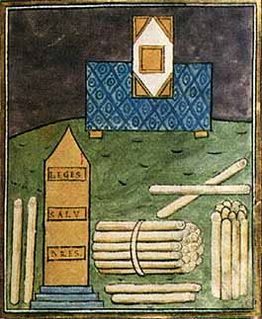
The quaestor sacri palatii, in English: Quaestor of the Sacred Palace, was the senior legal authority in the late Roman Empire and early Byzantium, responsible for drafting laws. In the later Byzantine Empire, the office of the quaestor was altered and it became a senior judicial official for the imperial capital, Constantinople. The post survived until the 14th century, albeit only as an honorary title.
A banneret, or knight banneret, was a medieval knight who led a company of troops during time of war under his own banner.
The Constitutional reforms of Augustus were a series of laws that were enacted by the Roman Emperor Augustus between 30 BC and 2 BC, which transformed the Constitution of the Roman Republic into the Constitution of the Roman Empire. The era that began when Augustus defeated Mark Antony and Cleopatra in the final war of the Roman Republic in 30 BC, and ended when the Roman Senate granted Augustus the title "Pater Patriae" in 2 BC.


