
Agriculture encompasses crop and livestock production, aquaculture, fisheries and forestry for food and non-food products. Agriculture was the key development in the rise of sedentary human civilization, whereby farming of domesticated species created food surpluses that enabled people to live in cities. While humans started gathering grains at least 105,000 years ago, nascent farmers only began planting them around 11,500 years ago. Sheep, goats, pigs and cattle were domesticated around 10,000 years ago. Plants were independently cultivated in at least 11 regions of the world. In the twentieth century, industrial agriculture based on large-scale monocultures came to dominate agricultural output.

Food security is the availability of food in a country and the ability of individuals within that country (region) to access, afford, and source adequate foodstuff. The availability of food irrespective of class, gender or region is another element of food security. Similarly, household food security is considered to exist when all the members of a family, at all times, have access to enough food for an active, healthy life. Individuals who are food secure do not live in hunger or fear of starvation. Food insecurity, on the other hand, is defined as a situation of " limited or uncertain availability of nutritionally adequate and safe foods or limited or uncertain ability to acquire acceptable foods in socially acceptable ways". Food security incorporates a measure of resilience to future disruption or unavailability of critical food supply due to various risk factors including droughts, shipping disruptions, fuel shortages, economic instability, and wars.
The Dietary Reference Intake (DRI) is a system of nutrition recommendations from the National Academy of Medicine (NAM) of the National Academies. It was introduced in 1997 in order to broaden the existing guidelines known as Recommended Dietary Allowances. The DRI values differ from those used in nutrition labeling on food and dietary supplement products in the U.S. and Canada, which uses Reference Daily Intakes (RDIs) and Daily Values (%DV) which were based on outdated RDAs from 1968 but were updated as of 2016.
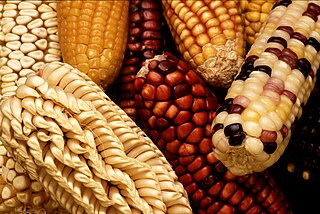
Agricultural biodiversity or agrobiodiversity is a subset of general biodiversity pertaining to agriculture. It can be defined as "the variety and variability of animals, plants and micro-organisms at the genetic, species and ecosystem levels that sustain the ecosystem structures, functions and processes in and around production systems, and that provide food and non-food agricultural products.” It is managed by farmers, pastoralists, fishers and forest dwellers, agrobiodiversity provides stability, adaptability and resilience and constitutes a key element of the livelihood strategies of rural communities throughout the world. Agrobiodiversity is central to sustainable food systems and sustainable diets. The use of agricultural biodiversity can contribute to food security, nutrition security, and livelihood security, and it is critical for climate adaptation and climate mitigation.
Protein digestibility-corrected amino acid score (PDCAAS) is a method of evaluating the quality of a protein based on both the amino acid requirements of humans and their ability to digest it.
Agricultural soil science is a branch of soil science that deals with the study of edaphic conditions as they relate to the production of food and fiber. In this context, it is also a constituent of the field of agronomy and is thus also described as soil agronomy.
Food biodiversity is defined as "the diversity of plants, animals and other organisms used for food, covering the genetic resources within species, between species and provided by ecosystems."
Nutritional rating systems are used to communicate the nutritional value of food in a more-simplified manner, with a ranking, than nutrition facts labels. A system may be targeted at a specific audience. Rating systems have been developed by governments, non-profit organizations, private institutions, and companies. Common methods include point systems to rank foods based on general nutritional value or ratings for specific food attributes, such as cholesterol content. Graphics and symbols may be used to communicate the nutritional values to the target audience.

The geography of food is a field of human geography. It focuses on patterns of food production and consumption on the local to global scale. Tracing these complex patterns helps geographers understand the unequal relationships between developed and developing countries in relation to the innovation, production, transportation, retail and consumption of food. It is also a topic that is becoming increasingly charged in the public eye. The movement to reconnect the 'space' and 'place' in the food system is growing, spearheaded by the research of geographers.

Sustainable diets are "dietary patterns that promote all dimensions of individuals’ health and wellbeing; have low environmental pressure and impact; are accessible, affordable, safe and equitable; and are culturally acceptable". These diets are nutritious, eco-friendly, economically sustainable, and accessible to people of various socioeconomic backgrounds. Sustainable diets attempt to address nutrient deficiencies and excesses, while accounting for ecological phenomena such as climate change, loss of biodiversity and land degradation. These diets are comparable to the climatarian diet, with the added domains of economic sustainability and accessiblity.
The term food system describes the interconnected systems and processes that influence nutrition, food, health, community development, and agriculture. A food system includes all processes and infrastructure involved in feeding a population: growing, harvesting, processing, packaging, transporting, marketing, consumption, distribution, and disposal of food and food-related items. It also includes the inputs needed and outputs generated at each of these steps. Food systems fall within agri-food systems, which encompass the entire range of actors and their interlinked value-adding activities in the primary production of food and non-food agricultural products, as well as in food storage, aggregation, post-harvest handling, transportation, processing, distribution, marketing, disposal, and consumption. A food system operates within and is influenced by social, political, economic, technological and environmental contexts. It also requires human resources that provide labor, research and education. Food systems are either conventional or alternative according to their model of food lifespan from origin to plate. Food systems are dependent on a multitude of ecosystem services. For example, natural pest regulations, microorganisms providing nitrogen-fixation, and pollinators.
The environmental impact of agriculture is the effect that different farming practices have on the ecosystems around them, and how those effects can be traced back to those practices. The environmental impact of agriculture varies widely based on practices employed by farmers and by the scale of practice. Farming communities that try to reduce environmental impacts through modifying their practices will adopt sustainable agriculture practices. The negative impact of agriculture is an old issue that remains a concern even as experts design innovative means to reduce destruction and enhance eco-efficiency. Though some pastoralism is environmentally positive, modern animal agriculture practices tend to be more environmentally destructive than agricultural practices focused on fruits, vegetables and other biomass. The emissions of ammonia from cattle waste continue to raise concerns over environmental pollution.

Fisheries are affected by climate change in many ways: marine aquatic ecosystems are being affected by rising ocean temperatures, ocean acidification and ocean deoxygenation, while freshwater ecosystems are being impacted by changes in water temperature, water flow, and fish habitat loss. These effects vary in the context of each fishery. Climate change is modifying fish distributions and the productivity of marine and freshwater species. Climate change is expected to lead to significant changes in the availability and trade of fish products. The geopolitical and economic consequences will be significant, especially for the countries most dependent on the sector. The biggest decreases in maximum catch potential can be expected in the tropics, mostly in the South Pacific regions.
The Committee on World Food Security (CFS) was established in 1974 as an intergovernmental body to serve as a forum in the United Nations System for review and follow-up of policies concerning world food security, including any and all production, physical, and economic access to food. It was reformed in 2009 to become a multi stakeholder committee. SIRPI constates a key role in achieving UN´s SDG No.2.

Patrick Webb is the Alexander McFarlane Professor of Nutrition at the Friedman School of Nutrition Science and Policy at Tufts University. He was Dean for Academic Affairs from 2005 to 2014.
Food composition data (FCD) are detailed sets of information on the nutritionally important components of foods and provide values for energy and nutrients including protein, carbohydrates, fat, vitamins and minerals and for other important food components such as fibre. The data are presented in food composition databases (FCDBs).
Vishweshwaraiah Prakash is an Indian structural biologist, food technologist and a former director-general designate of the Council of Scientific and Industrial Research (CSIR). He is a former director of the Central Food Technological Research Institute (CFTRI), Mysore and was involved with the International Union of Food Science and Technology as the chairman of its International Academy during 2008-10. He received the Shanti Swarup Bhatnagar Prize, the highest Indian award in the science and technology category in 1996. The Government of India awarded him the fourth highest civilian honour of the Padma Shri in 2004,

Agrifood systems encompass the primary production of food and non-food agricultural products, as well as in food storage, aggregation, post-harvest handling, transportation, processing, distribution, marketing, disposal and consumption. Within agrifood systems, food systems comprise all food products that originate from crop and livestock production, forestry, fisheries and aquaculture, and from other sources such as synthetic biology, and that are intended for human consumption.
The International Panel of Experts on Sustainable Food Systems (IPES-Food) is an international non-profit association, with the goal to promote transition to sustainable food systems around the world and it was registered in Belgium in the year 2015. It was founded by Daniel et Nina Carasso, Olivier De Schutter, former UN special rapporteur on the right to food, and Emile Frison, former Director General of Bioversity International to inform debates on food system reforms around the world. It conducts research focused in the domains of political economy, nutrition, climate change, ecology, agronomy, agroecology, and economics, as well as direct involvement in political processes.
Evan Fraser is a Canadian author and geographer. He is a Professor of Geography at the University of Guelph and the Director of the Arrell Food Institute.

