Related Research Articles
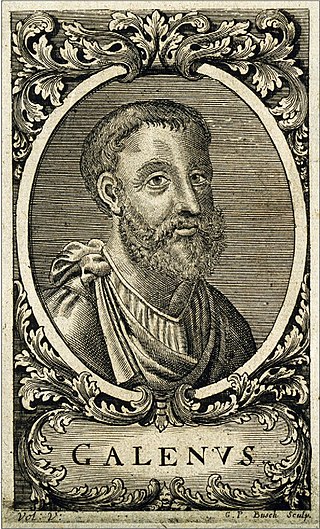
Aelius Galenus or Claudius Galenus, often anglicized as Galen or Galen of Pergamon, was a Roman and Greek physician, surgeon, and philosopher. Considered to be one of the most accomplished of all medical researchers of antiquity, Galen influenced the development of various scientific disciplines, including anatomy, physiology, pathology, pharmacology, and neurology, as well as philosophy and logic.

The history of medicine is both a study of medicine throughout history as well as a multidisciplinary field of study that seeks to explore and understand medical practices, both past and present, throughout human societies.
This is a timeline of the history of medicine and medical technology.
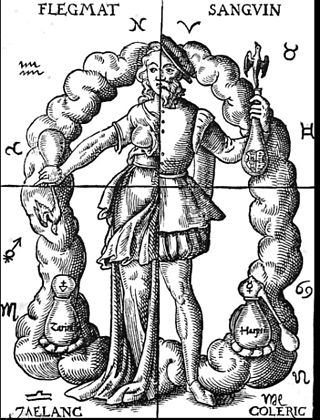
Humorism, the humoral theory, or humoralism, is a system of medicine detailing a supposed makeup and workings of the human body, adopted by Ancient Greek and Roman physicians and philosophers.

Hunayn ibn Ishaq al-Ibadi (Arabic: أبو زيد حنين بن إسحاق العبادي; ʾAbū Zayd Ḥunayn ibn ʾIsḥāq al-ʿIbādī was an influential Arab Nestorian Christian translator, scholar, physician, and scientist. During the apex of the Islamic Abbasid era, he worked with a group of translators, among whom were Abū 'Uthmān al-Dimashqi, Ibn Mūsā al-Nawbakhti, and Thābit ibn Qurra, to translate books of philosophy and classical Greek and Persian texts into Arabic and Syriac.

In the history of medicine, "Islamic medicine" Also known as "Arabian medicine" is the science of medicine developed in the Middle East, and usually written in Arabic, the lingua franca of Islamic civilization.
Alexander of Tralles was one of the most eminent physicians in the Byzantine Empire. His birth date may safely be put in the 6th century AD, for he mentions Aëtius Amidenus, who probably did not write until the end of the 5th or the beginning of the 6th century, and he is himself quoted by Paul of Aegina, who is supposed to have lived in the 7th century; besides which, he is mentioned as a contemporary of Agathias, who set about writing his History in the beginning of the reign of Justin II, about 565.

Byzantine medicine encompasses the common medical practices of the Byzantine Empire from c. 400 AD to 1453 AD. Byzantine medicine was notable for building upon the knowledge base developed by its Greco-Roman predecessors. In preserving medical practices from antiquity, Byzantine medicine influenced Islamic medicine and fostered the Western rebirth of medicine during the Renaissance.
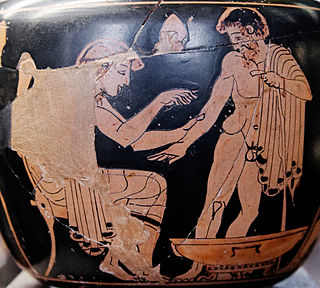
Ancient Greek medicine was a compilation of theories and practices that were constantly expanding through new ideologies and trials. The Greek term for medicine was iatrikē. Many components were considered in ancient Greek medicine, intertwining the spiritual with the physical. Specifically, the ancient Greeks believed health was affected by the humors, geographic location, social class, diet, trauma, beliefs, and mindset. Early on the ancient Greeks believed that illnesses were "divine punishments" and that healing was a "gift from the Gods". As trials continued wherein theories were tested against symptoms and results, the pure spiritual beliefs regarding "punishments" and "gifts" were replaced with a foundation based in the physical, i.e., cause and effect.

Oribasius or Oreibasius was a Greek medical writer and the personal physician of the Roman emperor Julian. He studied at Alexandria under physician Zeno of Cyprus before joining Julian's retinue. He was involved in Julian's coronation in 361, and remained with the emperor until Julian's death in 363. In the wake of this event, Oribasius was banished to foreign courts for a time, but was later recalled by the emperor Valens.
Abū Jaʿfar Aḥmad ibn Ibrāhīm ibn Abī Khālid ibn al-Jazzār al-Qayrawani (895–979), was a 10th-century Muslim Arab physician who became famous for his writings on Islamic medicine. He was born in Qayrawan in Tunisia. He was known in Europe by the Latinized name Algizar.
Qusta ibn Luqa, also known as Costa ben Luca or Constabulus (820–912) was a Melkite Christian physician, philosopher, astronomer, mathematician and translator. He was born in Baalbek. Travelling to parts of the Byzantine Empire, he brought back Greek texts and translated them into Arabic.

Medicine in ancient Rome was highly influenced by ancient Greek medicine, but also developed new practices through knowledge of the Hippocratic Corpus combined with use of the treatment of diet, regimen, along with surgical procedures. This was most notably seen through the works of two of the prominent Greek physicians, Dioscorides and Galen, who practiced medicine and recorded their discoveries. This is contrary to two other physicians like Soranus of Ephesus and Asclepiades of Bithynia, who practiced medicine both in outside territories and in ancient Roman territory, subsequently. Dioscorides was a Roman army physician, Soranus was a representative for the Methodic school of medicine, Galen performed public demonstrations, and Asclepiades was a leading Roman physician. These four physicians all had knowledge of medicine, ailments, and treatments that were healing, long lasting and influential to human history.
Metrodora was possibly the author of an ancient Greek medical text, On the Diseases and Cures of Women. She is known from a single Byzantine manuscript in the collection of the Laurentian Library in Florence. If she existed, her dates are disputed, with scholars' suggestions ranging from the first to the sixth century AD, and the latest possible date being the composition of the Laurentian manuscript in the tenth or eleventh century. Her name is also disputed; some scholars have suggested that Metrodora was a pseudonym or even the misinterpretation of the title of her work.
Modern understanding of disease is very different from the way it was understood in ancient Greece and Rome. The way modern physicians approach healing of the sick differs greatly from the methods used by early general healers or elite physicians like Hippocrates or Galen. In modern medicine, the understanding of disease stems from the "germ theory of disease", a concept that emerged in the second half of the 19th century, such that a disease is the result of an invasion of a micro-organism into a living host. Therefore, when a person becomes ill, modern treatments "target" the specific pathogen or bacterium in order to "beat" or "kill" the disease.
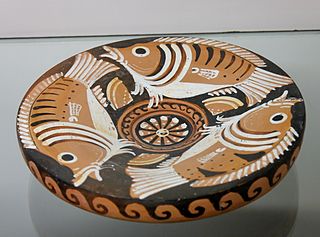
Classical antiquity is the period of cultural history spanning from the 8th century BC to the beginning of the Middle Ages. The major civilizations are those of the Mediterranean region, ancient Greece, ancient Rome, and southwest Asia. Nutrition consisted of simple fresh or preserved whole foods that were either locally grown or transported from neighboring areas during times of crisis. Physicians and philosophers studied the effect of food on the human body and they generally agreed that food was important in preventing illness and restoring health.
Drugs in ancient Rome were used for a variety of purposes. Cannabis and opium were used as medication to treat conditions such as insomnia or earaches. Roman doctors noticed the addictiveness of these drugs. They wrote that cannabis induced "a warm feeling" and opium was dangerous when diluted. Alcohol was believed to be beneficial when consumed in moderate amounts, yet harmful when consumed in excess. Ancient Roman authors and philosophers, such as Pliny and Seneca, believed that alcohol could cause problems such as frenzy, criminality, tiredness, hypersexuality, decreased sexual potency, and death, and that it would damage the social order.
Cleopatra the Physician was a Greek medical writer and author of a manual entitled Cosmetics. Six fragments of her Cosmetics survive in quotation from later medical writers.

Innovation in Byzantine medicine: the writings of John Zacharias Aktouarios (c.1275-c.1330) is a 2020 monograph by Greek author and academic Petros Bouras-Vallianatos. The book delves into the largely unexplored works of late Byzantine physician John Zacharias Aktouarios, known for his contributions to uroscopy, physiology, and pharmacology. It highlights Aktouarios' original theories, including the introduction of a new urine vial divided into eleven areas and his theory about the connection of each area with a certain part of the human body, and provides insight into the intellectual and social contexts of medical practice in the Byzantine era. Bouras-Vallianatos argues that Aktouarios' medical works were remarkably open to knowledge from outside Byzantium and displayed significant originality. The analysis of Aktouarios's treatises is based on a wide range of manuscripts and sources, shedding new light on Byzantine medical thought and its cultural exchanges with the Latin and Islamic worlds.
Sophia Xenophontos is a Greek-Cypriot classicist and associate professor of Greek at Aristotle University of Thessaloniki. She is also affiliate scholar with the University of Glasgow, where she was previously lecturer in Classics and principal investigator and director of the Byzantine Aristotle project funded by the AHRC. Xenophontos is an external collaborator for the Commentaria in Aristotelem Graeca et Byzantina project and the founder and editor-in-chief of the book series ‘Theorising the Greek and Roman Classics’.
References
- ↑ Zipser, Barbara. Pseudo-Alexander Trallianus de oculis, Einleitung, Text, Übersetzung und Kommentar. Heidelberg, Univ., Diss., 2003.
- ↑ "John the Physician's Therapeutics: A Medical Handbook in Vernacular Greek". John the Physician's Therapeutics. Brill. 17 June 2009. ISBN 978-90-474-3067-4.
In the present volume, the Therapeutics is published for the first time, along with a translation and an introduction to the topic.
- ↑ "Plants and minerals in Byzantine popular pharmacy: a new multidisciplinary approach". Wellcome. Retrieved 22 August 2020.
- ↑ "Simon Online". simonofgenoa.org. Retrieved 22 August 2020.
- 1 2 "The girl in the box: the mysterious crime that shocked Germany". the Guardian. 24 September 2019. Retrieved 22 August 2020.
- ↑ "Podcast Appearance". su.royalholloway.ac.uk. Retrieved 22 August 2020.
