Related Research Articles

Ōṁ is the sound of a sacred spiritual symbol in Indic religions. The meaning and connotations of Om vary between the diverse schools within and across the various traditions. It is part of the iconography found in ancient and medieval era manuscripts, temples, monasteries, and spiritual retreats in Hinduism, Buddhism, Jainism, and Sikhism. As a syllable, it is often chanted either independently or before a spiritual recitation and during meditation in Hinduism, Buddhism, and Jainism.

Krishna Dvaipayana, better known as Vyasa or Veda Vyasa, was a legendary sage portrayed in the Hindu epic Mahabharata, and regarded by Hindu-tradition as the compiler of that work. As a Shaktyavesha Avatar (śaktyāveśa-avatāra) of Vishnu, he is also regarded by tradition as the arranger of the mantras of the Vedas, as well as the author of the eighteen Puranas and the Brahma Sutras.
Shruti in Sanskrit means "that which is heard" and refers to the body of most authoritative, ancient religious texts comprising the central canon of Hinduism. Manusmriti states: Śrutistu vedo vijñeyaḥ meaning, "Know that Vedas are Śruti". Thus, it includes the four Vedas including its four types of embedded texts—the Samhitas, the Upanishads, the Brahmanas and the Aranyakas.
Smriti, literally "that which is remembered" are a body of Hindu texts usually attributed to an author, traditionally written down, in contrast to Śrutis considered authorless, that were transmitted verbally across the generations and fixed. Smriti is a derivative secondary work and is considered less authoritative than Sruti in Hinduism, except in the Mimamsa school of Hindu philosophy. The authority of smriti accepted by orthodox schools, is derived from that of shruti, on which it is based.

The Brahmanas are Vedic śruti works attached to the Samhitas of the Rig, Sama, Yajur, and Atharva Vedas. They are a secondary layer or classification of Sanskrit texts embedded within each Veda, often explain and instruct Brahmins on the performance of Vedic rituals. In addition to explaining the symbolism and meaning of the Samhitas, Brahmana literature also expounds scientific knowledge of the Vedic Period, including observational astronomy and, particularly in relation to altar construction, geometry. Divergent in nature, some Brahmanas also contain mystical and philosophical material that constitutes Aranyakas and Upanishads.
Samhita literally means "put together, joined, union", a "collection", and "a methodically, rule-based combination of text or verses". Samhita also refers to the most ancient layer of text in the Vedas, consisting of mantras, hymns, prayers, litanies and benedictions.

Jaimini was an ancient Indian scholar who founded the Mīmāṃsā school of Hindu philosophy. He was a disciple of sage Veda Vyasa, the son of Parashara. Traditionally attributed to be the author of the Mimamsa Sutras and Jaimini Sutras, he is estimated to have lived around the 4th-century BCE. His school is considered non-theistic, but one that emphasized rituals parts of the Vedas as essential to Dharma.
The Atharva Veda is the "knowledge storehouse of atharvāṇas, the procedures for everyday life". The text is the fourth Veda, but has been a late addition to the Vedic scriptures of Hinduism.

The Yajurveda is the Veda primarily of prose mantras for worship rituals. An ancient Vedic Sanskrit text, it is a compilation of ritual-offering formulas that were said by a priest while an individual performed ritual actions such as those before the yajna fire. Yajurveda is one of the four Vedas, and one of the scriptures of Hinduism. The exact century of Yajurveda's composition is unknown, and estimated by Witzel to be between 1200 and 800 BCE, contemporaneous with Samaveda and Atharvaveda.

The Vedas are a large body of religious texts originating in ancient India. Composed in Vedic Sanskrit, the texts constitute the oldest layer of Sanskrit literature and the oldest scriptures of Hinduism.
The oral tradition of the Vedas (Śruti) consists of several pathas, "recitations" or ways of chanting the Vedic mantras. Such traditions of Vedic chant are often considered the oldest unbroken oral tradition in existence, the fixation of the Vedic texts (samhitas) as preserved dating to roughly the time of Homer.

Mildred Pierce is a 1945 American film noir directed by Michael Curtiz and starring Joan Crawford, Jack Carson, and Zachary Scott, also featuring Eve Arden, Ann Blyth, and Bruce Bennett. Based on the 1941 novel by James M. Cain, this was Crawford's first starring role for Warner Bros., after leaving Metro-Goldwyn-Mayer, and she won the Academy Award for Best Actress.
Apaurusheya, meaning "not of human" or "impersonal, authorless", is a term used to describe the Vedas, the earliest scripture in Hinduism.
Atheism has been a historically propounded viewpoint in many of the Astika (Orthodox) streams of Hindu philosophy. Hindu spiritual atheists who affirms vedas and brahman or those who follow astika (orthodox) philosophies but reject personal god(s) are also called dharmic atheist or sanatani atheist. In current Indian languages Hindi or Bengali, āstika and its derivatives usually mean 'theist', and nāstika and its derivatives denote an 'atheist'; however, the two terms in ancient- and medieval-era Sanskrit literature do not refer to 'theism' or 'atheism'. In ancient India Astika means those who affirms vedas, atman and brahman while nastika by contrast, are those who deny all the respective definitions of āstika; they do not believe in the existence of Self or ishvara and rejects vedas. Sometimes nastika philosophies are also considered as a part of hindu philosophy because the word 'Hindu' is also an exonym and historically, the term has also been used as a geographical, cultural, and later religious identifier for people living in the Indian subcontinent. While majority scholars consider only the astika philosophies as hindu philosophy because the word 'Hindu' became a religious identity now.
Ācāra is a concept used in the context of Classical Hindu law that refers to the customary laws or community norms of a particular social group. These community norms are delineated and put into practice by people who have earned the respect of those within each individual group, such as a community leader or elder. Although in Dharmaśāstra the ideal person who defines the ācāra of a particular place is dictated as one who knows the Vedas or is “learned”, in actual practice this role is often deferred to group leaders along with Vedic scholars. Ācāra is theologically important in Hindu law because it is considered, along with the Vedas (Śruti), and Smriti, to be one of the sources of dharma. Particular regional ācāra is believed to be canonized in Dharmaśāstra texts; however scholars differ on the source for the actual accounts found within these texts.
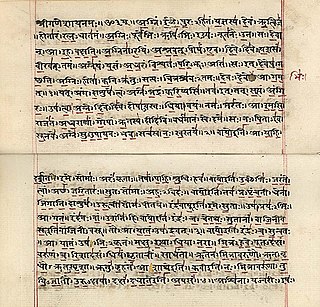
The Rigveda or Rig Veda is an ancient Indian collection of Vedic Sanskrit hymns (suktas). It is one of the four sacred canonical Hindu texts (śruti) known as the Vedas.

The Samaveda, is the Veda of melodies and chants. It is an ancient Vedic Sanskrit text, and part of the scriptures of Hinduism. One of the four Vedas, it is a liturgical text which consists of 1,875 verses. All but 75 verses have been taken from the Rigveda. Three recensions of the Samaveda have survived, and variant manuscripts of the Veda have been found in various parts of India.
Vadakke Madham Brahmaswam Vedic Research Centre is a residential institution for the study of vedas. It is located on the compound of Vadakke Madhom in Thrissur city of Kerala state in India. The centre once was the centre of learning for Vedas in South India and is the oldest Vedic school still running in India.
Avatsara was a Rishi of the Rig Veda. His name first appears in the Fifth Mandala which is older than the Second Mandala.
Dhi, this Sanskrit word means 'understanding', 'reflection', 'religious thought', 'mind', 'design', 'intelligence', 'opinion', 'meditation', 'imagination', 'notion', 'intellect', This word is directly connected with the word, Vāc meaning Speech, derived from Vac meaning, 'to speak'. Dhi is the voiced Vāc or 'Speech', it is the thought-mind or intellect. Dhi also means 'to hold' or 'to place', and indicates the activity of the intellect.
References
- ↑ Garrett, John (1873). A Classical Dictionary of India. Higginbotham. p. 517.
 | This article about a person notable in Hinduism is a stub. You can help Wikipedia by expanding it. |