 |
Bassam El Shammaa is a researcher in Egyptology and senior tour guide. [1] [2]
|
Bassam El Shammaa is a researcher in Egyptology and senior tour guide. [1] [2]
Shammaa, having expressed concern for the conditions in which the Sphinx monument and its surroundings exist, began an awareness campaign online during 2007. [3] The response from the Supreme Council of Antiquities (SCA) stated that a team of Cairean experts had been deployed with the goal of containing the risk. At the time of the article's publication, the head of the SCA, Zahi Hawass had stated that geological experts were compiling a report on the degree of risk present. [4]
During 2007 it was reported in the Daily News Egypt that Shammaa considered it possible that there had been two Sphinx statues present at the site of the existing monument, a position he had stated was supported by the traditionally considered position on the subject. This opinion was in contrary to the thought that the Sphinx is, in fact, the sole constructive at the location, designed to guard the Pyramids. Support for Shammaa's position was given (amongst others) by the Thutmosis IV stele showing, in fact, two sphinxes. To conclude the content of the article (as reported) stated that John Gardner Wilkinson considered the argument to be unsolvable. [5] [6]
The Alexandrian magazine (Amwag)stated the first to call for the rebuilding of the structure was Dr El Hadidi in 1978, to Dr Helmy the then governor Alexandria, he proceeded to promote the notion within the international media. At the time preliminary plans were made to begin the construction progress having been arrested by the change of governorship. Shammaa in 2008 appealed to the relevant bodies of Egypt to consider the proposed rebuilding, stating that since sufficient information available from early historical documentation and the measurements and plans taken at the 1978, the construction should proceed. [7]
His motivation to begin the campaign arose from observations of reactions from some of the visitors to the tomb site. Continuing to suggest that maintaining the mummified bodies at locations outside of Egypt was disrespectful of tradition of Egypt and the beliefs concerning the "sanctity and integrity of the dead" [8]
Egypt: Future of the Past ISBN 0-9658039-1-0 / 0-9658039-1-0 [9] Bassaam ElShammaa`. on Sekhmet neing "Our Mother the Ogress/`أمنا الغولة' in folktales" among Egyptians now. 2017لأربعاء، 06 ديسمبر December Wed. 7&th Day. This data is provided/added by Hasan El-Shamy.
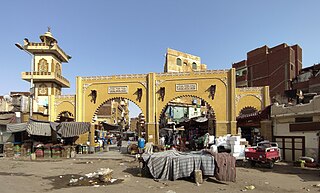
Aswan is a city in Southern Egypt, and is the capital of the Aswan Governorate.

Egyptology is the scientific study of ancient Egypt. The topics studied include ancient Egyptian history, language, literature, religion, architecture and art from the 5th millennium BC until the end of its native religious practices in the 4th century AD.

Hapi was the god of the annual flooding of the Nile in ancient Egyptian religion. The flood deposited rich silt on the river's banks, allowing the Egyptians to grow crops. Hapi was greatly celebrated among the Egyptians. Some of the titles of Hapi were "Lord of the Fish and Birds of the Marshes" and "Lord of the River Bringing Vegetation". Hapi is typically depicted as an androgynous figure with a prominent belly and large drooping breasts, wearing a loincloth and ceremonial false beard, depicted in hieroglyphics as an intersex person.

Giza is the third-largest city in Egypt by area after Cairo and Alexandria; and fourth-largest city in Africa by population after Kinshasa, Lagos, and Cairo. It is the capital of Giza Governorate with a total population of 4,872,448 in the 2017 census. It is located on the west bank of the Nile opposite central Cairo, and is a part of the Greater Cairo metropolis. Giza lies less than 30 km (18.64 mi) north of Memphis, which was the capital city of the unified Egyptian state during the reign of pharaoh Narmer, roughly 3100 BC.

Mohamed Mostafa ElBaradei is an Egyptian law scholar and diplomat who served as the vice president of Egypt on an interim basis from 14 July 2013 until his resignation on 14 August 2013.

Luxor is a city in Upper Egypt, which includes the site of the Ancient Egyptian city of Thebes. Luxor had a population of 1,333,309 in 2020, with an area of approximately 417 km2 (161 sq mi) and is the capital of the Luxor Governorate. It is among the oldest inhabited cities in the world.

The Great Sphinx of Giza is a limestone statue of a reclining sphinx, a mythical creature with the head of a human and the body of a lion. Facing directly from west to east, it stands on the Giza Plateau on the west bank of the Nile in Giza, Egypt. The face of the Sphinx appears to represent the pharaoh Khafre. The original shape of the Sphinx was cut from the bedrock, and has since been restored with layers of limestone blocks. It measures 73 m (240 ft) long from paw to tail, 20 m (66 ft) high from the base to the top of the head and 19 m (62 ft) wide at its rear haunches.

Zahi Abass Hawass is an Egyptian archaeologist, Egyptologist, and former Minister of State for Antiquities Affairs, serving twice. He has also worked at archaeological sites in the Nile Delta, the Western Desert, and the Upper Nile Valley.

The Supreme Council of Antiquities was a department of the Egyptian Ministry of Culture from 1994 to 2011. It was the government body responsible for the conservation, protection and regulation of all antiquities and archaeological excavations in Egypt, and was a reorganization of the Egyptian Antiquities Organisation, under Presidential Decree No. 82 of Hosni Mubarak.

Amenemhat IV was the seventh and penultimate king of the Twelfth Dynasty of Egypt during the late Middle Kingdom period, ruling for more than nine years in the late nineteenth century BC or the early eighteenth century BC.

The Giza pyramid complex in Egypt is home to the Great Pyramid, the Pyramid of Khafre, and the Pyramid of Menkaure, along with their associated pyramid complexes and the Great Sphinx. All were built during the Fourth Dynasty of the Old Kingdom of ancient Egypt, between c. 2600 – c. 2500 BC. The site also includes several temples, cemeteries, and the remains of a workers' village.

Gebel el-Silsila or Gebel Silsileh is 65 km (40 mi) north of Aswan in Upper Egypt, where the cliffs on both sides close to the narrowest point along the length of the entire Nile. The location is between Edfu in the north towards Lower Egypt and Kom Ombo in the south towards Upper Egypt. The name Kheny means "The Place of Rowing". It was used as a major quarry site on both sides of the Nile from at least the 18th Dynasty to Greco-Roman times. Silsila is famous for its New Kingdom stelai and cenotaphs.
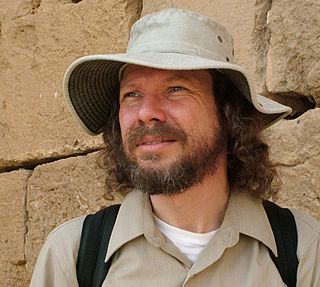
Robert Milton Schoch is an American associate professor of Natural Sciences at the College of General Studies, Boston University. Following initial work as a vertebrate paleontologist, Schoch co-authored and expanded the fringe Sphinx water erosion hypothesis since 1990, and is the author of several pseudohistorical and pseudoscientific books.
Tourism is one of the leading sources of income, crucial to Egypt's economy. At its peak in 2010, the sector employed about 12% of workforce of Egypt, serving approximately 14.7 million visitors to Egypt, and providing revenues of nearly $12.5 billion as well as contributing more than 11% of GDP and 14.4% of foreign currency revenues.

The Ministry of Awqaf of Egypt is one of ministries in the Egyptian government and is in charge of religious endowments. Religious endowments, awqaf, are similar to common law trusts where the trustee is the mosque or individual in charge of the waqf and the beneficiary is usually the community as a whole. Examples of waqfs are of a plot of land, a market, a hospital, or any other building that would aid the community.

Tahrir Square, also known as Martyr Square, is a major public town square in downtown Cairo, Egypt. The square has been the location and focus for political demonstrations. The 2011 Egyptian revolution and the resignation of President Hosni Mubarak occurred at the Tahrir Square.
Tarek El Ashry is an Egyptian football coach who is the current manager of the Egyptian Premier League team Pharco. He established his name as a young manager by winning three cup titles. In addition, he is considered to be the first manager to implement a 4-4-2 formation in Egyptian football successfully.

The Sphinx water erosion hypothesis is a fringe claim, contending that the Great Sphinx of Giza and its enclosing walls eroded primarily due to ancient floods or rainfalls, attributing their creation to Plato's lost civilization of Atlantis over 11,500 years ago.
The Ministry of Tourism and Antiquities is the Egyptian government organization which serves to protect and preserve the heritage and ancient history of Egypt. In December 2019 it was merged into the Ministry of Tourism with Khaled al-Anani retaining his function.

Eugène Grébaut was a French Egyptologist. Grébaut made significant discoveries in the complex of mortuary temples and tombs located at Deir el-Bahari including several Egyptian mummies of the twenty-first Dynasty.