
Nikolaos Gyzis was considered one of Greece's most important 19th century painters. He was most famous for his work Eros and the Painter, his first genre painting. It was auctioned in May 2006 at Bonhams in London, being last exhibited in Greece in 1928. He was the major representative of the Munich School, the major 19th-century Greek art movement.

Modern Greek art is art from the period between the emergence of the new independent Greek state and the 20th century. As Mainland Greece was under Ottoman rule for all four centuries, it was not a part of the Renaissance and artistic movements that followed in Western Europe. However, Greek islands such as Crete, and the Ionian islands in particular were for large periods under Venetian or other European powers' rule and thus were able to better assimilate the radical artistic changes that were occurring in Europe during the 14th-18th century.

The National Gallery is an art museum located on Vasilissis Sofias avenue in the Pangrati district, Athens, Greece. It is devoted to Greek and European art from the 14th century to the 20th century.

Nikolaos Vokos was a Greek painter of the Munich School art movement.

The Heptanese School of painting succeeded the Cretan School as the leading school of Greek post-Byzantine painting after Crete fell to the Ottomans in 1669. Like the Cretan school, it combined Byzantine traditions with an increasing Western European artistic influence and also saw the first significant depiction of secular subjects. The school was based in the Ionian Islands, which were not part of Ottoman Greece, from the middle of the 17th century until the middle of the 19th century. The center of Greek art migrated urgently to the Ionian islands but countless Greek artists were influenced by the school including the ones living throughout the Greek communities in the Ottoman Empire and elsewhere in the world.

The most important artistic movement of Greek art in the 19th century was academic realism, often called in Greece "the Munich School" because of the strong influence from the Royal Academy of Fine Arts of Munich, where many Greek artists trained. The Munich School painted the same sort of scenes in the same sort of style as Western European academic painters in several countries, and did generally not attempt to incorporate Byzantine stylistic elements into their work.
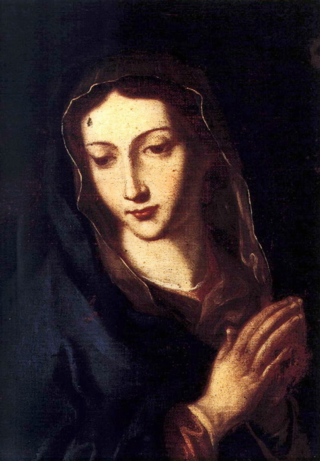
Panagiotis Doxaras (1662–1729) also known as Panayiotis Doxaras, was an author and painter. He was a prolific member of the Heptanese School. He was influenced by early members of the movement namely: Elias Moskos, Theodoros Poulakis, Stephanos Tzangarolas, Spyridon Sperantzas and Victor. The Heptanese School evolved during the Baroque period and continued into the Late Baroque or Rococo. Doxaras’s son Nikolaos Doxaras continued the artistic movement into the Neoclassical era. Both Panagiotis and his son Nikolaos Doxaras refined the school. The school was heavily influenced by the Venetian Style. The Heptanese School also influenced Italian painting. Other artists Doxaras influenced were Nikolaos Kantounis. Panagioti’s teacher was famous painter Leos Moskos. He studied with him while he was in Venice. Doxaras painted notable portraits of Johann Matthias von der Schulenburg. He introduced Maniera Italiana to the Heptanese School drastically changing the style from the Maniera Greca. He is considered the father of the Greek Rococo and the Modern Greek Enlightenment in art.

Munich School is the name given to a group of painters who worked in Munich or were trained at the Royal Academy of Fine Arts of Munich between 1850 and 1918. In the second half of the 19th century the Academy became one of the most important institutions in Europe for training artists and attracted students from across Europe and the United States.

Nikolaos Doxaras. He was a Greek painter and teacher. His father was famous painter Panagiotis Doxaras. Panagiotis Doxaras was the father of the Greek Rococo and the Modern Greek Enlightenment in art. They are both prominent members of the Heptanese School. They refined Greek art bringing the Maniera Greca into the Maniera Italiana. Artists he influenced include: Nikolaos Kantounis, Nikolaos Koutouzis and Gerasimos Pitsamanos. His influence can be seen in some of Nikolaos Kantounis's paintings notably The Assumption. Nikolaos taught famous painter Nikolaos Koutouzis. Both Nikolaos Koutouzis and Doxaras artistic style refined the art of the Ionian Islands. Venetian painting influenced countless Greek artists who were living in the empire. From Michael Damaskinos to Theodore Poulakis. Twenty years after Nikolaos's death the style came to an end due to the Fall of the Republic of Venice. A new artistic style developed after the Greek Rococo which coincided with Neoclassicism in the rest of Europe called the middle Modern Greek Enlightenment in art also known as Neo-Hellenikos Diafotismos.
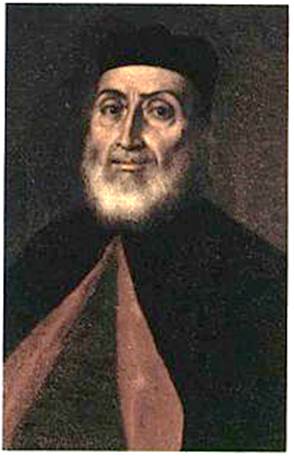
Nikolaos Koutouzis, or Koutousis was a Greek painter, poet and priest. He was part of the Heptanese School, but also a member of the Modern Greek Enlightenment in art. His teacher was the painter Nikolaos Doxaras. Koutouzis has 136 paintings attributed to him. He was one of the last Greek painters to incorporate the Venetian style during its decline, due to the Fall of the Republic of Venice. He was the teacher of Nikolaos Kantounis, who was heavily influenced by his style.

Nikolaos Kantounis or Kandounis was a Greek priest, painter and teacher who did not follow the traditional Maniera Greca. His teacher was the famous painter Nikolaos Koutouzis. He began to incorporate the Maniera Italiana into the Heptanese School. Kantounis, Panagiotis Doxaras, Nikolaos Doxaras and Koutouzis were all prolific members of that school. Kantounis was one of the most important painters in the Neoclassical Period in Greece. He was a representative of the middle to late Modern Greek Enlightenment in Greek art. Over 164 of his paintings have survived. He is known for painting many portraits. Some of his works resemble the style of Nikolaos Doxaras. He was also a member of the secret organization for Greek Independence called the Filiki Eteria.
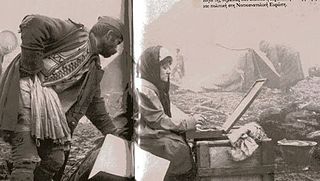
Thalia Flora-Karavia was a Greek artist and member of the Munich School who was best known for her sketches of soldiers at war.

Andreas Pavias was a Greek painter and educator. He was one of the founding fathers of the Cretan School, and his works influenced countless artists both Italian and Greek; paintings by Pavias could be found in many churches and private collections in both geographic areas. Seven of these paintings survive today, six bearing the artist's signature. The most famous of the group is a Crucifixion.

Madre della Consolazione is a tempera painting created by Greek painter Nikolaos Tzafouris. Tzafouris was active during the second half of the 15th century. He was a prominent member of the Cretan School. He was influenced by Angelos Akotantos. The painter was exposed to works of Giovanni Bellini. At some point, he traveled to Venice and studied painting in the city. He is considered one of the most important painters because he introduced two prototypes that were mass produced by Cretan workshops. The painter is attributed with starting the specific style on the island of Crete. Most historians refer to the style as the Italian style Madonna in comparison to its Greek counterparts. Madre della Consolazione is very important because it served as a prototype for workshops on the island and it was heavily copied. Famous Greek painter Nikolaos Gripiotis and his contemporaries mass-produced the prototype. It is very difficult to attribute unsigned works because the prototype was mass-produced.

Georgios Chatzopoulos was a Greek painter affiliated with the Munich School of Athens.
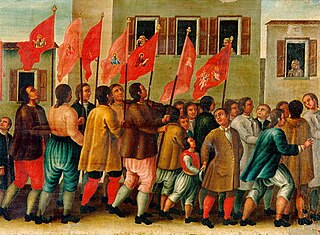
Ioannis Korais was a Greek painter. He was a prominent member of the Heptanese School. His contemporaries were Nikolaos Doxaras and Nikolaos Koutouzis. His family was from the island of Chios. He was the grandson of the painter Michael Korais from Chios. He helped revolutionize Greek painting. He was a follower of Panagiotis Doxaras and the new techniques he was employing.

Ioanni Korai was a Greek painter that shared the same name as his famous uncle Ioannis Korais. He was a prominent painter on the Ionian Islands. His family migrated to Zakynthos from Chios. He was a member of the Heptanese School. His contemporaries were Dionysios Kallivokas and Nikolaos Koutouzis. He was taught painting by Ioannis Korais. He was active during the Modern Greek Enlightenment and Greek romanticism in art. He influenced countless Greek and Italian painters. Korai brought Greek artwork into the Modern Greek art period. Twelve of his paintings survived. His most notable painting is a portrait of Kyriakos Chorafas painted in 1826. The painting is at the National Gallery of Athens.
Assumption of Mary was a painting created by Greek painter Nikolaos Doxaras. He was the son of famous Greek painter Panagiotis Doxaras. Nikolaos flourished on the Ionian Islands. He was a representative of the Heptanese School. He traveled all of the Ionian Islands painting. He spent close to a decade in Venice. He had a relationship with Johann Schulenberg. Doxaras stayed with him from 1730 to 1738 at the Palazzo Loredan. He was his confidant at the Schulenburg Art Gallery. He also painted for Schulenburg. He left Venice and continued painting all over the Ionian islands until his death. He was active from 1725 to 1775. Five of his paintings survived. Both Nikolaos and his father attempted to popularize oil painting.

Lamentation of Christ is an oil painting created by Greek painter Nikolaos Kantounis. He was a painter and teacher. He was a priest. His teachers were famous painters Ioannis Korais and Nikolaos Koutouzis He was a representative of the Heptanese School. His artwork was created during the Neoclassical and Romantic periods in Greek art. He was active on the island of Zakynthos from 1782–1834. He was one of the earliest members of the modern Greek art period. Over 164 of his paintings have survived. He is known for painting many portraits. He was a member of the secret organization for Greek Independence called the Filiki Eteria. Towards the end of his life he was honored with the rank of Grand Sakellarios.

Saint Spyridon, John the Baptist, Saint Peter and Saint George is an oil painting created by Greek painter Nikolaos Koutouzis. He was a prominent member of the Heptanese School of painting. He was from the island of Zakynthos. He studied with Nikolaos Doxaras and Giovanni Tiepolo. He was an active painter for over fifty years. One hundred and thirty-six paintings are attributed to the artist. He was active from 1750 to 1813.

