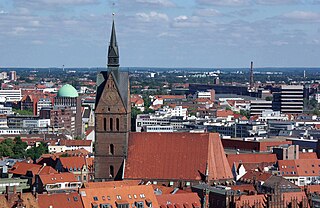
The Market Church is the main Lutheran church in Hanover, Germany. Built in the 14th century, it was referred to in 1342 as the church of Saints James and George in dedication to Saint James the Elder and Saint George. Replacing an older, smaller, church at the same location that dated to 1125 and that is known to have been called St. Georgii in 1238, Hanover grew around it and the market place situated immediately adjacent to its south that was established around the same time. Today the official name of the church is Market Church of Saints George and James, and along with the nearby Old Town Hall is considered the southernmost example of the northern German brick gothic architectural style.

The German: Eilenriede is a 640-hectare (1,600-acre) municipal forest in Hanover, Germany. It is the largest urban city forest in Germany, one of the largest in Europe, and is nearly twice the size of Central Park in New York. The biggest German urban park in the strict sense of the word, however, is the 375-hectare (930-acre) English Garden in Munich.
Hermann Bahlsen was a German entrepreneur in the food industry as well as the inventor of the Leibniz butter biscuit and founder of the Bahlsen confectionery factory.
Helmut Knocke is a German architecture historian and author.

The aerial bombings of Hanover are a series of eighty-eight air raids by Royal Air Force (RAF) Bomber Command and the United States Army Air Forces (USAAF) on the German city of Hanover during World War II. Collectively these air raids killed 6,782 persons, predominantly civilian residents. Around 1,000 aerial mines, 34,000 high explosive bombs, 900,000 incendiary bombs and 50,000 fire bombs were dropped. The most destructive and deadly air raid on Hanover was conducted by the RAF on the night beginning 8 October 1943, killing 1,245 persons, and is an example of carpet bombing of suburban and residential civilian targets laid out in the Area Bombing Directive of 14 February 1942.

Johann Georg Christian Kestner was a German lawyer and archivist. He is also notable as the model for Lotte's husband Albert in The Sorrows of Young Werther by Goethe, with Kestner's fiancée Charlotte Buff used as the model for Lotte herself.

Hanover Drama is a theatre company in Hanover, the state capital of Lower Saxony, Germany. The company is resident at the Hanover Playhouse situated approximately 200 metres (660 ft) east of Hanover Opera House, and the Ballyard situated approximately 530 metres (1,740 ft) west-southwest of the opera house in the old town. Collectively these venues have five stages:
The hübschefamilies were the third elite class of the Electorate and Kingdom of Hanover in the 18th and early 19th centuries, after the nobility and the clergy. At the time Hanover was in a personal union with the United Kingdom. The group consisted of the higher bourgeoisie and the elite of university-educated civil servants, and played a significant role in the governing of Hanover, often as higher civil servants.
Hugo Thielen is a German freelance author and editor, who is focused on the history of Hanover, the capital of Lower Saxony, in a lexicon of the city, another one especially of its art and culture, and a third of biographies. He co-authored a book about Jewish personalities in Hanover's history.

Klaus Mlynek is a German historian and scientific archivist, a former director of the City of Hanover Archive, and one of the editors and authors of the Hannover City Lexicon, an encyclopedia of Hanover.
Waldemar R. Röhrbein was a German historian. He worked as a museum director in Lower Saxony, his last post being from 1976 to 1997 at the Historisches Museum Hannover, and was president of the Homeland Federation of Lower Sachsony. He contributed to encyclopedias about Hanover's history and culture.

Hanover Historical Museum is an historical museum situated in Hanover, the capital of Lower Saxony, Germany. The museum was founded in 1903 as the Homeland Museum of the City of Hanover. Its collections are related to the history of the city, the history of the House of Guelf, and of the state of Lower Saxony.
Dirk Böttcher was a German printer master, author and president of the association of Friends of the Historisches Museum Hannover.
Greta Hofer, néeGreta Köhler, pseudonym Greta Colere was a German opera singer.

Reimar Dahlgrün was a German pianist, professor at the Hochschule für Musik, Theater und Medien Hannover and journalist.
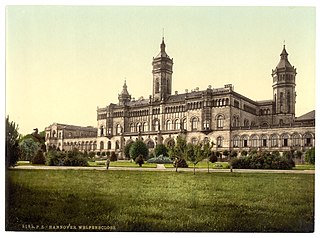
Christian Heinrich Tramm was a German architect who, in 1850, introduced the Rundbogenstil in Hanover.
Adolf Falke was a German architect, draughtsman, designer, stage designer and municipal politician.

The Broyhan House is a residential and commercial building constructed in 1576 in Hanover's historic old town. It is the second-oldest preserved half-timbered building in Hanover, and stands on the cellar walls of an earlier building dating to the 14th century. The house is named after the brewer Cord Broyhan, who lived in the earlier building from 1537 and who died in Hanover in 1570 before the current building was constructed.
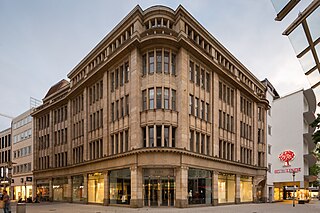
Elsbach & Frank was a textile retail business founded in the 19th century in Hanover, the capital of Lower Saxony, Germany. The department store built by this company on the corner of Osterstraße and Große Packhofstraße, called Kaufhaus zum Stern, is the only building in the city center that survived the air raids on Hanover during the Second World War without major damage. Today, the building is used by a branch of the Spanish fashion chain Zara.

Ferdinand Elsbach was a German textile merchant and manufacturer.

