Related Research Articles

Abbas I, commonly known as Abbas the Great, was the fifth shah of Safavid Iran from 1588 to 1629. The third son of Shah Mohammad Khodabanda, he is generally considered one of the greatest rulers of Iranian history and the Safavid dynasty.

Kakheti is a region (mkhare) formed in the 1990s in eastern Georgia from the historical province of Kakheti and the small, mountainous province of Tusheti. Telavi is its capital. The region comprises eight administrative districts: Telavi, Gurjaani, Qvareli, Sagarejo, Dedoplistsqaro, Signagi, Lagodekhi and Akhmeta.
Qizilbash or Kizilbash were a diverse array of mainly Turkoman Shia militant groups that flourished in Azerbaijan, Anatolia, the Armenian highlands, the Caucasus, and Kurdistan from the late 15th century onwards, and contributed to the foundation of the Safavid dynasty in early modern Iran.

Simon I the Great, also known as Svimon, of the Bagrationi dynasty, was a Georgian king of Kartli from 1556 to 1569 and again from 1578 to 1599. His first tenure was marked by war against the Persian domination of Georgia. In 1569 he was captured by the Persians, and spent nine years in captivity. In 1578 he was released and reinstalled in Kartli. During this period, he fought as a Persian subject against the Ottoman domination of Georgia. In 1599 Simon I was captured by the Ottomans and died in captivity. During 1557 to 1569 he was known as Mahmud Khan and from 1578 to 1599 as Shahnavaz Khan. He was also referred to as Simon the Mad by the Ottomans.
George X, of the Bagrationi royal dynasty, was a king of the eastern Georgian kingdom of Kartli from 1599 until his death.
Bagrat VII (1569–1619), also known as Bagrat Khan, was King of Kartli, eastern Georgia, effectively serving as a khan for the Persian shah Abbas I from 1615/1616 to 1619.

The Kingdom of Kakheti was a late medieval/early modern monarchy in eastern Georgia, centered at the province of Kakheti, with its capital first at Gremi and then at Telavi. It emerged in the process of a tripartite division of the Kingdom of Georgia in 1465 and existed, with several brief intermissions, until 1762 when Kakheti and the neighboring Georgian Kingdom of Kartli were merged through a dynastic succession under the Kakhetian branch of the Bagrationi dynasty. Through much of this period, the kingdom was a vassal of the successive dynasties of Iran, and to a much shorter period Ottoman Empire, but enjoyed intermittent periods of greater independence, especially after 1747.

Alexander II of the Bagrationi dynasty, was a king of Kakheti in eastern Georgia from 1574 to 1605. In spite of a precarious international situation, he managed to retain relative economic stability in his kingdom and tried to establish contacts with the Tsardom of Russia. Alexander fell victim to the Iran-sponsored coup led by his own son, Constantine I.
Constantine I, also known as Constantine Khan, Constantin(e) Mirza, or Konstandil / Kustandil Mirza, of the Bagrationi dynasty, was a king of Kakheti in eastern Georgia from March to October 1605.

Teimuraz I (1589–1663), of the Bagrationi dynasty, was a Georgian monarch who ruled, with intermissions, as King of Kakheti from 1605 to 1648 and also of Kartli from 1625 to 1633. The eldest son of David I and Ketevan, Teimuraz spent most of his childhood at the court of Shah of Iran, where he came to be known as Tahmuras Khan. He was made king of Kakheti following a revolt against his reigning uncle, Constantine I, in 1605. From 1614 on, he waged a five-decade long struggle against the Safavid Iranian domination of Georgia in the course of which he lost several members of his family and ended up his life as the shah's prisoner at Astarabad at the age of 74.
Jesse or Isā Khān, of the Bagrationi dynasty, was a Safavid-appointed ruler of Kakheti in eastern Georgia from 1614 to 1615.

The Treaty of Constantinople, also known as the Peace of Istanbul or the Treaty of Ferhad Pasha, was a treaty between the Ottoman Empire and the Safavid Empire ending the Ottoman–Safavid War of 1578–1590. It was signed on 21 March 1590 in Constantinople. The war started when the Ottomans, then ruled by Murad III, invaded the Safavid possessions in Georgia, during a period of Safavid weakness. With the empire beleaguered on numerous fronts and its domestic control plagued by civil wars and court intrigues, the new Safavid king Abbas I, who had been placed on the throne in 1588, opted for unconditional peace, which led to the treaty. The treaty put an end to 12 years of hostilities between the two arch rivals. While both the war and the treaty were a success for the Ottomans, and severely disadvantageous for the Safavids, the new status quo proved to be short lived, as in the next bout of hostilities, several years later, all Safavid losses were recovered.

The Kingdom of Kartli was a late medieval/early modern monarchy in eastern Georgia, centred on the province of Kartli, with its capital at Tbilisi. It emerged in the process of a tripartite division of the Kingdom of Georgia in 1478 and existed, with several brief intervals, until 1762 when Kartli and the neighbouring Georgian kingdom of Kakheti were merged through dynastic succession under the Kakhetian branch of the Bagrationi dynasty. Through much of this period, the kingdom was a vassal of the successive dynasties of Iran, and to a much shorter period Ottoman Empire, but enjoyed intermittent periods of greater independence, especially after 1747.
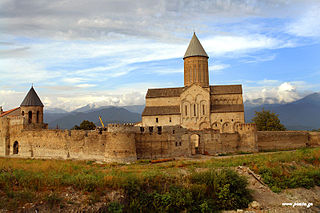
The Bakhtrioni uprising was a general revolt in the eastern Georgian Kingdom of Kakheti against the political domination of Safavid Persia, in 1659. It was named after the main battle, which took place at the fortress of Bakhtrioni.
Paykar Khān Igīrmī Dūrt was a Qizilbash chieftain in the service of Safavid Persia in the late 16th and early 17th centuries. His career flourished in the southeastern Caucasus, where he ran the governments of Barda and Kakheti on behalf of Shah Abbas I until being overthrown in a Georgian uprising in 1625.
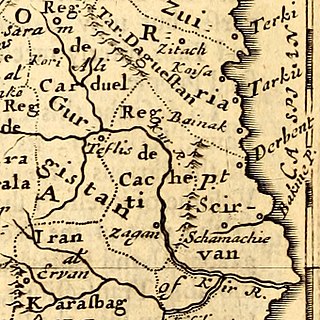
Zagem or Bazari was a town in the southeast Caucasus, in the eastern Georgian kingdom of Kakheti. It flourished from the 15th to the 17th century as a vibrant commercial and artisanal centre. In the 1550s, it became a dependency of the Karabakh–Ganja province of Safavid Iran. The fortunes of the town were reversed by Safavid military actions in the area in 1615. By the 1720s, the town had been reduced to an insignificant hamlet. The settlement was located in what is now the Zaqatala District of Azerbaijan, but no evidence of the town remains at the site. The toponym Zagem is found exclusively in non-Georgian sources; Georgians knew it as Bazari, meaning "bazaar".
Mohammad-Qoli Khan Qajar was an Iranian military leader and official, who served as the governor (beglarbeg) of Karabakh and Ganja in 1616-1627 and 1633. He was a son of the previous governor of Karabakh, Mohammad-Khan Qajar (1606–1616), and a member of the Ziyādoghlu branch of the Turkoman Qajar clan. Around 1620, when Paykar Khan Igirmi Durt was given a sister of Lohrasb by then incumbent king Abbas I on the occasion of him being appointed as the new governor of Kakheti, Mohammad-Qoli Khan Qajar was given a sister of Tahmuras Khan. When in 1624, king Abbas I married his granddaughter to Semayun Khan, Abd-ol-Ghaffar's wife was a companion to the bride, while Mohammad-Qoli Khan Qajar ordered Paykar Khan Igirmi Durt to host the banquet in the second term of the wedding party.

The province of Georgia was a velayat (province) of Safavid Iran located in the area of present-day Georgia. The territory of the province was principally made up of the two subordinate eastern Georgian kingdoms of Kartli and Kakheti and, briefly, parts of the Principality of Samtskhe. The city of Tiflis was its administrative center, the base of Safavid power in the province, and the seat of the rulers of Kartli. It also housed an important Safavid mint.
Mohammad Hossein Khan was a Safavid official and military leader, who briefly served as governor of Shaki in the Shirvan province, during the reign of king (shah) Abbas I.
Ali-Qoli Beg was a Safavid official, who briefly served as governor of Kartli together with his brother Emamqoli Beg, during the reign of king (shah) Abbas I.
References
- 1 2 3 4 5 Floor & Herzig 2012, p. 478.
- ↑ Floor & Herzig 2012, p. 479.
- ↑ Floor & Herzig 2012, pp. 474, 478.
- ↑ Floor & Herzig 2012, p. 481.


